African Theories

They grow deeper with time, drawing strength from history, culture, and lived experience.
Though often unseen or overlooked, they hold understanding of African realities.
From these strong roots, ideas grow to address social issues locally and across the world.
Table of Contents
- Theories by Ubuntu level
- Research, evaluation and governance tools
- Myths about theories
- Truths about theories
- How theories are created or developed
- How to use theories
- How to test or validate theories?
- Theories and approaches from outside that may be useful
- Theories and approaches that have very limited relevance, are harmful or dangerous
- Safe theories, approaches, frameworks and models
Theories by Ubuntu level
All theories on this page are listed here by the Ubuntu level they mainly address. Within Society, theories are grouped by the Ubuntu values of justice, indigeneity and holism. Placement is interpretive, and many theories work at more than one level.
Family and kinship (ukama) | Household
- Individual-in-Family Theory (IIF)
- African Family Theory (Ukama Theory)
- Integrated Musha/Nyumba Theory
- Six Tier System of Child Care, Welfare and Development
- The Zera Model of children growth and development in Zimbabwean culture
- Theory of Grandparents
- Africa Ageing Theory (Nyanguru Model of Ageing)
- Okoye Intergenerational Connection Model of Aging (OICMA)
Community (ujamaa)
- Ujamaa Theory (African Community Theory)
- Theory of Zunde Ramambo
- Ubuntu Community Garden Model (UCGM)
- Developmental Social Work (DSW) Approach or Developmentalist Theory
- Bottom-Up Approach
- Africa Strengths Theory
- African Asset Theory
- Friendship Bench Approach
- Kalinganire’s Social Work Practice Model (2017)
- Case Management Framework
- Jairos Jiri Charity and Philanthropy Model
- Jairos Jiri Disability and Rehabilitation Model
- Ubudlelane Philosophy
- Omoluwabi
- Tree of Life Model by Ncazelo Ncube
Society (ujamii)
Justice
Theories about fairness, rights and equal access, and about challenging unequal power in politics, law, gender relations, aid, trade and public services.
- Ubuntu Political Theory
- Ubuntu Social Justice, Criminal Justice and Jurisprudence Theory
- Theory of Dead Aid
- Mitumba Theory
- Disadvantage Expectations Theory (Tarajio ya Hasara)
- Batho Pele Principles
- African Feminism
- Ubuntu Feminism
- Nego-feminism
- Women Empowerment Framework or Longwe Framework for Gender Analysis
- Longwe’s Women Empowerment Tool
- Longwe’s Empowerment Framework
Indigeneity
Theories that root social work and development in African knowledge, culture, language and self-definition, and that work to remove colonial ideas and structures.
- Colonial Theory (including the Seven Dimensions of Colonisation Model and Neo-Colonial Theory)
- Decolonisation/Decolonial Theory/Decoloniality
- Africa Decolonisation Theory
- Epistemic Decolonisation Theory
- Decolonising the Mind Theory (Ngugi wa Thiong’o)
- Kudyiswa/Kurutsiswa Theory of Decolonisation
- Theory of the Colonial Library
- Indigenisation Theory
- Ukuru Theory
- Steve Biko’s Black Consciousness Theory
- Double Consciousness Theory (Du Bois)
- Paulo Freire’s Theory of Education and Decolonisation
- Unhu (Ubuntu) Education Theory
- African Theory of Education
- Nziramasanga Educational Model
- Ajayi’s Model of Decolonising Higher Education
- Restorative Learning for a Decolonised Curriculum
- Tesfaye’s Developmental Social Work Curricula
- Thiong’o’s Theory of African Languages
- Orature Theory (Zirimu’s Orature Theory)
- Afriture Theory
- Afrocentrism
- Afrocentricity
- Theories of Cheikh Anta Diop
- African Renaissance Theory
- Sankofa Theory
- Credo Mutwa’s Theoretical Framework
- Indigenous Health Theory
- Mugabeism
Holism
Theories that see people, economy, politics, health and community as connected, and that treat development as a whole, as shared across Africa and across borders.
- African Social Development (ASD) Model
- Human Factor (HF) Approach to Development
- One-Africa Theory
- Nkrumaism
- The Holistic Model of Educational and School Social Services (HOMES)
- Holistic and Integrative Health Model
- Ubuntu Model of Migration and Refugees
- Diaspora Theory
- Shaka Zulu Theory of Leadership and Management
- Ubuntu Business Theory
- Ubuntu Management Theory
- Ubuntu Engineering Theory
Environment (umvelo)
- African Environmental Theory
- Ubuntu Land Laws (Ubuntu Tenure)
- Green Belt Movement (GBM) Model
- Africa Solarpunk Model
Spirituality (uroho)
Across all levels
These theories set out Ubuntu itself or bring several levels together.
- Ubuntu Model of Ubuntu (UMU)
- Samkange’s Theory of Ubuntu
- Kaunda’s Theory of African Humanism (Ubuntu)
- Kawesa’s Model of Ubuntu
- Ubuntu Moral Theory (Ubuntu Morality)
- Ubuntu Psychology
- Ubuntu Social Work, Welfare and Development Theory
- Integrated Ubuntu Theory of Decolonisation
- Rooted Tree Development Theory (Kugarika)
Research, evaluation and governance tools
- Ubuntu Research Theory
- Decolonised Research Methodology/Design/Approach
- Indigenous Research Methodology/Approach
- African Research Methodology (ARM)
- Participatory Action Research (PAR)
- Made in Africa Evaluation (MAE) Approach
- Ibrahim Index of African Governance (IIAG)
- Models to calculate decolonisation
- Model decolonisation calculator for tertiary education institutions
- Model decolonisation calculator for social work and development educational institutions
Myths about theories
- It is a myth that theories should be developed in western countries or that useful theories are those developed in the west. African people from several centuries ago have been developing theories, and we continue to do that now. We have old but very useful theories that our ancestors developed. Most might not be written, they are orature (oral literature), but they are the old roots of our society. Most western theories are not useful to African communities, some are even dangerous to African society as you will see in the color coded boxes below.
- It is a myth that only professors can develop theories, anyone can develop a theory. A theory becomes important based on how much it is used. African theories are used less, therefore, they do not become important. Only when Africans use their theories can they become prominent. We have seen this with Ubuntu.
- It is a myth that when you write your essay, thesis, review, blog, presentation or report you need to rely on western theories. Your strongest writing is that which uses appropriate, local and indigenous theories.
- It is a myth that we only have to use existing theories, no, you can develop your own. When you are writing an essay, report, thesis, book chapter or book or planning an intervention, you can start by presenting the data and information, then propose a theory. Others call this a grounded theory approach or bottom-up approach. The fact that you need to gather the information first, often results in people avoiding grounded theory approach in favour of established theories but it is important to develop theories. This theory is quite relevant to Africa but it allows for more theories to be generated. This covers the current gap in literature, and avoid us using theories, models and approaches that do not promote African values.
- It is a myth that theories only come from researchers. In fact, persuasive theories in western literature were not developed from research but by philosophers, thinkers or lay people.
Truths about theories
When professional social work was introduced to Africa, as was the case in most developing countries of the Caribbean, Asia, the Pacific and South America, the foreigners who brought social work wrongly assumed that social work was new to these regions, and therefore chose to sideline, ignore and replace existing systems with theirs. In replacing existing systems, the foreign people depended on theories from outside, simply their theories or western theories. The local theories did not die, but thrived where western influence was not there, or alongside them. With time, most local theories found their way back into African social work.
How theories are created or developed
Go to this page for information on how theories and models are made.
How to use theories
- Theorise the problem – in research, learning and practice, theories are used to extend understanding of the social problem, issue or challenge.
- Theorise your methodology – in research, practice and teaching, theories are used to understand and improve methods, techniques and actions.
- Theorise your findings or results – after research or a practice activity or project, use theories to explain findings or results and outcomes.
- Theorise your discussion or reflection – in research, we discuss findings or results, theories are used to extend the discussion. In practice, we discuss outcomes, and theories are useful in that discussion. In teaching and learning to reflect, in that reflection we use theories to explore what our ideas might mean and the implications.
- Theorise your practice – theories help us understand why we do what we do, what we should do, what to do and how to do it.
- Theorise your teaching – theories help shape what we teach and how.
- Theorise your learning – theories help us shape how we learn and what we learn.
- Theorise your fieldwork – theories help us undestand how people do what they do and how to intervene.
How to develop a theoretical framework
A theoretical framework is the set of ideas you use to see a problem, plan your work and make sense of what you find, and it can rest on one theory, several theories, or a philosophy plus one or more theories. Start with your problem, aim and questions, because the framework must serve them. Next, name your worldview or philosophy, such as Ubuntu, which sets out your beliefs about people, knowledge and the world. Then choose the theories that explain your problem in your context, using the quick guide to find them by Ubuntu level: one is enough if it covers the whole problem, two or three work when the problem has parts that one theory misses, and more than three or four usually make the work shallow. For example, you could use Ubuntu as the philosophy, the Ubuntu Model of Ubuntu (UMU) to structure the levels, and the Ubuntu Social Work, Welfare and Development Theory to guide practice. Explain what each theory contributes, where they agree or differ, and which one leads, since a list of theories is not a framework. Turn the concepts into tools by linking them to your questions, methods and analysis in research, or to assessment, intervention and evaluation in practice. Finally, test the framework on a small amount of data or a few cases, look for what it cannot explain, ask participants, elders or peers to review it, and revise it, saying what it does well and what it leaves out.
How to test or validate theories?
Testing and validating theories is important to improve their quality and power. In the process of testing and validating, other theories are discarded, improved, strengthened and alternatives theories can emerge. Anyone can test any theory. There are several ways for testing and validating as follows:
- Workshop or seminar
- Baliano (experts panel consultation)
- Griot (expert consultation)
- Peer review (review by one or two experts in the field)
- Survey (short or long)
- Application of theory by researcher, educator or practitioner
- Measuring how much the theory is used over time
- Observe if what the theory says is happening in the family, community, society, environment or spiritually
- Community validation
- Compare with alternative theories
- Indaba (large group discussion)
- Dare (small group discussion)
- Philosophical analysis – assess how the theory fit the philosophy of Ubuntu (valuing family, communityness, societyhood, environemnt and spirituality)
- Analyse the application of the theory in other disciplines, for example humanities, STEM, arts etc
- Analyse the existence of the theory’s assumptions in orature (oral literature)
- Case study – an indepth application of the theory in one instance or location
- Multiple studies – study of the application of the theory in multiple instances or locations
- Experiment
Results can be shared with users of the theory through seminars, publications, social media or other means.
Theories and approaches from outside that may be useful
The amber group consists of theories developed outside but that may be useful. The red group, as the color suggests, are harmful or dangerous theories, or those with limited relevance. More theories will be added.
- Systems Theory (the west’s Ubuntu-like ideas, should not replace Ubuntu or be seen as equal)
- Social Learning Theory with African examples and explanations
Theories and approaches that have very limited relevance, are harmful or dangerous
- Colonial and Neo-Colonial Theory – the shameful view that for Africa to develop it should be colonised
- Assimilation Theory – the view that Black people need to be changed to Coloured or White people to be better, beautiful, ‘civilised’ or acceptable
- Dependence Theory (that Africa will do well by depending on the west)
- Psychoanalysis or psychodynamic theory (Freud)
- Gestalt theory
- Humanistic theory (because of focus on the individual)
- Body Mapping Approach
- Modernisation Theory (too much focus on western market values for urban communities)
- Darwinism/Theory of evolution by natural selection
- Biestek’s Principles of Casework (too much focus on western individualistic and Abrahamic religion values (especially values of the Christian faiths)
- Positivism (Auguste Comte)
- Trauma Theory (it magnifies ‘trauma’; too much focus on deficits; views individual as weaker, the worker or organisation as experts; presents families and culture as sources of trauma; has been used to demonise African way of life and culture; neglects structural issues like colonialism, assimilation; advances western view of trauma and neglects the role of the individual in shaping their own present life). Trauma approaches are cause trauma in themselves, they relieve and magnify it.
- Maslow’s Hierachy of Needs (too much individualistic ideals)
- Individualism (as a philosophy it promotes smaller social networks, individualised (as opposed to family or community) identity, promotes autonomy which causes conflict, unnecessary competition, materialism and ultimately poor mental health)
- Western feminism
- Françafrique – the wrongful colonial view that France owns a part of Africa which it controls by military, currency, trade, foreign policy, aid, economic, cultural and so called-democratic measures that install puppets, when in actual fact, this is a continuation of colonisation getting resources out of Africa.
- Mzungu misconception of Ubuntu
Safe theories, approaches, frameworks and models
Ubuntu Theories
Origin of Ubuntu
About 60 000 years ago, Black people migrated out of Africa and some settled in the Pacific region. Descendants of the people who settled in the Pacific region have values similar to Ubuntu today. These Black Indigenous people are found in Australia, Tonga, Fiji, Papua New Guinea and other countries. It can not be discounted that Ubuntu started before this great migration out of Africa.
About 4 000 years ago, oral, archeological and linguistic research has shown that most Black people were concentrated in West-Central and Northern parts of Africa. They then spread throughout the continent mainly because of invasion, desertification, improved technology and population growth. While they spread, they spread with their common cultures and philosophy. This philosophy was Ubuntu.
There is a misconception that Ubuntu originated from the Bantu group alone. It originated from all groups of Black people in Africa – the Bantu, Kush, Ba, Nile-Sahara, Khoi, Masarwa, Hadza and Sandawe. These groups interacted since time immemorial and values and principles of Ubuntu are found among all of them.
More information about Ubuntu is available here https://africasocialwork.net/ubuntu/
Definition of Ubuntu
Ubuntu is a collection of values and practices that black people of Africa view as making people and their communities authentic. While the nuances of these values and practices vary across different ethnic groups, they all point to one thing – an authentic individual human being is part of a larger and more significant relational, communal, societal, environmental and spiritual world. The term Ubuntu is expressed differently is several African communities and languages but all referring to the same thing. In Angola, it is known as gimuntu, Botswana (muthu), Burkina Faso (maaya), Burundi (ubuntu), Cameroon (bato), Congo (bantu), Congo Democratic Republic (bomoto/bantu), Cote d’Ivoire (maaya), Equatorial Guinea (maaya), Guinea (maaya), Gambia (maaya), Ghana (biako ye), Kenya (utu/munto/mondo), Liberia (maaya), Malawi (umunthu), Mali (maaya/hadama de ya), Mozambique (vumuntu), Namibia (omundu), Nigeria (mutunchi/iwa/agwa), Rwanda (bantu), Sierra Leonne (maaya), South Africa (ubuntu/botho), Tanzania (utu/obuntu/bumuntu), Uganda (obuntu), Zambia (umunthu/ubuntu) and Zimbabwe (hunhu/unhu/botho/ubuntu). It is also found in other countries not mentioned here.
Ubuntu Model of Ubuntu (UMU)
Level and value: Across all levels. The five aspects below are the five Ubuntu levels used in the guide.
Proposed by: Mtandao (2024)
In one sentence: The UMU is a five-part guide that helps writers, researchers, educators, students and practitioners think, write, research, assess and evaluate in ways grounded in Ubuntu.
Key ideas
Use the five aspects of Ubuntu below as a guide. They work best in this order, but you can use them in any order. In most cases all five apply, but not in every circumstance.
- Family experiences (ukama): your own experiences as well as the immediate family, the larger family, the clan and the tribe.
- Community experiences (ujamaa): the immediate community, such as the village, and the larger community.
- Societal experiences (ujamii): economic, social and political experiences.
- Environmental experiences (umvelo): land, air, water, plants and animals.
- Spiritual experiences (uroho): connection to parents and Elders, living or deceased, to the Creator and to the environment.
Use in social work and development
Work through the five aspects when you plan a study, write a paper, design a lesson, assess a case or evaluate a programme. For each aspect, ask what Ubuntu means in that part of the situation, and note where an aspect does not apply. Suggested questions, which you can edit:
- Family: who is part of this person’s family, clan or tribe, and what is my own family experience of this issue?
- Community: how does the village or wider community shape the issue and the response?
- Society: which economic, social and political conditions are involved?
- Environment: how are land, water, air, plants and animals connected to the issue?
- Spirit: how do Elders, ancestors and the Creator relate to the issue?
Limits
The model says that not every aspect applies in every circumstance, so users must judge which aspects to use and explain why they left some out.
See also: Ubuntu Social Work, Welfare and Development Theory, Samkange’s Theory of Ubuntu, Integrated Ubuntu Theory of Decolonisation, Rooted Tree Development Theory (Kugarika)
Cite as: Mtandao. (2024). Ubuntu Model of Ubuntu (UMU). Africa Social Work and Development Network. https://africasocialwork.net/african-theories-of-social-work/#ubuntu-model-of-ubuntu
Ujamaa Theory (African Community Theory)
Level and value: Community (ujamaa).
Proposed by: Popularised by Julius Kambarage Nyerere (1968) when he was President of Tanzania. Ujamaa existed long before he was born, and it is credited to him because of his work to popularise it.
In one sentence: Ujamaa is communityhood, where communities work together, look after each other and put human relationships first.
Key ideas
- Ujamaa is about communityhood: communities working together and looking after each other.
- It is about human relationships.
- The idea is older than Nyerere. He popularised it when he was President of Tanzania, and this is why it is credited to him.
Use in social work and development
Use ujamaa to understand and strengthen the ways communities already support their members, such as shared care of children and older people, and to plan community work that builds on those relationships and does not replace them.
Limits
The word is also linked to Nyerere’s political programme in Tanzania. When you use the theory, say whether you mean the long-standing community value or that programme.
See also: African Family Theory (Ukama Theory), Theory of Zunde Ramambo, Bottom-Up Approach, Ubudlelane Philosophy
Cite as: Nyerere, J. K. (1968). Ujamaa: Essays on socialism. Oxford University Press.
Individual-in-Family Theory (IIF)
Level and value: Family and kinship (ukama) | Household.
Proposed by: Mtandao (2024)
In one sentence: The IIF Theory puts the family, and not the individual, at the centre of understanding and supporting a person’s well-being.
Key ideas
- Family circumstances contribute to a person’s well-being.
- Strategies to maintain, promote and revive well-being also come through the family.
- The focus is the family, not the individual.
Use in social work and development
Use the theory to assess and plan with the family as the unit, and not only the person who asked for help. For example, when a child, an older person or an adult is struggling, look at the circumstances of their family and at what the family can do to maintain, promote or restore their well-being.
Limits
Some people have little contact with their family, or a family that is not able to support them. In these cases, consider the wider family, clan and community, as the Ubuntu Model of Ubuntu does.
See also: African Family Theory (Ukama Theory), Integrated Musha/Nyumba Theory, Ubuntu Model of Ubuntu (UMU)
Cite as: Mtandao. (2021). Individual-in-Family Theory (IIF). Africa Social Work and Development Network. https://africasocialwork.net/african-theories-of-social-work/#individual-in-family-theory-iif
African Family Theory (Ukama Theory)
Level and value: Family and kinship (ukama) | Household.
Proposed by: Mtandao (2024)
In one sentence: Ukama means relations and familyhood, and the theory holds that families look after each other and that family relationships are social capital.
Key ideas
- Ukama means relations. It is about familyhood.
- Families look after each other.
- For an individual, family includes immediate, extended and tribal relatives.
Pillars of the African family theory
- Value for marriage.
- Value for child bearing.
- Value for blood-line and maintaining race-line.
- Value for extended family (tribe or clan).
- Value for strengthening the bond between the families involved in the marriage, for example through the exchange of gifts.
- Value for a permanent home.
- Value for sharing or dividing family roles.
- Value for looking after one another and not putting individual needs first.
- Value for community.
- Maintaining African values.
Roles in the family
Each member of the family has roles in the family, the extended family and the community. If a member fails to play their role, the family, extended family or community will not function effectively. Some of the roles are:
- Mothers (including mother’s sisters)
- Fathers (including father’s brothers)
- Brothers and sisters
- Aunts
- Grandparents
Ukama as social capital
Ukama is an asset. It is social capital. From family and extended relationships, an individual gets:
- Resources or economic support when needed
- Moral and psychological support, for example during sickness, disasters or death
- Social support, for example mentoring
- Information, for example family history
- Care
- Alternative family
- Dispute resolution
- Inheritance, for example of a home, land or livestock
- Identity and belonging
Use in social work and development
Use the pillars, roles and forms of social capital as a checklist when you assess a family. Ask which roles are filled and which are vacant, for example after the death of a parent, and which relatives or clan members can fill them. Then ask which of the nine forms of support the family can still give, and plan to strengthen those before looking outside the family.
Limits
The roles listed are examples (“some of the roles”), and families change through migration, urban life, death and separation. A practitioner should check which roles and relatives apply to the family in front of them and not assume the full structure exists.
See also: Individual-in-Family Theory (IIF), Integrated Musha/Nyumba Theory, Theory of Grandparents, Ubuntu Model of Ubuntu (UMU), Ujamaa Theory (African Community Theory)
Cite as: Mtandao. (2020). African Family Theory (Ukama Theory). Africa Social Work and Development Network. https://africasocialwork.net/african-theories-of-social-work/#african-family-theory-ukama-theory
Unhu (Ubuntu) Education Theory
Level and value: Society (ujamii), indigeneity.
Proposed by: Mtandao (2024)
In one sentence: Ubuntu education guides and promotes African ideas in education, and decolonises it from Western educational philosophies.
Key ideas
- Ubuntu has been used in education to guide and promote African ideas and to decolonise education from Western educational philosophies.
- Ubuntu education uses the family, community and environment as sources of knowledge and as teaching and learning media.
- The essence of education is family, community, societal and environmental well-being.
- Interaction, liberation, participation, recognition, respect and inclusion are important aspects of Ubuntu education.
- Methods of teaching and learning include group and community approaches.
- In short, Ubuntu shapes the objectives, content, methodology and outcomes of education.
Use in social work and development
Use the theory when you design or teach a course, a training programme or a community education session. Draw on the learners’ families, communities and environment for content and examples. Teach through group and community methods, and judge outcomes by the well-being of families, communities, society and the environment as well as by individual results.
Limits
Many schools and universities work with imported curricula, fixed assessments and large classes. Educators using this theory may need to explain how the approach fits those requirements.
See also: African Theory of Education, Nziramasanga Educational Model, Ajayi’s Model of Decolonising Higher Education, Restorative Learning for a Decolonised Curriculum, Ubuntu Model of Ubuntu (UMU)
Cite as: Mtandao. (2024). Unhu (Ubuntu) Education Theory. Africa Social Work and Development Network. https://africasocialwork.net/african-theories-of-social-work/#unhu-ubuntu-education-theory
Ubuntu Psychology
This focuses on ubuntu resilience, sensation, motivation, bereavement, mourning, memory, dreams, recovery, trauma and many others.
Ubuntu Social Work, Welfare and Development Theory
Level and value: Across all levels.
Proposed by: Mtandao (2024)
In one sentence: This theory describes Afrocentric ways of providing a social safety net to vulnerable members of society, with interventions that strengthen families, communities, society, the environment and spirituality.
Key ideas
- It refers to Afrocentric ways of providing a social safety net to vulnerable members of society.
- Common elements are collectivity, ukama (relationality), ujamaa (collaboration) and looking at people holistically.
- The approaches are indigenous and help to decolonise.
- Ubuntu is against materialism and individualism.
- Interventions by social workers, welfare workers and development workers should strengthen, and not weaken, families, communities, society, the environment and people’s spirituality.
The five pillars of Ubuntu intervention
- Family (ukama)
- Community (ujamaa)
- Society (ujamii)
- Environment (umvelo)
- Spirituality (uroho)
Use in social work and development
Before and after an intervention, check it against the five pillars. Ask whether it strengthens or weakens the family, the community, society, the environment and the spiritual life of the people involved. Adjust the plan where it weakens any of them.
Limits
Funders and agencies often count individual results, so practitioners may need to show how outcomes for families and communities will be recorded and reported.
See also: Ubuntu Model of Ubuntu (UMU), African Family Theory (Ukama Theory), Ujamaa Theory (African Community Theory), African Social Development (ASD) Model, Integrated Ubuntu Theory of Decolonisation
Cite as: Mtandao. (2022). Ubuntu Social Work, Welfare and Development Theory. Africa Social Work and Development Network. https://africasocialwork.net/african-theories-of-social-work/#ubuntu-social-work-welfare-and-development-theory
Ubuntu Research Theory
Level and value: Research, evaluation and governance tools. The theory also fits Society (ujamii), indigeneity.
Proposed by: several authors; Mtandao (2020)
In one sentence: Ubuntu guides research objectives, ethics and methodology, and decolonises the research agenda and methods.
Key ideas
Purpose and position
- The objectives of Ubuntu research are to empower families, communities and society at large.
- The position of the researcher is important because it helps form relationships with the participants.
- Human beings are seen as part of nature, not as separate from it.
Agenda and participation
- The agenda of the research belongs to the community, and true participation is highly valued.
- Ujamaa, which means pulling together and is about collaboration, is highly valued.
- Relational and collective approaches to research are valued.
- Oral literature (orature) is valued because most African thought is not written.
Methods of data collection
- Dare: an approach in which participants sit together, often in a circle, and share respectfully in turn.
- Storytelling (nyaya) and dialogue (hurukuro).
- Kuseva: participants and leaders need opportunities to talk at length, using proverbs, idioms, folklore, maxims (short statements) and even songs.
Ethics and communication
- In true Ubuntu research, written consent is of no significance and is not valued, because relationships are more important than contracts.
- Research is incomplete without asking the participants to verify what you will publish, how you will gain from the research and how the community will gain.
- The research itself, together with feedback, must be provided in appropriate languages and formats.
- Ubuntu values good communication, that is, how you say what you have to say, and how deep it is.
- Ubuntu research values humane approaches and discourages cheating, deceit, harm and disrespect.
Use in social work and development
Use the theory to design a study from the start: let the community set the agenda, state your own position, choose methods such as dare and storytelling, and plan how participants will check your findings and receive feedback in their own language before and after publication.
Limits
University and funding ethics committees usually require written consent, and many journals ask for it. Researchers who follow this theory may need to explain to committees how relationship-based consent works, and to decide how to meet the written requirement without damaging trust.
See also: Indigenous Research Methodology/Approach, African Research Methodology (ARM), Decolonised Research Methodology/Design/Approach, Participatory Action Research (PAR), Orature Theory (Zirimu’s Orature Theory)
Cite as: Mtandao. (2020). Ubuntu Research Theory. Africa Social Work and Development Network. https://africasocialwork.net/african-theories-of-social-work/#ubuntu-research-philosphy
Ubuntu Moral Theory (Ubuntu Morality)
Level and value: Across all levels.
Proposed by: Drawn from Metz and Gaie (2010) and Samkange and Samkange (1980).
In one sentence: In Ubuntu morality, actions are right when they honour relationships and harmony with others, and life is valued above wealth.
Key ideas
- Actions are “right roughly insofar as they are a matter of living harmoniously with others or honouring communal relationships” (Metz & Gaie, 2010, p. 273).
- “One’s ultimate goal should be to become a full person, a real self or a genuine human being” (Metz & Gaie, 2010, p. 275).
- Relationships (ukama) are important. Among the Shona people, for example, when a person dies, their property is shared amongst relatives in culturally approved ways. This practice is called kugova.
- Life is valued. As Samkange said, “If and when one is faced with a decisive choice between wealth and the preservation of the life of another human being, then one should opt for the preservation of life” (Samkange & Samkange, 1980, p. 7).
Use in social work and development
Use the theory to test a decision or an intervention: does it honour the relationships involved, and does it protect life where life and wealth are in conflict? It can also guide how practitioners respond to practices such as kugova, by asking how the sharing of property is done and whether it follows the culturally approved ways.
Limits
Practices such as kugova differ between families and places, and in some cases may leave out widows or children. Check the outcome against Ubuntu’s own values of caring for one another and preserving life.
See also: Samkange’s Theory of Ubuntu, Ubuntu Social Justice, Criminal Justice and Jurisprudence Theory, African Family Theory (Ukama Theory), Kaunda’s Theory of African Humanism (Ubuntu)
Cite as: Metz, T., & Gaie, J. B. R. (2010). The African ethic of Ubuntu/Botho: Implications for research on morality. Journal of Moral Education, 39(3), 273-290.
Sources
- Metz, T., & Gaie, J. B. R. (2010). The African ethic of Ubuntu/Botho: Implications for research on morality. Journal of Moral Education, 39(3), 273-290.
- Samkange, S., & Samkange, T. M. (1980). Hunhuism or Ubuntuism: A Zimbabwean indigenous political philosophy. Graham Publishing.
Ubuntu Political Theory
Level and value: Society (ujamii), justice.
Proposed by: Samkange and Samkange (1980), in the book Hunhuism or Ubuntuism: A Zimbabwean indigenous political philosophy.
In one sentence: Ubuntu Political Theory asks whether a country’s own philosophy can serve its people as well as foreign ideologies, and holds that a leader’s authority comes from the will of the people.
Key ideas
- In Hunhuism or Ubuntuism, Samkange and Samkange (1980) asked, “Is there a philosophy or ideology indigenous to [a] country that can serve its people just as well, if not better than, foreign ideologies?”
- Samkange’s maxim for leadership is: “The king owes his status, including all the powers associated with it, to the will of the people under him” (Samkange & Samkange, 1980, p. 7).
- A king here means a leader of a home, family, school, workplace, village, community, organisation, country, nation or the international community.
- It also refers to professionals such as social workers, because of the statutory authority they have when working with families, communities or clients.
Use in social work and development
Use the maxim to reflect on your own authority. When you work with families, communities or clients, ask whether your decisions respond to the will of the people you serve, and how they can be consulted and heard before you use your statutory powers. The same question applies to managers, teachers and community leaders.
Limits
Social workers hold their authority from the law and from the community’s trust, and the two may pull in different directions. Practitioners need to say how they will balance them in each case.
See also: Samkange’s Theory of Ubuntu, Ubuntu Social Justice, Criminal Justice and Jurisprudence Theory, Kaunda’s Theory of African Humanism (Ubuntu), Ubuntu Moral Theory (Ubuntu Morality)
Cite as: Samkange, S., & Samkange, T. M. (1980). Hunhuism or Ubuntuism: A Zimbabwean indigenous political philosophy. Graham Publishing.
Samkange’s Theory of Ubuntu
Level and value: Across all levels.
Proposed by: Stanlake Samkange and Tommie Marie Samkange (1980), in Hunhuism or Ubuntuism: A Zimbabwean indigenous political philosophy.
In one sentence: Samkange’s theory calls on Africans to learn, write and practise Ubuntu, and sets out three maxims on human relations, the sanctity of life and people-centred status.
Key ideas
- Samkange asked, “Whose fault is it if no one knows about the philosophy of your grandfather and mine? Is it not your fault and mine? We are the intellectuals of [Africa]. It is our business to distil this philosophy and set it out for the world to see” (Samkange & Samkange, 1980).
- Samkange and Samkange (1980) argued that Africans need to learn, write and practise Ubuntu. Just as Westerners use the philosophies of their ancestors, Africans should find pride in the philosophies of their ancestors, such as Ubuntu.
- Several theories, frameworks and models are built on Ubuntu. For a start, [add link: this article] might be useful. More articles are in the Special Issue published by the African Journal of Social Work in 2020 [add link].
- For a history of Samkange, see [add link: this document].
- Samkange’s theory has three maxims (short statements), summarised in the table below and set out in full under the table.
The three maxims
| Maxim | In short |
|---|---|
| Human relations | Affirm your humanity by recognising the humanity of others and building respectful relations. |
| Sanctity of life | Where wealth and another person’s life conflict, preserve life. |
| People-centred status | A leader’s status and power come from the will of the people. |
Table 1: Samkange’s Ubuntu maxims
Maxim 1: Human relations
“To be human is to affirm one’s humanity by recognizing the humanity of others and, on that basis, establish respectful human relations with them” (Samkange & Samkange, 1980, p. 6).
“The attention one human being gives to another: the kindness, courtesy, consideration and friendliness in the relationship between people; a code of behaviour, an attitude to other people and to life, is embodied in hunhu or Ubuntu” (Samkange & Samkange, 1980, p. 6).
Maxim 2: Sanctity of life
“If and when one is faced with a decisive choice between wealth and the preservation of the life of another human being, then one should opt for the preservation of life” (Samkange & Samkange, 1980, p. 7).
This is an ethical principle.
Maxim 3: People-centred status
“The king owes his status, including all the powers associated with it, to the will of the people under him” (Samkange & Samkange, 1980, p. 7).
A king here means a leader of a home, family, school, workplace, village, community, organisation, country, nation or the international community. It also means a professional such as a social worker, because of the power they have when working with service users, communities or clients.
Other maxims
- Motho ke motho ka batho (Sotho or Tswana): a person is a person through other people.
- Umuntu ngumuntu ngabantu (Zulu): a person is a person through other people.
- Munhu munhu nevanhu (Shona): a person is a person through other people.
- Ndiri nekuti tiri (Shona): I am because we are.
Use in social work and development
Use the three maxims as questions for practice. Does this action build respectful relations? Does it protect life before wealth or convenience? Does the leader, professional or organisation answer to the people they serve?
Limits
The three maxims cover relations, life and leadership. They do not say much about the environment or spirituality, so combine them with theories such as the Ubuntu Model of Ubuntu when you need those levels.
See also: Ubuntu Political Theory, Ubuntu Moral Theory (Ubuntu Morality), Kaunda’s Theory of African Humanism (Ubuntu), Ubuntu Model of Ubuntu (UMU)
Cite as: Samkange, S., & Samkange, T. M. (1980). Hunhuism or Ubuntuism: A Zimbabwean indigenous political philosophy. Graham Publishing.
Ubuntu Spirituality
Level and value: Spirituality (uroho).
Proposed by: Mtandao (2024)
In one sentence: Ubuntu spirituality is communalised and values the family and the environment, and spiritual connection is an asset for mental health, identity, solving social problems and development.
Key ideas
Core claims
- Ubuntu spirituality is communalised, and values the family and the environment.
- Spirituality is good for mental health and identity.
- Spiritual disconnection worsens and causes social problems.
- Spiritual connection is an asset for solving social problems and for development.
- Spirituality is the benefit of religion in everyday life: happiness, self-worth, wellbeing, security, protection, fulfilment and hope (Mtandao, 2024).
Family and kinship (ukama)
- Good family relations are valued more than prayer and worship.
- Family ceremonies mark birth, naming, puberty, age-group initiation, marriage, death and ancestorship.
Community (ujamaa)
- Community ceremonies mark harvest, planting, hunting and eldership.
- Spiritual advisers, healers, medicine people and diviners support people.
Society (ujamii)
- Society ceremonies mark the new moon and fruits.
Environment (umvelo)
- Land and the environment are part of spirituality.
- Disconnection from land and the environment weakens spirituality.
Spirituality (uroho)
- Connection runs across the unborn, the living, the deceased, the ancestors and the Creator.
- Dreams help us reflect on life.
- Sacred and spiritual objects give luck and protection.
Use in social work and development
When you assess a person, family or community, look for spiritual disconnection that may be worsening a social problem or affecting mental health and identity, such as lost ceremonies, broken ties with relatives or ancestors, or separation from land. Then list the spiritual connections as assets to build on in the plan, with the person’s agreement. Ask about dreams as one way the person reflects on their life.
Limits
Names, ceremonies and practices differ between peoples, so check what applies to the person and community you are working with. The claims that spirituality is good for mental health and identity, that disconnection causes social problems and that connection is an asset would be stronger with evidence from studies.
See also: African Spiritual Theory, Kwanza Spirituality Theory, African Asset Theory, Africa Strengths Theory, Ubuntu Model of Ubuntu (UMU), African Family Theory (Ukama Theory), African Environmental Theory
Cite as: Mtandao. (2021). Africa religion (uAfrica). Africa Social Work and Development Network. https://africasocialwork.net/africa-religion-uafrica/
Ubuntu Feminism
Level and value: Society (ujamii), justice.
Proposed by: Mtandao (2024)
In one sentence: Ubuntu feminism rejects the Western view that Ubuntu is patriarchal, and holds that women are included at every level of life.
Key ideas
- It rejects the Western view that Ubuntu is patriarchal.
- Ubuntu does not promote the patriarchal values of competition, individuality and violence.
- Women are included at all levels: the home, the community and society.
- There are areas where women are more dominant than men, and areas where men are more dominant.
Use in social work and development
Use the theory to look at gender roles at each Ubuntu level without assuming that men lead everywhere. Ask where women lead and where men lead in the family, the community and society, and make sure women’s voices are heard in each.
Limits
Practices differ between families, communities and societies, and some practices harm women. Check them against the theory’s own rejection of competition, individuality and violence.
See also: African Feminism, Nego-feminism, Women Empowerment Framework or Longwe Framework for Gender Analysis, Ubuntu Social Justice, Criminal Justice and Jurisprudence Theory, African Family Theory (Ukama Theory)
Cite as: Mtandao. (2020). Ubuntu Feminism. Africa Social Work and Development Network. https://africasocialwork.net/african-theories-of-social-work/#ubuntu-feminism
Ubuntu Engineering Theory
Level and value: Society (ujamii), holism.
Proposed by: Mtandao (2024)
In one sentence: Ubuntu Engineering Theory is the practice of creating designs, concepts, innovations, processes and products inspired by Ubuntu values.
Key ideas
- Designs, concepts, innovations, processes and products are inspired by Ubuntu values.
- The values are those of the family, community, environment and spirituality.
Use in social work and development
Use the theory to ask of any design, innovation or product: how does it serve families and communities, protect the environment and respect spirituality? For example, a water or housing project can be designed with the community and built to protect the local environment.
Limits
This entry is short. Adding examples of Ubuntu-inspired designs and a source would help readers apply it.
See also: Ubuntu Business Theory, Ubuntu Management Theory, Africa Solarpunk Model, African Environmental Theory, Ubuntu Model of Ubuntu (UMU)
Cite as: Mtandao. (2024). Ubuntu Engineering Theory. Africa Social Work and Development Network. https://africasocialwork.net/african-theories-of-social-work/#ubuntu-engineering-theory
Ubuntu Business Theory
Level and value: Society (ujamii), holism.
Proposed by: Mtandao (2024)
In one sentence: The Ubuntu Business Theory is a model that guides business through eight Ubuntu elements.
Key ideas
The model emphasises these eight elements:
- Relations
- Culture
- Indigeneity
- Wholism/holism/holistic
- Justice and freedom
- Responsibility
- Community/collectivity/reciprocity
- Respect
For Mbigi’s management philosophy, see [add link: Mbigi’s management philosophy].
Use in social work and development
Use the eight elements as a checklist when you plan, run or review a social enterprise, cooperative or business. For each element, ask how the business shows it, and note any that are missing.
Limits
The entry names the elements without defining them. Adding a short meaning and an example for each would help readers apply the model.
See also: Ubuntu Management Theory, Ubuntu Social Work, Welfare and Development Theory, Ubuntu Model of Ubuntu (UMU), Ubuntu Engineering Theory
Cite as: Mtandao. (2024). Ubuntu Business Theory. Africa Social Work and Development Network. https://africasocialwork.net/african-theories-of-social-work/#ubuntu-business-theory
Ubuntu Management Theory
This model emphasises these elements: Relations; Culture; Indigeneity; Wholism’/holism/holistic; Justice and Freedom; Responsibility; Community/Collectivity/Reciprocity; and Respect
See Mbigi’s management philosophy.
Ubuntu Social Justice, Criminal Justice and Jurisprudence Theory
Level and value: Society (ujamii), justice.
Proposed by: Mtandao (2024)
In one sentence: Ubuntu justice is mainly about returning, replacement and compensation, with families and communities taking part in the process.
Key ideas
- Ubuntu justice emphasises deterrence; returning, replacement and compensation; apology, forgiveness and reconciliation; and warnings and punishments.
- It is mainly about returning, replacement and compensation.
- Families and communities are involved in the processes of justice.
- Reconciliation restores ukama (relations).
The five elements of Ubuntu justice
| Element | Meaning |
|---|---|
| Deterrence | Discouraging harm, which can be done socially, physically, economically or spiritually. |
| Returning, replacement and compensation | Bringing back what has been stolen, replacing it or compensating for it. In Shona these are called kudzora and kuripa. |
| Apology, forgiveness and reconciliation | Restoring ukama (relations) after the step above has been met. |
| Warnings and punishments (retribution) from the community | Given by the community, leaders and elders if the steps above have not been achieved or have been ignored. |
| Warnings and punishments from spiritual beings | Given by spiritual beings if the steps above have not been met. In Shona culture these are called jambwa and ngozi. |
Table 1: The five elements of Ubuntu justice
Levels of Ubuntu justice
- Individual
- Family
- Community
- Societal: social justice, economic justice (for example, labour justice), legal justice and political justice
- Environmental: environmental justice (for example, land justice)
- Spiritual: spiritual justice and religious justice
Use in social work and development
When someone has been harmed, ask first whether the harm has been returned, replaced or compensated, whether the family and community are involved, and how ukama can be restored through apology, forgiveness and reconciliation. Treat warnings and punishments as a later step, when the earlier steps have not been met.
Limits
Spiritual warnings and punishments, such as jambwa and ngozi, cannot be applied or checked by agencies. National law also applies, so practitioners must check how community processes fit legal requirements and protect children and women.
See also: Ubuntu Political Theory, Ubuntu Moral Theory (Ubuntu Morality), Ubuntu Land Laws (Ubuntu Tenure), African Family Theory (Ukama Theory)
Cite as: Mtandao. (2024). Ubuntu Social Justice, Criminal Justice and Jurisprudence Theory. Africa Social Work and Development Network. https://africasocialwork.net/african-theories-of-social-work/#ubuntu-social-justice-criminal-justice-and-jurisprudence
Kaunda’s Theory of African Humanism (Ubuntu)
Level and value: Across all levels.
Proposed by: Kenneth Kaunda, first president of Zambia. He wrote his philosophy of Ubuntu in the 1960s and summarised it in 2007 (Kaunda, 2007).
In one sentence: Kaunda’s African humanism places the human person at the centre and sets out eight principles for living and governing together.
Key ideas
Background
- Kenneth Kaunda was born in 1924 in Zambia. With his compatriots, he led a struggle against colonisation, and he became Zambia’s founding president, serving from 1964 to 1991, a period of 27 years. He died in 2021.
His philosophy promoted:
- Maintaining an African overarching philosophy in all spheres of life: political, economic and social.
- Doing away with colonial mentality and breaking with the colonial past.
- Appreciation of African values, heritage and worldviews.
- Socialism: the means of production, distribution and exchange are owned and controlled by the community.
- Authentic African identity.
- African spirituality.
His two basic personal principles were relating with the Creator, God, and relating with neighbours and each other. He wrote: “Zambian humanism came from our own appreciation and understanding of our society. Zambian humanism believes in God the Supreme Being. It believes that loving God with all our soul, all our heart, and with all our mind and strength, will make us appreciate the human being created in God’s image. If we love our neighbour as we love ourselves, we will not exploit them but work together with them for the common good” ([add source], p. iv).
The eight principles of African humanism
Kaunda (2007) set out eight basic principles of African humanism, or Ubuntu.
| Principle | In Kaunda’s words |
|---|---|
| The human person at the centre (people centred) | “…This MAN is not defined according to his color, nation, religion, creed, political leanings, material contribution or any matter…” |
| The dignity of the human person | “Humanism teaches us to be considerate to our fellow men in all we say and do…” |
| Non-exploitation | “Humanism abhors every form of exploitation of MAN by man.” |
| Equal opportunities for all, non-discrimination | “Humanism seeks to create an egalitarian society, that is, society in which there is equal opportunity for self-development for all…” |
| Hard work and self-reliance | “Humanism declares that a willingness to work hard is of prime importance without it nothing can be done anywhere…” |
| Working together | “The National productivity drive must involve a communal approach to all development programs. This calls for a community and team spirit…” |
| The extended family | “…under extended family system; no old person is thrown to the dogs or to the institutions like old people’s homes…” |
| Loyalty and patriotism | “…It is only in dedication and loyalty can unity subsist.” |
Table 1: Kaunda’s eight principles of African humanism
Use in social work and development
Use the eight principles as a checklist for programmes and policies. For example, ask whether a programme puts people at the centre, protects their dignity, avoids exploitation, offers equal opportunity, builds self-reliance, works with communities, supports the extended family and builds unity.
Limits
Kaunda’s humanism was tied to a socialist economic programme and, later, to one-party rule in Zambia. When you apply the principles, separate the values from that political system and say which you mean.
See also: Samkange’s Theory of Ubuntu, Ubuntu Political Theory, Ubuntu Moral Theory (Ubuntu Morality), Ujamaa Theory (African Community Theory), Nkrumaism
Cite as: Kaunda, K. D. (2007, October 28). Zambian humanism, 40 years later. Sunday Post, 20-25.
Sources
- Kaunda, K. D. (2007, October 28). Zambian humanism, 40 years later. Sunday Post, 20-25.
- Kaunda, K. D. (1974). Humanism in Zambia: A guide to its implementation. Lusaka.
- Kaunda, K. D. (1973). The humanist outlook. Longman Group.
- Kaunda, K. D. (1966). A humanist in Africa. Longmans, Green.
Okoye Intergenerational Connection Model of Aging (OICMA)
Level and value: Family and kinship (ukama) | Household.
Proposed by: Okoye (2021), with the Africa Social Work and Development Network (ASWDNet) proposing the model from her work on ageing.
In one sentence: The OICMA holds that the well-being of older adults is deeply rooted in their relationships with younger generations and in the informal social support they receive.
Key ideas
- The well-being of older adults is deeply rooted in their relationships with younger generations.
- It also depends on the informal social support they receive.
- By strengthening intergenerational bonds and informal social support, we can:
- Enhance older adults’ mental and physical health (afya).
- Promote social inclusion and community engagement (umoja).
- Foster a sense of purpose and meaning across generations (mwana).
- Develop innovative solutions to societal challenges through collaborative problem-solving (ujamaa).
- Promote successful ageing and a sense of fulfilment for all.
The six components of the OICMA
| Component | What it means |
|---|---|
| Sankofa na Mmadu (intergenerational solidarity) | Positive relationships between older adults and youth foster a sense of belonging and reduce loneliness and isolation. |
| Mzuri wa Mzee (goodness of the elder) | Older adults provide wisdom, experience and emotional support, while youth offer technological skill, physical assistance and fresh perspectives. |
| Igwebuike (coming together) | Intergenerational relationships help to pass on cultural values, customs and history, promoting social cohesion and community engagement. |
| Sema (speak with and educate the youth) | Educating youth about ageing, ageism and elder abuse can combat negative stereotypes and promote empathy, leading to more supportive relationships. |
| Kuleta kwa Jamii (gathering of the community) | Governments and organisations can run initiatives that bring generations together, and provide the resources and infrastructure for intergenerational connections to grow. |
| Ibuanyidanda (social support) | Successful ageing depends on the quality and number of informal supports available to older adults, because many governments in Africa are stepping back from providing formal support for all older adults. |
Table 1: The components of the OICMA
The African words come from several languages, including Swahili, Yoruba, Zulu, Igbo and Shona, to reflect the diversity of the continent.
About the originator of the work
Dr Uzoma Odera Okoye is a Professor in the Department of Social Work at the University of Nigeria, Nsukka. Her background is in sociology and social work, and she holds a PhD in social gerontology. She has published articles on elder abuse, caregiving, intergenerational relationships, and the impact of HIV/AIDS, informal social support, migration and internal displacement on older adults. Her research interests are social gerontology, public health and migration. She has supervised several PhD students and completed projects with international agencies.
Use in social work and development
The theory can guide research, policy and programme development on ageing. In practice, plan activities that bring older adults and young people together, teach young people about ageing and elder abuse, and strengthen the family and community supports that older adults rely on.
Limits
The model depends on informal support, which falls mainly on families and can burden carers. Formal support from governments is still needed, especially for older adults who have no close relatives.
See also: Theory of Grandparents, Africa Ageing Theory (Nyanguru Model of Ageing), African Family Theory (Ukama Theory), Sankofa Theory
Cite as: Okoye, U. O. (2021). Okoye Intergenerational Connection Model of Aging (OICMA). Africa Social Work and Development Network. https://africasocialwork.net/african-theories-of-social-work/#okoye-intergenerational-connection-model-oicma
Questions to help you reflect on this theory
- On a scale of 1-10, how much does this theory relate to the experiences of your African family or community?
- What are the best aspects of this theory?
- On a scale of 1-10, how likely are you to recommend this theory to a practitioner, educator or researcher on the topic?
- Where would the theory be most and less useful?
- How can the theory be strengthened?
Publications and other works on gerontology (includes 45 journal articles, 7 book chapters and 3 presentations.
Kawesa’s Model of Ubuntu
Level and value: Across all levels.
Proposed by: Kawesa (2021)
In one sentence: Kawesa’s model says that Ubuntu is expressed through three core values: just, productive and orderly.
Key ideas
- If Ubuntu means “I am because you/we are”, the natural question is “Who am I?” or “What makes us who we are?”
- The answer is found in three universal core values, which express Ubuntu.
- If entrenched, Obuntu Bulamu can stimulate social intelligence, enabling individuals to build trust and social capital in the larger community.
- Obuntu is a vital ingredient in the development of mindsets towards trustworthiness, the promotion of peace and the achievement of the Sustainable Development Goals (SDGs), with a focus on youth and culture.
The three core values
| Value | Meaning |
|---|---|
| Just | Permitting others to deserve the best of you. |
| Productive | Taking the least amount of time to create meaningful value. |
| Orderly | Choosing the most efficient and effective means of achieving a predetermined outcome. |
Table 1: Kawesa’s three core values
Use in social work and development
Use the three values to review your own conduct and the programmes you run. Ask whether you give others the best of you, whether the work creates meaningful value without wasting time, and whether the means chosen are efficient and effective. The model suits youth and culture programmes that aim to build trust and peace.
Limits
Productive and orderly stress efficiency, so read them together with the relational values in other Ubuntu models, such as the Ubuntu Model of Ubuntu, so that efficiency does not override relationships.
See also: Ubuntu Model of Ubuntu (UMU), Samkange’s Theory of Ubuntu, Kaunda’s Theory of African Humanism (Ubuntu), Ubuntu Moral Theory (Ubuntu Morality)
Cite as: Kawesa, R. (2021). The reality of who you are. Buntu Community International.
Ubuntu Land Laws (Ubuntu Tenure)
Level and value: Environment (umvelo).
Proposed by: Mtandao (2024)
In one sentence: The ten Ubuntu Land Laws guide ownership, use, distribution, inheritance, conservation, land justice and the relations between land and people.
Key ideas
- Land includes soil, water, animals, trees, pastures, mountains, minerals and rivers.
- The ten laws guide ownership, use, distribution, inheritance, conservation, land justice and land-human relations.
The ten Ubuntu Land Laws
| Law | What it says |
|---|---|
| 1. Ancestral ownership | Land is spiritually and ancestrally significant. It belongs to ancestors and future generations, and cannot be sold or traded but is passed on to the next generation. |
| 2. Family and community ownership | Land is a family and communal resource, not individual property, managed for the benefit of all community members. |
| 3. Guardianship | There is a land guardian or leader at the family level, the community or village level and the societal level. |
| 4. Land for all families | Principles of fairness ensure that all adult members who start a family get land from elders or guardians, which they will pass on to their offspring. |
| 5. Restorative land justice | Disputes are resolved through processes that prioritise land return and the repair of relationships. |
| 6. Respect for elders | Elders play a significant role in land matters because of their guardianship, wisdom, legal knowledge and experience. |
| 7. Sustainability | Land use practices are sustainable so that land stays productive for future generations (intergenerational responsibility). |
| 8. Cultural land rituals and ceremonies | Rituals and ceremonies care for the land and show appreciation of ancestors. |
| 9. Environmental stewardship | People are responsible for managing natural resources sustainably, respecting ecological balance and community well-being. |
| 10. Land has many dimensions | Land is environmental, spiritual, cultural, economic, political and social. It is economic because it is the source of livelihoods and wealth, and social because permanent homes and graveyards are built on it. |
Table 1: The ten Ubuntu Land Laws
Use in social work and development
Use the laws to assess land disputes, resettlement, evictions and land use programmes. Ask who the guardian is at each level, whether all families have land, and whether a dispute can be settled by returning land and repairing relationships. Include elders and plan ceremonies and conservation with the community.
Limits
Some of these laws, such as the rule that land cannot be sold, differ from statutory land systems, title deeds and commercial land markets. Practitioners need to explain how the laws work alongside national land law.
See also: African Environmental Theory, Ubuntu Social Justice, Criminal Justice and Jurisprudence Theory, Integrated Musha/Nyumba Theory, Green Belt Movement (GBM) Model
Cite as: Mtandao. (2024). Ubuntu Land Laws (Ubuntu Tenure). Africa Social Work and Development Network. https://africasocialwork.net/african-theories-of-social-work/#ubuyntu-land-laws
Integrated Ubuntu theory of decolonisation
Level and value: Across all levels.
Proposed by: Mtandao (2022)
In one sentence: The Integrated Ubuntu Theory of Decolonisation sees decolonisation as respecting and using African values at the family, community, societal, environmental and spiritual levels.
Key ideas
- Decolonisation happens at five Ubuntu levels, and the theory brings them together (integrates them).
- At every level, decolonisation means respecting and using African values.
- At the environmental level, it also means protecting vegetation, animals and land from being colonised.
The five levels of decolonisation
| Level of decolonisation | Meaning |
|---|---|
| Family decolonisation | Respecting and using African family values. |
| Community decolonisation | Respecting and using African community values. |
| Societal decolonisation | Respecting and using African values in governance, economics, religion, education and so on. |
| Environmental decolonisation | Respecting and using African environmental values, and protecting vegetation, animals, land and so on from being colonised. |
| Spiritual decolonisation | Respecting and using African spiritual values. |
Table 1: The levels of Ubuntu decolonisation
Use in social work and development
Use the five levels as a review of a programme, curriculum, organisation or policy. At each level, ask which African values are respected and used, and which are missing or replaced by foreign ones, then plan changes for the gaps.
Limits
The entry names the levels but not how to measure progress. Readers can pair it with the decolonisation calculators on this page to put numbers on each level.
See also: Africa Decolonisation Theory, Decolonisation/Decolonial Theory/Decoloniality, Kudyiswa/Kurutsiswa Theory of Decolonisation, Models to calculate decolonisation, Ubuntu Model of Ubuntu (UMU)
Cite as: Mtandao. (2022). Integrated Ubuntu Theory of Decolonisation. Africa Social Work and Development Network. https://africasocialwork.net/african-theories-of-social-work/#aioseo-ubuntu-theory-of-decolonisation
Ubudlelane philosophy
Level and value: Community (ujamaa).
Proposed by: Mzukisi Xweso and Dr Zukiswa Gwam (2025), Department of Social Development Professions, Nelson Mandela University.
In one sentence: The Ubudlelane philosophy holds that compassionate sharing and mutual support can help to reduce poverty and other social ills in communities.
Key ideas
- Ubudlelane is an isiXhosa term related to ukwabelana, which means “to share”. In Shona it is synonymous with kupanana.
- The concept is deeply embedded in human sociability and communal living, and reflects values that go beyond national boundaries.
- The philosophy is summed up in the African proverb ukuqhe’kezelana ngesonka, meaning “breaking bread”. It shows the role of compassionate communities in which people come together to share, support and uplift one another.
- The philosophy holds that poverty alleviation and the reduction of social ills in communities can be greatly advanced by recognising and practising compassionate sharing and mutual support.
The basic tenets of Ubudlelane
| Tenet | What it means |
|---|---|
| Sharing and reciprocity | Recognising the value of mutual sharing and exchange, which rests on ukuqhe’kezelana ngesonka. |
| Community and togetherness | Building and strengthening community connections. |
| Empathy and understanding | Fostering empathy and understanding among individuals and groups. |
| Inclusivity and diversity | Celebrating diversity and promoting inclusivity, just like gathering compassionately to support one another. |
| Respect and dignity | Promoting respect and dignity for all individuals, regardless of background or circumstances. |
| Collaboration and cooperation | Encouraging collaborative efforts and cooperative problem-solving. |
| Gratitude and appreciation | Cultivating gratitude and appreciation of one’s role in a compassionate community, including families and groups, and recognising the resources shared. |
| Social justice, forgiveness and reconciliation | Treating social justice as a significant value in shared relationships fosters a spirit of forgiveness and reconciliation. Just as breaking bread can symbolise a new beginning, these values pave the way for renewed and harmonious interactions. |
Table 1: The basic tenets of Ubudlelane
Use in social work and development
Use the tenets to design community projects against poverty and social problems, such as food sharing, savings groups and mutual aid. Ask how each project encourages sharing, respect, cooperation and reconciliation among the people involved.
Limits
Sharing depends on people having something to share. Where poverty is deep, communities may also need support from outside.
See also: Ujamaa Theory (African Community Theory), Theory of Zunde Ramambo, African Asset Theory, Ubuntu Social Justice, Criminal Justice and Jurisprudence Theory
Cite as: Xweso, M., & Gwam, Z. (2025). Ubudlelane philosophy. Africa Social Work and Development Network. https://africasocialwork.net/african-theories-of-social-work/#ubudlelane-philosophy
Omoluwabi philosophy
Level and value: Community (ujamaa).
Proposed by: Yoruba worldview; described by Akinsola (2011).
In one sentence: Omoluwabi is a Yoruba worldview of the high-level qualities of character expected of a person in the community.
Key ideas
- The name has three parts: omo (child), olu-iwa (master of character) and bi (born of).
- Literally, omoluwabi means a person who behaves like someone who is properly nurtured and who lives by the lessons of the education they have received.
- The concept is comprehensive and all embracing. To be an omoluwabi is to be a complete, well-rounded person in every respect.
- Iwa is the Yoruba word for good character, and it is the central focus and goal of Yoruba education (Akinsola, 2011, pp. 225-226).
- Yoruba children are taught to become an omoluwabi through oral literature: proverbs, poems, wise sayings, songs, folktales and riddles.
Qualities of an omoluwabi
- Being of help to the community
- Character deserving honour
- Hard work
- Integrity (otito): truthfulness and honesty
- Respect (owo) for the rights of others
- Humility and respect
- Courage
- Respect for old age and seniority
- Loyalty to parents and local customs
- Devotion to duty
- Readiness to help the needy and the infirm
- Sympathy, sociability, intelligence and energy
Sayings that teach good character
- Iwa rere l’eso eniyan: good character is an ornament for a person.
- Oruko rere san ju wura ati fadaka lo: a good name is more precious than gold and silver.
- Ise ni ogun ise: hard work is the antidote to poverty.
Use in social work and development
Use the philosophy in parenting, education and youth programmes that build character. Draw on proverbs, songs and stories to teach honesty, respect, hard work and service to the community, and invite elders to share them.
Limits
The philosophy comes from the Yoruba people. When you apply it to other communities, check which qualities and sayings fit their own worldview.
See also: Unhu (Ubuntu) Education Theory, African Theory of Education, Orature Theory (Zirimu’s Orature Theory), Ubudlelane Philosophy
Cite as: Akinsola, E. F. (2011). Omoluwabi’s approach to educating the African child. In A. B. Nsamenang & T. M. S. Tchombe (Eds.), Handbook of African educational theories and practices: A generative teacher education curriculum (pp. 223-233). Human Development Resource Centre (HDRC).
Ukuru Theory
Level and value: Society (ujamii), indigeneity.
Proposed by: Mtandao (2023)
In one sentence: Ukuru means dominance, oppression or colonisation, and the theory describes how it silences African voices and ideas and harms people in many ways.
Key ideas
Meaning
- Ukuru means dominance, oppression or colonisation. It can happen at the individual, community, societal or global level.
- The opposite is uhuru, which means freedom. Mukuru is the dominator.
What it does
- Ukuru results in the silencing of voices, beliefs, values, theories and thoughts.
- Some histories, literatures, symbols and practices are made invisible or are not recognised.
In social work
- Ukuru has made African founders and theorists of social work invisible, while promoting Western founders and theorists.
- Pan-African ideals of familyhood, communityhood and spirituality are often submerged in Western ideals of individualism.
Impacts of ukuru
Ukuru has short-term and long-term psychosocial impacts:
- Conformity: the silenced adopt the mukuru’s voice, beliefs, values, theories and thoughts.
- Silencing, self-silencing or peer-censoring: individuals set limits for themselves and others.
- Parallelism or parallelity: individuals use African ways alongside Western ways, or do what they do not value or believe in.
- Imitation: doing what social workers in Western countries do, thinking that the West is better, or leaving the thinking to someone else.
- Identity erosion.
- Enslaved mindset (mental slavery).
- Reduced self-esteem, inferiority complex or colonial mentality.
- “Criticalless”: not being critical.
- Conflict that results from parallel, divisive systems and interpretations.
Ukuru has many other negative impacts: psychological, social, cultural, economic, environmental, spiritual and political.
Use in social work and development
Use the theory to look for ukuru in your own practice, teaching and organisation. Ask whose theories, founders and examples are used, which voices are missing, and where people use African ways only alongside Western ones. Then plan steps towards uhuru, such as using African theories and writers in the curriculum.
Limits
The impacts described come from the theory itself. Research with social workers and students would show how common each one is.
See also: Decolonisation/Decolonial Theory/Decoloniality, Decolonising the Mind Theory (Ngugi wa Thiong’o), Double Consciousness Theory (Du Bois), Integrated Ubuntu Theory of Decolonisation, Indigenisation Theory
Cite as: Mtandao. (2023). Ukuru Theory. Africa Social Work and Development Network. https://africasocialwork.net/african-theories-of-social-work/#ukuru-theory
Colonial Theory
The starting point to understanding decolonisation is to understand colonisation, which is:
- People leaving their country/land to occupy another by force and deception (this is what the Berlin Conference achieved).
- Monarchies taking over another monarchy or its land by force or deception (as was done by the British Monarchy and other European monarchies.
- Imposing culture, and displacing local culture.
- Colonising countries setting up companies to exploit local resources for the benefit of the colonial country. This includes taking away minerals, forestry resources etc.
- Colonists replacing local rulers, armies, police and prisons with their own.
- Colonists bringing in their laws and judges.
- Colonists bringing in their administrative system.
- Implanting foreign languages e.g. English, French, Portuguese and Arabic.
- Implanting foreign religions e.g. Christianity or Islam.
- Replacing or attempts to replace another race through killings/genocide or assimilation through rape and killing of males (for example, in areas like Sydney in Australia, black Aboriginal people have become extinct and they have been replaced by white Aboriginal people, descendants of the Black Aboriginal people as a result of a planned process to wipe-out the Black race in those areas).
- Replacing names of people and surnames and names of places and things with foreign – replacing identities.
In the colonist’s mind, they want to dominate, increase their wealth and influence, and see themselves as the ‘chosen race’, the other races are sub-human. Colonisation is not only physical, but cultural, psychological, social, economic and if not controlled, it can be perpetual affecting generations.
Ngugi wa Thiongo (1986, p. 16) “The real aim of colonialism was to control the people’s wealth: what they produced, how they produced it, and how it was distributed; to control, in other words, the entire realm of the language of real life. Colonialism imposed its control of the social production of wealth through military conquest and subsequent political dictatorship. But its most important area of domination was the mental universe of the colonised, the control, through culture, of how people perceived themselves and their relationship to the world. Economic and political control can never be complete or effective without mental control. To control a people’s culture is to control their tools of self-definition in relationship to others. For colonialism this involved two aspects of the same process: the destruction or the deliberate undervaluing of a people’s culture, their art, dances, religions, history, geography, education, orature, and literature, and the conscious elevation of the language of the colonizer. The domination of a people’s language by the language of the colonizing nations was crucial to the domination of the mental universe of the colonized.”
The Seven Dimensions of Colonisation Model
- Pre-colonisation – this period was charaterised by uprooting people from their lands and enslaving them in America, Europe or other lands.
- Colonisation of the mind – the weapons of this form of colonisation are the Abrahamaic religion (Christianity and Islam); European languages (English, French, Portugeese etc) and Arabic language and European and Arabic education. This form of colonisation continues today.
- Land colonisation – the major weapons were guns, horses, dogs, fire and European laws. This form of colonisation was largely defeated but impacts millions of people today in Africa as white people refuse to give back stolen land using European laws and so-called internatiomnal laws.
- Political colonisation – achieved by taking power from local leaders and replacing them with European Kings (e.g. the British Monarchy), administrators, laws, police and army. A major weapon was dividing the local population, coersion, taxation and bribery.
- Extended colonialism – there are several colonial practices that were maintained, most of them in disguise. Examples include:
- Maintenance pf the French currency in former colonies
- Former French colonies forced to bank 85% (later reduced to 60%) of their currency reserves with the French government in France which invests them for the benefit of French people
- White people not giving up colonised land in South Africa, Zimbabwe, Namibia etc
- Western education, literature (books, journals, lwas, guidelines etc), syllabus etc still being used. This results in miseducation.
- Continued dominance of non-African religious and cultural institutions, particularly the Abrahamaic religion.
- Aid – aid is assistance, gift or relief provided by a family, community, organisation (donor, giver or aider) or country to another family, community, organisation or country (receiver or aidee) in the form of money (e.g. cash or grant), food, clothing, water, houses, energy, medicines, body organs (e.g. kidneys or sperms) equipment, books, toiletries, jobs (allowing people from another country to work in another), labour (e.g. experts like researchers, doctors and engineers or general like drivers), security personnel, arms, jobs, scholarships, adoption home, foster home and subsidies (e.g. cheap loans or reduced tax). Aid can be driven by humanitarian or voluntary altruism or aimed at some economic, social, cultural, diplomatic and political benefits in return.
- Neo-colonialism – this includes all new forms of colonisation, and does not include extensions of colonisation. Examples include:
- Intellectual colonialism – Mass recruitment of professionals from former colonised nations that are meeting all costs of education and training beut end up with no doctors, nurses, social workers, engineers etc. All this leads to loss of intellectual capital and intellectual poverty.
- New economic colonisers, for example, China
- Threat of sanctions and actual sanctions
- Funding of the African Union budget by foreigners, more than 50% of the budget is foreign funded
- Structural adjustment programs
Neo–Colonial (Neo-Colonialism) Theory (Kwame Nkrumah)
It is also important to understand neo-colonialism, the new methods of colonisation that followed after liberation wars. Neo-colonial theory is credited to Kwame Nkrumah who described it as the continuation of colonisation through several means, hidden or open. The elements of neo-colonialism are:
- Colonial monarchies still find ways to maintain dominance (e.g. forming Commonwealth institutions).
- Land and artifacts that were stolen during colonialism not returned and claimed by colonists.
- Brain drain and migration.
- Aid
- International organisations.
- Literature
- Language.
- New foreign countries replacing the former colonisers e.g. China influence in Africa.
- The United Nations, its organisations, laws, policies and conventions are used as tools to continue with colonisation.
- Whiteness, white superiority or white supremacy continues in all industries and facets of life.
- Media and internet.
- Colonising the mind.
Put simply, decolonisations means undoing colonisation.
Decolonisation/Decolonial Theory/Decoloniality
Decolonists refuse colonial theorists’s racist assumption that for Africa to develop, we need to embrace colonial thinking (philosophies, values and literature), artifacts, institutions, economies and religions. Decolonization starts at the family and community and moves onto the school through to all other institutions of society. Examples of decolonisation include:
- Fighting for independence, freedom and liberation by whatever means, guns, pens, boycotts, terror, tongues, resistance etc. The liberation movement in Africa achieved this.
- Giving African monarchies their role and land back.
- Using African languages, orature and literature (read Ngugi).
- Stopping migration to former colonies for study, work or other reasons.
- Taking back stolen resources, for example land (Robert Mugabe of Zimbabwe achieved this for his people).
- Using African philosophies, values, ethics, methods (read Mbigi among others).
- Using and valuing African religions (read Mbiti).
- Use local laws.
- Using and valuing own culture.
- Restitution or former colonies paying so that the cost of decolonisation is met.
- Decolonising the mind.
Stages and Levels of Decolonisation
Decolonisation is a process that involves the coloniser and the colonised. It can be measured as follows:
| Stages of decolonisation | What this means? |
| Stage 0-1 (colonial) | Still at the level of colonisation. |
| Stage 2 (tokenistic) | There is no genuineness to decolonise. Colonial practices are maintained in disguise. |
| Stage 3 (transitional) | There is potential to decolonise, in between. |
| Stage 4 (original, indigenous) | Decolonisation has happened. Indigenous or original does not mean going back to what things were before colonisation, but where they could have been now had colonisation not been there. |
| Stage 5 (permanent) | Full decolonisation has been achieved. |
This framework can be used to measure decolonisation at any level: continental, country, institutional, community or individual. It can also be used to measure decolonisation by sector – economic, political, social, cultural, religious and other. In social work, it is used to measure how these have been decolonised – syllabi, library, examinations, teaching staff, methods, fieldwork, international work, recruitment of students (do you prefer students who have passed foreign languages), language (how much do you value local languages in teaching or literature) and research.
Th strengths of decolonisation varies, it exists on a continuum and it can be measured as follows:
| Strengths level | Description |
| 1 | Doing nothing to decolonise, maintaining the status quo |
| 2 | Cononist led decolonisation, focuses on interests of the coloniser |
| 3 | Hesitation. Slow, negotiation means used to decolonise. |
| 4 | Radical means used to decolonise. |
| 5 | Forceful means used to decolonise. |
Africa decolonisation theory
This theory borrows from Ubuntu social justice. Decolonisation means:
- Removing – removing what is causing harm, for example removing foreign rule, removing foreign religion, removing foreign language, removing foreign names, removing foreign laws etc.
- Returning – meaning bringing back what has been stolen or colonised e.g. land, minerals, artifacts etc.
- Replacing – replacing what has been stolen or compensating.
- Apologising – admitting wrong doing and committing not to repeat it.
- Asking for forgiveness – getting forgiven rests with those who had been wronged.
- Reconciling – restoration of relations.
- Rennaissance – a period where Africa’s worldviews, knowledges, processes, culture, politics, aspirations, institutions, education, systems – like in the beginning, dominate its life.
Indigenisation Theory
They argue that Africa should use African ideas, philosophies, literature, theories, approaches and models.
African Social Development (ASD) Model
Level and value: Society (ujamii), holism, with a strong link to justice.
Developed in: African social work education from the 1970s (Association of Social Work Education in Africa conference, Addis Ababa, 1974), and applied to practice in Zimbabwe by Kaseke (2001).
In one sentence: The ASD Model directs social work to the structural causes of social problems, which lie in social policies, structures and institutions.
Key ideas
- Social work in Africa is mostly practised with individuals, families and communities. The macro level, which is the whole of society, is often left out. Social development addresses this gap.
- Problems are treated as structural, so the focus is on social policies, social structures and social institutions, and not only on the people affected.
- People should be able to reach the resources that meet their basic needs without losing their self-esteem (Kaseke, 2001).
- Social justice and equality are at the core of the model.
- The model grew from the view that economic growth alone had not improved most people’s welfare. The benefits of modernisation did not reach the majority, while wealth stayed with a few.
- It moves social work away from the residual (welfare) model, which treats symptoms, towards facilitating social change that lets people realise their potential.
- Real change needs action at both the macro and micro levels.
Use in social work and development
A social worker using this model works on policy and institutions as well as casework. For example, they may advocate for a social protection policy, or help a community influence how a public service is delivered, alongside support to the families affected.
Limits
The model needs access to policy spaces and institutional support, which many practitioners do not have. Most of the sources are from 1974 to 2001, so current evidence from African countries should be added.
See also: Developmental Social Work (DSW) Approach or Developmentalist Theory, Bottom-Up Approach, Human Factor (HF) Approach to Development
Cite as: Kaseke, E. (2001). Social development as a model of social work practice: The experience of Zimbabwe. School of Social Work Staff Papers. School of Social Work.
Sources
- Association of Social Work Education in Africa. (1974). Conference proceedings. Addis Ababa.
- Gray, M., Mazibuko, F., & O’Brien, F. (1996). Social work education for social development. Journal of Social Development in Africa, 11, 33-42.
- Kaseke, E. (2001). Social development as a model of social work practice: The experience of Zimbabwe. School of Social Work Staff Papers. School of Social Work.
- Selassie, S. G. (1976). Government and the promotion of social equality: A comparative analysis of selected developing countries [Doctoral dissertation, University of Michigan].
- Yimam, A. (1990). Social development in Africa, 1950-1985: Methodological perspectives and future prospects. Gower.
Developmental Social Work (DSW) Approach or Developmentalist Theory
Unlike social development, developmental social work involves both social and economic development. Developmental strategies can be applied when doing work with individuals, groups, families, communities and society at large. In short, developmental approach cuts across all methods of social work. At times, is is referred to as socio-economic development. Characteristics and intentions of developmental approach are:
- Improving poor people’s productive capacity to address poverty
- Ensures access to means of production, particularly land, including introducing land reforms
- Focuses on maximising people’s form of production e.g. farming, mining, fishing, trading, processing and others
- Creates and supports policies that support people to realise their full potential
- Focuses at both micro or local (families, villages and communities) and macro or large-scale (district, provincial and national) levels
- Community level framework or plan locks into national framework or plan
- Social work curriculum is designed from a social development perspective
- Economically viable social assistance programs e.g. start-up capital, support, public assistance or others
- Infrastructure development
- Adequate funding for rural programs and rural workers
- Does not look at public assistance as an end, but as a way to ensure that people become socially and economically active
- Casework and groupwork are not prioritised because they are remedial and palliative, they perpetuate and maintain social exclusion
- Economic and social strategies are meant to address poverty and underdevelopment
- Disagrees with western modernisation’s view that poverty and underdevelopment results from the setup of African communities, lifestyles, cultures and methods
- Disagrees with the view economic growth is the answer to poverty, in fact, economic growth with no human face is the facilitator of inequality
Some role of development and social workers are:
- Creating opportunities for economic productivity (e.g. farming, irrigation, mining, fishing, off-farm income generating projects, self-employment and enterprises)
- Lobbying and advocacy for social justice
- Mobilising local savings
- Improving people’s economic productivity skills
- Community workers mobilise the rural communities to improve infrastructure such as roads, bridges, clinics and schools
- Assisting communities to develop development projects (proposals, plans, funding and feasibility)
- Ensuring that communities contribution is valued, pursued and recognised
Mupedziswa, R (2001) The quest for relevance: towards a conceptual model of developmental social work education and training in Africa. In International Social Work. Vol 44;3 Pages 285-300.
Lombard, A. and Wairire, G. (2010). Developmental Social Work In South Africa And Kenya: Some Lessons for Africa. The Social Work Practitioner-Researcher (now Southern African Journal of Social Work & Social Development).
Hochfeld, T et al (2009, 2010a and 2010b)
One-Africa Theory
This theory proposes that we need to focus on what binds African people because there is more that bind that separate them. The theory further suggests that colonists focused on separating Africa by creating country borders, emphasising tribal conflicts and nurturing language differences. Instead this theory promotes:
- Dismantling of colonial borders and creation of a federation of all African countries (or United States of Africa)
- A unified African military force
- One currency with an African central bank
- One African citizenship and one passport that will allow movement freely across borders
- One continental organisation (the African Union [AU] started in 2001, previously the Organisation of African Unity [OAU] formed 25 May 1963 in Addis Ababa)
- Unitary African government
- Broad common cultures and philosophies e.g. ubuntu while acknowledging unique components of each culture
- Central headquarters (offered by Ethiopia)
The goals of a one-Africa are to cover the region against political, economic and social manipulation and to present a united front. Large economies, the likes of China and the United States have benefited from their large markets. Africa has over 1.2 billion people in over 54 countries
Proponents of the one Africa theory include the founders of the OAU including Kwame Nkrumah of Ghana, Muamar Gaddafi of Libya, Emperor of Ethiopia Haile Selassie, President of Egypt Gamal Abdel Nasser, Léopold Sédar Senghor of Senegal, Robert Mugabe of Zimbabwe and people like Marcus Garvey of Jamaica. Statements in support of one-Africa include the following:
Alieu Ebrima Cham Joof from Gambia addressing pan-African leaders in 1963: It is barely 75 years when the European Powers sat around the table in Germany each holding a dagger to carve up Africa for its own benefit.… Your success will inspire and speed up the freedom and total independence of the African continent and eradicate imperialism and colonialism from the continent and eventually neo-colonialism from the globe… Your failure, which no true African in Africa is praying for, will prolong our struggle with bitterness and disappointment. I, therefore, adjure that you ignore any suggestion outside Africa and holding that the present civilization, which some of the big powered are boasting of, sprang up from Africa, and realising that the entire world has something earthly to learn from Africa, you would endeavour your utmost to come to agreement, save Africa from the clutches of neo-colonialism and resurrect African dignity, manhood and national stability.
Kwame Nkrumah address to pan-African leaders, 1963: On this continent it has not taken us long to discover that the struggle against colonialism does not end with the attainment of national independence. Independence is only the prelude to a new and more involved struggle for the right to conduct our own economic and social affairs; to construct our society according to our aspirations, unhampered by crushing and humiliating neo-colonialist controls and interference… No sporadic act nor pious resolution can resolve our present problems. Nothing will be of avail, except the united act of a united Africa. We have already reached, the stage where we must unite or sink into that condition which has made Latin America the unwilling and distressed prey of imperialism after one and a half centuries of political independence. As a continent we have emerged into independence in a different age, with imperialism grown stronger, more ruthless and experienced, and more dangerous in its international associations. Our economic advancement demands the end of colonialist and neo-colonialist domination in Africa… The masses of the people of Africa are crying for unity. The people of Africa call for a breaking down of boundaries that keep them apart. They demand an end to the border disputes between sister African States – disputes that arise out of the artificial barriers that divided us. It was colonialism’s purpose that left us with our border irredentism that rejected our ethnic and cultural fusion. You can read more about Nkrumaism here.
An extended theory proposes that inclusion of the African diaspora in one Africa. Such include states started by former slaves taken from Africa as well as states or communities with black people, including those in the Pacific including Australia. Others have even called for a common language, and Swahili has been mentioned as a potential candidate. One language would address the division in Africa according to main colonial languages.
There are advantages and disadvantages with this theory but it is important to note that the current work of the AU seems to be largely informed by this perspective.
Africa Strengths Theory
This theory is not new to Africa. It has always been used in Africa. The theory says if you focus on things you can do better or that you have, you will succeed because that is where your strength is. If you want to follow others you will fail because that is not your domain. This is an opposite of the deficit perspective that has been used by outsiders on Africa.
Theory of Grandparents
This theory emphasizes the positive contribution of elderly people. They are regarded as denhe reruzivo (a well or pot of knowledge). Their wisdom is valued. This theory does not support the notion that being aged is associated with retirement from life, lack of wisdom, uselessness and evil. When people grow old, they become wiser and more caring.
- that Africa’s religions do not exist, and to be replaced.
- that African land ownership does not exist, land to be taken away.
- that African skin color is inferior, to be changed, replaced or assimilated.
- that African methods of economy, research, jurisprudence, farming etc are inferior, to be replaced
- African languages are inferior, and they are to be replaced
Related to the concept of strengths and deficits is power and powerlessness. Power is anything that makes you do things better, easily and successfully. Powerlessness does the opposite. Another concept is resilience, which means ability to withstand pressure against all odds.
African Asset Theory
From an ubuntu perspective, Africans value assets and use them to quantify and qualify wealth. Assets can be classified as follows:
- Family assets: land, cattle, houses, food, clothes, blankets, inherited/monarchical leadership and power, knowledge, water sources,
- Community assets: pastures, paths, roads, schools, local markets, water sources,
- Societal assets: rivers, markets,
- Environmental assets: forests, shared land
- Spiritual assets: worship places, ancestors, symbols of worship
- Social capital: family relations and community networks
Africa Ageing Theory – Nyanguru model of ageing
Nyanguru was a social work academic who taught in Zimbabwe and Lesotho. The focus for his research was ageing. He viewed aging from an African ubuntu perspective. Basis elements from his work on ageing are:
- Families have the ultimate responsibility to take care of older persons and this has to be encouraged. In one of his researches he reported with surprise that “Many of the children were unable to support their parents because of their own family obligations. The majority of the children neither lived with their parents nor visited them regularly. The elderly parents received few remittances from their children, even those who were employed”, (Nyanguru et al, 1994)
- “Maintenance of the family structure should not necessarily be subject to legislation but should be the basis of all national planning”, (Nyanguru et al, 1994).
- Institutionalisation should not be a priority “Not enough thought has been given to alternatives to institutions in many developed countries”, (Nyanguru et al, 1994). Problems of older persons in institutions are too many (Nyanguru, 1990, 1991) including but not limited to health, income, psychological (loneliness, stress and unhappy dying process) and housing among others. Read more.
Friendship Bench Approach



Founded by Zimbabwean psychiatrist, Dr Dixon Chibanda, in 2010, the model states that if you want people with psychosocial problems to speak, you need to provide a suitable environment (e.g. a bench, not necessarily an office), you need to develop friendship with them, they need to speak with a trusted person (in this case older grandmothers) who have experience in listening and are not judgmental. Grandmothers represent wisdom, care and kindness. Two people sitting on a bench symbolises deep friendship. It does not have to be a nice bench, it can be a stool, a log, stones or just flat ground but it has to be private. The bench approach can be used in mental health, social work, counseling and family work with any age group – youths, students, children or adults.
African Environmental Theory
Africans have a symbiotic relationship with their natural environment. It is a source of income, a heritage and a source of spiritual being.
African Spiritual Theory
The importance of being, becoming, connectedness, belonging, identity, homeliness, ‘futureliness’, ‘pastliness’, wholeness and purposefulness in life. There are two kinds of spiritual being:
- Positive spiritual being that gives strength, motivation and all the positive aspects mentioned in the first paragraph.
- Negative spiritual being that results in loss of strengths and causes social dysfunction.
Diaspora Theory
This theory has two opposing dimensions, those who are pro-diaspora and those who are anti-diaspora.
- Those that are for argue that the diaspora the diaspora offers opportunities for Africans to work, gain income and develop their families, communities, nations and Africa as a whole. There are those who support this theory on the basis that incomes and freedoms are better where Africans migrate to.
- Those against it argue that those going out are selling out, they should stay to develop together. Others strongly argue that the best of African brains, innovations, artists, scientists and energy is taken away to develop other nations at the expense of African communities. Others are concerned with gross violation of human rights through racism, trafficking and continued slavery in the diaspora. There are several ways that people migrate: education, work, scholarships, refugees, trafficking, border jumping and many others.
The African Union (AU) defines the African Diaspora as “Consisting of people of African origin living outside the continent, irrespective of their citizenship and nationality and who are willing to contribute to the development of the continent and the building of the African Union.” It went further to state that the AU shall “invite and encourage the full participation of the African Diaspora as an important part of our continent, in the building of the African Union” (AU, 2020, paragraph 3).
Bottom-Up Approach
This approach applies to different situations, including in community development, research, politics, policy, conflict resolution, governance and education. The underlying philosophy is that starting from the bottom is always more successful than starting from the top. In community development, starting with the community going up to government is more beneficial than top-down approach where governments take ideas and initiatives to the people. In research, starting without a theory then develop a theory from research data is a bottom-up approach.
Kalinganire’s Social Work Practice Model (2017)
Social work in Rwanda (as in the rest of Africa) will succeed if it embraces the following traditional values and practices.
- Ubunyarwanda (national pride): pride in national citizenship, cooperation and cohesion
- Dignity: self-respect and good character
- Cooperation: working together
- Itorero ry’igihugu: aim to be good, live in peace and harmony, strong sense of cultural values. These values are:
- Perseverance
- Mutual aid
- Individual and social responsibility to family and community especially children.
Case Management Framework
The full name of this framework is National Case Management System for the Welfare and Protection of Children in Zimbabwe. It was developed in 2017 by the Ministry of Public Service, Labour and Social Welfare. It has six steps as shown in the picture.
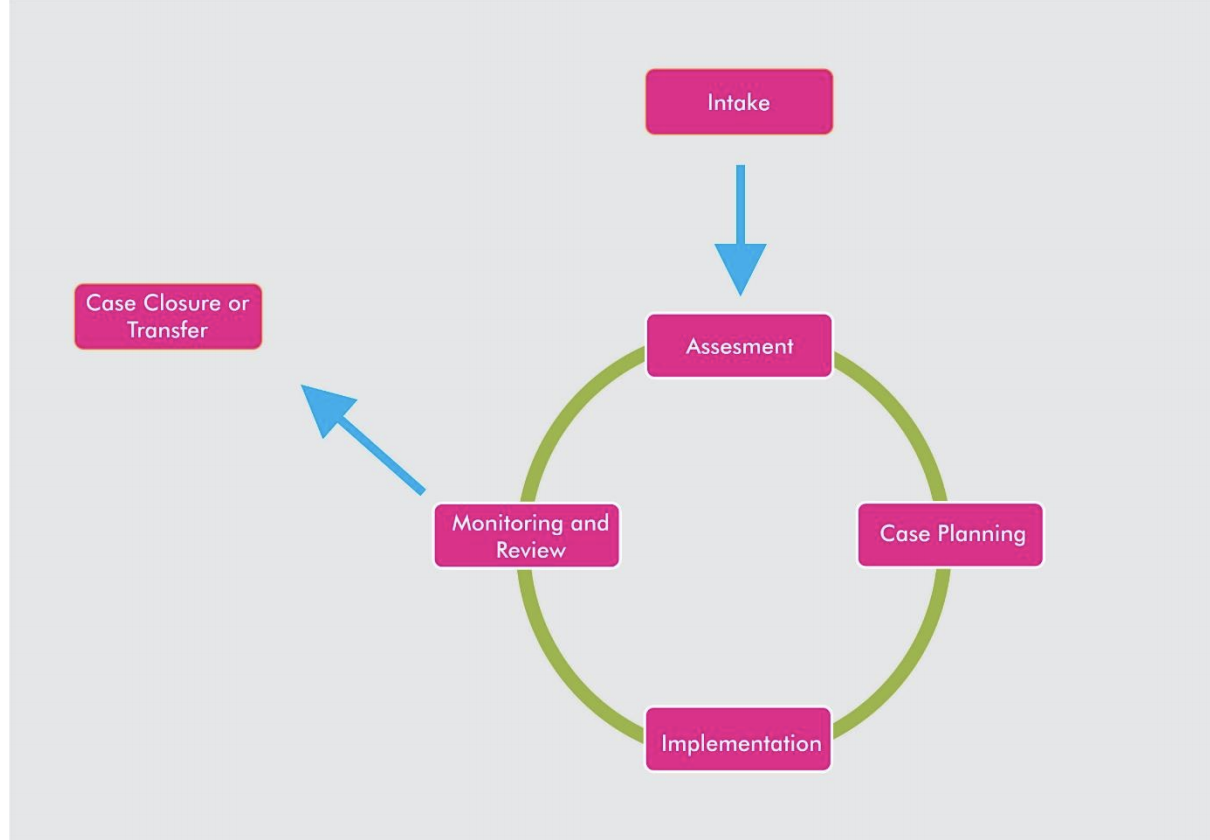
Six Tier System of Child Care, Welfare and Development
This system was developed by Ministry of Public Service, Labour and Social Welfare (Zimbabwe) (1999) as part of its National Orphan Care Policy to respond to high numbers of orphans and vulnerable children (OVC) from the HIV/AIDS epidemic. The system lists and describes sources of care and welfare, and generally a social safety net for children. These, are, in order of the priority they are used in Zimbabwe:
- biological or the nuclear family
- extended family (kinship care)
- community care
- formal foster care
- adoption
- residential child care facility
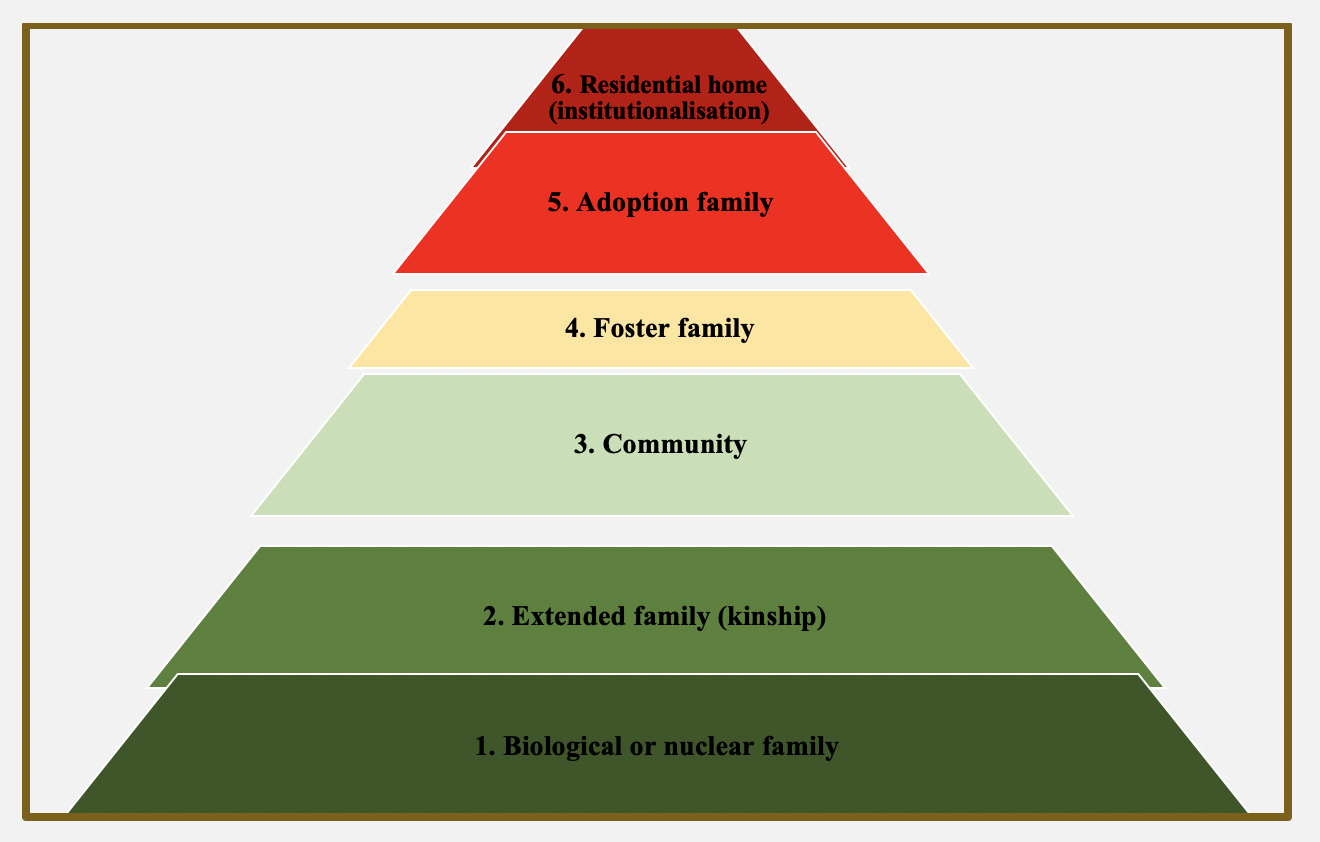
Number 1 and 2 are fully supported and culturally appropriate in the African context.
Number 3 has support but it has challenges because it is believed that people who are related by blood should stay with and look after a child. However, the community can provide support whilst the children stays at their home or with their relatives. Formal foster care and adoption are very foreign concepts, they are not fully supported by Africans. Adoption for instance, has been favoured by white people who come from outside to adopt black children, and many see this as an extension of white supremacy and colonialism. Residential care is also very foreign but has been forced upon African communities by western philanthropists, workers and governments. Large and small institutions (or children’s homes) are being closed or changed to residential villages. The homes have failed to address the challenges because they use a westernised model that has created new challenges of children who do not fit into African communities. The ultimate solution is to support families, extended families and communities and not to foster, adopt or institutionalise children then dump them when they turn 18 years.
The Zera Model of children growth and development in Zimbabwean culture
| Zera | Description | What happens at this stage? |
| Zvichauya | Future baby | Marriage – parents marry and have sex |
| Mhuru | Foetus | Conception – pregnancy |
| Rusvava | Baby – from birth to few months old | Birth – baby is born |
| Mucheche | Baby – up to two years | Training and Learning1 – social and biological skills |
| Ndumure | Post breastfeeding | Independence – child is given room to explore, more self-directed learning |
| Gondora | Exploring with independence | Training and Learning2 – social and occupational skills |
| Pwere | Exploring with adulthood | Transition to adulthood – adult roles are acquired and mentorship is provided |
| Mhandara/Jaya | Young adult | Maturity – accepted as an adult and mentorship is continued |
In doing social work with children, it is important to acknowledge these stages and how they are conceptualised within African contexts. At zvichauya stage, the motivation of any adult person is to get married and have children. An adult in Ubuntu already carries a zvichauya, a future baby. Hence, a marriage that gives children is highly valued, and marriages that do not produce children are highly stigmatised or prohibited. In rusvava and mucheche stages, the concern is to ensure a safer birth, survival of the baby and learning of skills such as eating, walking, talking, listening and safety. At the ndumure stage, breastfeeding is stopped, and independence is promoted as the child becomes a gondora. From this stage, more occupational training and learning is expected. Skills gained include cooking, cleaning, farming and caring. The pwere stage is the midway between being a ‘baby’ and a mature child. At this stage, mentorship provided by relatives who have this role such as aunts and uncles, is provided. The final stage that takes children to about 16-20 years is the mhandara (for girls) and jaya (for boys). At this stage, children begin to transition into adulthood resulting in some of them being accepted as adults, but others still considered to be children.
The implications of these stages for understanding the individual child matter for social work with children. For example, these stages emphasise local understandings of a child’s developmental needs and parental responsivity. During the stage of ndumure, parents and community members may encourage independence in activities of daily living including toilet training, feeding and communication. At the stage of mhandara and jaya, the expectation is that the child has developed talents and mastered specific life skills that potentially contribute to further economic independence. Social workers must recognise that each person exists within a cultural setting and a community and that the individual and community shape, influence and benefit from each other. There are obvious methods of casework with children that clash with Ubuntu values. These include fostering and adoption, institutionalisation and probation work. At each stage, the child, family, community, environment and spiritual world have responsibilities of providing protection, identity and connectedness.
Jairos Jiri Charity and Philanthropy Model
Jairos Jiri was a Prince in the Rozvi Royal family, the last Shona rulers of Zimbabwe. His names of respect were Moyo (meaning heart) and muRozvi (his tribal and royal name). He was born in 1921 in Bikita Reserve, a dry area where his people had been driven by white colonialists three decades earlier. His father, Chief Mutenyami Jiri was a Kingmaker, an Appointer of Rozvi Chiefs. As Royal people, people like Chief Mutenyami would not only appoint chiefs but provide social services in the community like feeding the hungry and housing the travelers or homeless. His mother, Mai Marufu came from a royal family too and was charitable as was expected of her role. As expected of Royal Rozvi, Baba Jiri’s family was guided by unhu values. They were spiritual and valued family and community. They prayed to Mwari (God) and respected their elders, present and past. Values of helping, giving, friendship, being good in the community and working and doing work that please Mwari (God) guided their royal family. In 1950, he founded Jairos Jiri Association for the Rehabilitation of the Disabled and the Blind in Bulawayo, Zimbabwe. It was initially registered as Bulawayo and Bikita Physically Defective Society. At the time of his death in 1982, the Association, which Mr. Jiri founded, had grown from one centre in 1950 to 16 centres including schools, special schools for the deaf and blind, hostels and homes, vocational training center, agriculture skills training center, clinics, orthopedic workshops and satellite units, community-based rehabilitation programme, craft shops and gender empowerment programmes. For all this work, he was recognized and awarded locally, regionally and internationally.Baba (respected father) Jiri’s charity model was replicated by several organisations in Zimbabwe and Africa. His model can be described by the acronym HOPESS as follows:
| H | Have natural values of hunhu. |
| O | Observe the environment for opportunities to help. |
| P | Provide help using your own physical, financial and other resources. |
| E | Encourage and treat people you want to help as your friends and family. |
| S | Seek outside help. |
| S | Start and sustain a charity organisation. |
Jairos Jiri Disability and Rehabilitation Model
| T | Take people you want to help as your friends or family (ukama). |
| O | Only use existing facilities like friends, hospitals and homes (ujamaa). |
| P | Provide resources like transport people to facilities because they may not be able to go on their own. |
| A | Adequate care, education and support. Provide practical ideas about how rehabilitation could be done. |
| R | Reduce stigma and cost of care by providing housing (institutionalization). |
| E | Enterprises (ushavi) for income. |
| N | Need for supporting carers like his wife and friends. |
| T | Training opportunities for self-reliance. |
TO PARENT, is to provide care as you would do your own children. This was a key strategy for Baba Jiri. The facilities he built were homes, he was Baba, the father and his wife was a Mother. This explains why Ethel, his 4th wife was able to carry on with the family trust after Baba’s death. The major strengths of his model are that it supports building of skills and income but a major weakness is institutionalisation because resources like food, shelter and education are limited. Further, once institutionalised, people are separated from community and it becomes very difficult for them to thrive in those communities when they go back. This model does not address the structural issues that cause disability, exclusion and injustice. However, the work that he started has changed to include community work and advocacy for social inclusion.
Nkrumaism
Kwame Nkrumah became the first Prime Minister of Ghana in 1952 (and later President in 1966) after the country achieved independence from Britain. He promoted a pan-Africanist ideology now known as Nkrumaism (at times called Consciencism). The Africanist’s ideas are crucial for social work teaching and practice.
This resource will be useful for subjects like Social Development, Socio-Economic Development, Globalisation, Law and Policy, Politics and Social Work, radical Social Work, Decolonisation, Research and many others.
Mugabeism
Most of Mugabe’s ideas about liberation, indigenisation, sustainable development, decolonisation and globalisation are contained in a 2002 speech delivered at a United Nations summit in South Africa. The speech can be accessed here https://sdgs.un.org/statements/zimbabwe-14934. Below are some snippets from the speech.
“The multilateral programme of action we set for ourselves at Rio has not only been unfulfilled but it has also been ignored, sidelined and replaced by a half-baked unilateral agenda of globalisation in the service of big corporate interests of the North. The focus is profit, not the poor, the process is globalisation, not sustainable development, while the objective is exploitation, not liberation.
Comrade President, it has become starkly clear to us that the failure of sustainable development is a direct and necessary outcome of a neo-liberal model of development propelled by runaway market forces that have been defended in the name of globalisation. Far from putting people first, this model rests on entrenching inequities; give away privatisation of public enterprises and banishing of the State from the public sphere for the benefit of big business. This has been a vicious, all-out, assault on the poor and their instruments of sustainable development. In Zimbabwe, we have, with a clear mind and vision, resolved to bring -to an end this neo-liberal model.
For us in Zimbabwe, the agenda for sustainable development has to be reasserted, with a vigorous, democratic and progressive interventionist State and public sector capable of playing a full and responsible developmental role. We are ready to defend the agenda of the poor and we are clear that we can only do that if we do not pander to foreign interests or answer to false imperatives that are not only clearly alien and inimical to the interests of the poor who have given us the mandate to govern them but are also hostile to the agenda for sustainable development.
That is why we, in Zimbabwe, understand only too well that sustainable development is not possible without agrarian reforms that acknowledges, in our case, that land comes first before all else, and that all else grows from and off it. This is the one asset that not only defines the Zimbabwean personality and demarcates sovereignty but also that has a direct bearing on the fortunes of the poor and prospects for their immediate empowerment and sustainable development. Indeed, ours is an agrarian economy, an imperative that renders the issue of access to land paramount. Inequitable access to land is at the heart of poverty, food insecurity and lack of development in Zimbabwe. Consequently, the question of agrarian reforms has, in many developing countries, to be high on the agenda of sustainable development if we are to meet the targets that are before us for adoption at this Summit.
In our situation in Zimbabwe, this fundamental question has pitted the black majority who are the right-holders, and, therefore, primary stakeholders, to our land against an obdurate and internationally well-connected racial minority, largely of British descent and brought in and sustained by British colonialism. Economically, we are an occupied country, 22 years after our Independence. Accordingly, my Government has decided to do the only right and just thing by taking back land and giving it to its rightful indigenous, black owners who lost it in circumstances of colonial pillage. This process is being done in accordance with the rule of law as enshrined in our national Constitution and laws. It is in pursuit of true justice as we know and understand it, and so we have no apologies to make to any one.”
Orature Theory (Zirimu’s Orature Theory)
II ‘Writure’ = written literature II Orature = non-written literature
This pedagogical theory asserts that non-written forms of literature are equally powerful. Orature (oral literature) is passed through the spoken word and thrives in communities when it is practised or lived. Most of Africa’s ‘literature’ is not written, hence the use of the term orature, which was coined by Ugandan theorist Pio Zirimu (Gikandi, 2003). Orature includes folklore, songs, stories, poems, teasing, epics, jokes or humour (comics/funnies), metaphor or idiom and proverbs and riddles. Orature is a rich oral tradition and a lived experience which forms part of the African culture. Non-written sources were just as important, especially in communities that did not have a tradition of writing.
Ugandan theorist Pio Zirimu is credited with coining the word orature, meaning oral literature. Ngugi wa Thiongo expanded the theory in his book Decolonising the Mind (1986) when he criticised foreign colonial languages and literature for displacing orature – for example, he said, in his learning at primary school, rich oral stories of hare, leaopard and lion were replaced with Oliver Twist by colonial educators. This theory argues that most of the knowledge, theories, philosophies and memories and evidence in African society is not written, it is contained in songs, dances, stories, proverbs, tales, poems, songs, clan poetry, oral theories, models, frameworks and names. They are not oral, they also involve performance, an audience, and at times, teachers and mentors. Knowledge is stored in memories, symbols and the environment from where it is decoded and communicated orally or otherwise. For example, praise poetry and praise names play an important role of communicating people’s ancestry or family tree. In the same manner, clan animals convey meaning about ancestry, history and rules of families and tribes. Without these sources of knowledge, incest would be difficult to prevent and people will easily forgot their genealogies. Orature sources of information are a precious heritage that should be protected and nurtured. Simon Gikandi (2003) said orature ‘means something passed on through the spoken word, and because it is based on the spoken language it comes to life only in a living community.’ He further said ‘Where community life fades away, orality loses its function and dies. It needs people in a living social setting: it needs life itself.’
Zirimu, P. (1973). An approach to Black Aesthetics, in Pio Zirimu and Andrew Gurr, eds. (1973). Black Aesthetics: Papers from a Colloquium Held at the University of Nairobi, June, 1971. East African Literature Bureau.
Zirimu, P. (1973). Oracy as a tool of development, in Pio Zirimu and Andrew Gurr, eds. Black Aesthetics: Papers from a Colloquium Held at the University of Nairobi, June, 1971. East African Literature Bureau. with Austin Bukenya
Useful texts by other modern writers:
Afriture Theory
The thesis of this theory is that African orature and literature (Afriture) must not be seen as inferior to others. The major proponents are Ngugi wa Thiongo and Pio Zirimu but there are many others. Their theory says:
- African languages must be the basis of African communication, learning, memory and writing – not French, Portugees, English, Arabic or other foreign languages.
- Language and literature carry people’s culture and memories and by replacing our languages we are replacing our cultures and memories. Linguicide is when African languages are displaced and resultantly disappear because of favour foreign langauges.
- Literature is a silent colonial tool – the pen is a colonial tool in the same manner the gun was.
- Literature is a neo-colonial strategy.
- Oral literature is rich, relevant and powerful.
- Syllabi at university, colleges and schools must focus on African literature, and it is the role of teaching departments and academics to decolonise the syllabi.
Thiongo’s Theory of African Languages
Ngugi wa Thiongo argues that foreign languages are or have replaced African languages to the detriment of African culture and literature.
Thiongo (1986, p. 11)”One of the most humiliating experiences was to be caught speaking [Gikuyu] in the vicinity of the school. The culprit was given corporal punishment — three to five strokes of the cane on bare buttocks — or was made to carry a metal plate around his neck with inscriptions such as I AM STUPID or I AM A DONKEY. Sometimes the culprits were fined money they could hardly afford. And how did the teachers catch the culprits? A button was initially given to one pupil who was supposed to hand it over to whoever was caught speaking his mother tongue. Whoever had the button at the end of the day would sing who had given it to him and the ensuing process would bring out all the culprits of the day. The children were turned into witch-hunters and in the process were being taught the lucrative value of being a traitor to one’s immediate community”.
“Written literature and orature are the main means by which a particular language transmits the images of the world contained in the culture it carries… Language as communication and as culture are then products of each other. . . . Language carries culture, and culture carries, particularly through orature and literature, the entire body of values by which we perceive ourselves and our place in the world. . . . Language is thus inseparable from ourselves as a community of human beings with a specific form and character, a specific history, a specific relationship to the world (15-16).”
There are different ways to use Afrtican languages in social work:
- Not using foreign langauges as an entry requirement.
- Stocking libraries with literature in African languages.
- Allowing students to cite African languages in essays and research.
- Using Africal languages for labels (e.g. room labels), names of subjects etc
- Teaching in African langauges.
- Translating literature to local languages.
- Preparing students to practice in local languages because their communities speak local languages. English, French, Portugeese and Arabic are in most cases a barrier to effective social work.
- Having local languade sessions at conferences.
Theory of Dead Aid
Founded by Dambisa Moyo, a Zambian economist, this theory argues that international development aid provided to Africa is doing more harm than good. Dambisa argues that for every dollar given in aid, many more dollars leave Africa for the donor countries. Her 2010 book, Dead Aid: Why Aid Is Not Working and How There Is a Better Way for Africa, gives a broader view into the problems of aid. “In the past fifty years, more than $1 trillion in development-related aid has been transferred from rich countries to Africa. Has this assistance improved the lives of Africans? No. In fact, across the continent, the recipients of this aid are not better off as a result of it, but worse—much worse”, said Moyo.
In the dead aid theory or myths of aid thesis Dambisa’s view is that when it comes to Africa, aid is a cancerous disease not the cure. In the 1970s, aid picked but poverty went up in Africa. Asia was poorer than Africa, received little aid, but now Africa which received aid is poorer than Asian countries like China, Singapore, Taiwan and others. In the hands of powerful African leaders and politicians, aid becomes an asset to fight for just like diamonds, it is used for manipulation and corrupt activities. Africa needs economic growth not aid, argues Moyo. More than US$1 trillion dollars has been given to Africa as aid from the west in the last 50 years but as Rwanda President Paul Abdoulaye Kagame said, there is little to show for it in terms of human growth and economic development. Former Senegalese President Wade, said aid alone has never developed a nation. The aid given to Africa so far, is equivalent to over US$1000 per African. Aid has not lived up to expectations of reducing poverty and increasing economic growth. As development and growth strategy or policy, aid has been mythical if not deadly. The thesis can be divided into three ideas (1) what aid is (1) the problems with aid (3) aid-free alternatives. We have prepared this document titled Dead Aid Theory and Social Work about this theory. View or download the document to learn about the ten (10) problems with aid and the 5 no-aid alternatives that Moyo proposed.
Paulo Freire’s Theory of Education and Decolonisation
Paulo Freire was a Brazilian educator and philosopher. His ideas contribute significantly to social work education, teaching, training, learning and practice and more generally to decolonisation.
- Emancipatory learning – learning should empower students, people or communities to challenge, overturn and liberate them from oppression and colonialism.
- Learning should be transformative.
- Education should conscientise people and make them aware of their oppression, leading to taking action against oppression.
- Critical pedagogy, learning, reflection, understanding and awareness are all important, they lead to emancipation which leads to liberation
- Teaching and learning should involve respectful dialogue, and acknowledge the humanity of each other.
- Educators should not treat students as empty vessels (it is dehumanising) that they fill with the knowledge but rather learn together at the same pace (the banking concept of teaching, where students are fed with knowledge to digest later, is wrong).
- Unjust systems dehumanise people, and those dehumanised should pursue a process of humanise themselves (to become truly humans).
- For liberation to occur, those facing injustice must use their own language to define their world and the injustice they face
- Liberation needs revolutionary leaders, who use dialogue with people to develop a common understanding of their injustice, and then plan actions together.
Ubuntu Model of Migration and Refugees
To understand this theory, we do have to appreciate the Ubuntu concepts of musha, ukama, kushava and nyika. Musha means a permanent home, where one lives with family closer to relatives and a permanent community. Musha is usually located in someone’s ancestral lands, on it is a home or homes, farming land and a grave yard. It has spiritual, social and economic significance. Musha is connected to other misha of relatives, friends, community, country and continent. When death comes, musha is the final resting (burial) place. Ukama means relations, mainly those connected by blood. When a person leaves their home to work in another area, town, country or continent, it is called kushava. Kushava is not permanent, a person who goes out to work is expected to come back at musha frequently and when they have worked enough, they come back permanently. So kushava is a journey that starts at musha and ends there. Every individual’s family has musha. Migration is a form of kushava. Nyika means country. There are two forms of country. Countries that are run by Kings (Countries with a capital letter C) and present day countries which are nation states that are run by presidents in Africa with the exception of Eswatini and Morocco that still have functioning monarchies at national level. In a Country, you find a person’s land or ancestral lands and in country, a person has citizenship.
The same concept applies to the refugee journey. No one can be a refugee for ever. No one wants to leave their permanent home, community and country permanently even if they are granted citizenship of another country. They can stay in temporary homes in their country, in neighbouring countries and overseas, but their permanent home remains and they will remain connected. Ultimately, they will return to their permanent home. The migration or refugee journey starts with unfavourable conditions in home country or community but in other cases, people are forced into the journey because of slavery, false hopes or promises. When they depart from their permanent home, they the preference is to stay near home where they have access to relatives, their community and people they relate with in terms of race, language and practices. For refugees, this could be a refugee camp. For migrants this could be an industrial area or town. If conditions become good, they can return or return frequently. If conditions are not good, they move on to another place especially outside the country. This is a difficult decision because they will be moving away from permanent home where there is the comfort of family and community. The next step is to move to places with more favourable opportunities especially outside the continent, again, this is a very difficult decision. Refugees or migrants will take up opportunities for permanent residency or citizenship but they will remain connected and attached to their place, country or continent of origin.
Assimilation and acculturation can solve immediate problems of transition, but create harder problems in future because after assimilation and acculturation, the return becomes difficult. Getting citizenship or permanent residency, a job or a house in another country does not provide ultimate belonging.
Often, countries who take migrants and organizations, individuals and families who support refugees to come to their countries do so hoping that the refugees will stay in the host country for ever. But this is fallacious for most African refugees who do not want to be separated from their family, relatives, musha, countries and continent forever. Being a refugee or migrant is a journey, that finishes with coming back home to contribute to your own family, community and country. Death on country, and burial in country are preferred. Every journey ends where it started.
Some important concepts in this theory are:
- Culturation: a process of internalising or being socialised into one’s culture through parental, family and community teaching and observation but also reading, watching and behaving.
- Acculturation: a process of learning another culture to the extent that you allow it to replace your own culture or you wrongly accept it as your own culture. It is a result of social, economic, psychological and political processes of the dominant culture that weaken and attract ‘converts’ from other cultures. Acculturation has several negative consequences including but not limited to conflict in family and community, mental health, colonial mentality, mental slavery, disempowerment and low self-esteem.
- Multiculturation: a process of learning or mixing cultures together with the hope of promoting multiculturalism but multiculturalism itself is a fallacy which doesn’t work, it can not be achieved where there is a dominant or colonising culture. Multiculturalism can be used to hide histories of colonisation. Due to multiculturation, the dominant culture usually swallows the less dominant group through assimilation. Multiculturalism could work where there are no racial differences.
- Deculturation: a process of erasing people’s culture, and replacing it with something different.
- Assimilation: this process includes acculturation and deculturation and is very dangerous. While people’s culture is being erased, it is being forcefully, gradually or covertly replaced with the dominant culture. It often involves replacing religions, languages, knowledge (education), laws and race. The biological process of race replacement is the highest form of assimilation.
Sankofa Theory
The Adinkra people are an Akan tribe of Ghana, West of Africa. Their symbol is a bird called Sankofa. Like many African tribes, the Akan’s literature found in their rich oral traditions and symbols. The Sankofa (shown below) is not just a bird, it is orature.

Sankofa teachings have now been collected into an academic theory. The theory can be summarised as for you to successfully go forward, you need to look back. The Sankofa principle can be applicable or understood as follows:
| Aspect | Look Back (behind or past) to move ahead (front or future) |
| Knowledge (e.g. philosophies, orature, theories or frameworks) | Use philosophies, oratures, theories or frameworks of the past to shape the future |
| Practice (e.g. reflection and critical thinking) | Look back to learn to improve your practice |
| Pedagogies (e.g. teaching and learning) | Look back for pedagogies |
| Social work (e.g. social welfare, social assistance, community work and development) | Leave no one behind |
| Present socio-economic circumstances (poverty) | Consider the importance and contribution of history |
| Culture | Look back to where you come from |
| History | Value your history. History of families is important in understanding their present situation and aspirations. |
| Learning (e.g. assessment and teamwork) | A Sankofa assessment asks students to use the past to inform the present and future. |
| Research (e.g. ethics and literature review) | Look at literature already there before new research. Past literature is useful for current research |
| Family, relations or community | If you succeed, support others to succeed. I am because we are. |
Bangura, A. K. (2011). African-Centered Research Methodologies: From Ancient Times to the Present. San Diego: Cognella.
Muzerengi, Tapiwa & Gudyani, Shepherd. (2023). The Sankofa Methodology: A Pan-African Approach to Poverty Alleviation. 10.1007/978-3-031-21841-5_10.
Double Consciousness Theory (Du Bois)
This theory was developed by Du Bois in the book (Du Bois, 1903, The Souls of Black Folk), and it says, if you are a black person living or working in a country of white people or a person of mixed race (in this case black plus another race), your position is difficult because you belong to two worlds – the world of blackness and the world of the other race. This is double consciousness or twoness. It affects the way you identify, think, see the world and act. You will be divided between the two races, and it is difficult to commit to one of the races. Du Bois was mainly referring to black people in countries of white people.
One ever feels his twoness—an American, a Negro; two souls, two thoughts, two unreconciled strivings; two warring ideals in one dark body, whose dogged strength alone keeps it from being torn asunder. (1903)
Such a double life, with double thoughts, double duties, and double social classes, must give rise to double words and double ideals, and tempt the mind to pretence or revolt, to hypocrisy or radicalism. (1903)
I began to feel that dichotomy which all my life has characterized my thought: how far can love for my oppressed race accord with love for the oppressing country? And when these loyalties diverge, where shall my soul find refuge? (1968: 169)
It is true, as I have argued, that Negroes are not inherently ugly nor congenitally stupid. They are not naturally criminal and their poverty and ignorance today have clear and well-known and remediable causes. (1940: 173–4)
The focus of his thesis was America but double consciousness affects:
- black people who have migrated to or are working in countries of white people
- mixed race children and people in general (referred by Du Bois to as coloured group, the group he belonged)
- mixed race couples
- black politicians or military personnel serving in countries of white people
In social work, double consciousness affects the way one defines colonisation and decolonisation.
Another important concept related to double consciousness is race suicide, which Du Bois saw as an attempt to assimilate to the ‘white and the yellow race’ as a result of being ashamed of being black or of mixed race. Assimilation is facilitated by domination and oppression but also inferiority complex. Du Bois gave the education system as an example, it is designed to facilitate assimilation. He said:
It is almost impossible for a Negro boy trained in a white (Northern) high school and a white college to come out with any high idea of his own people or any abiding faith in what they can do. (1940: 191)
Double consciuosness features in the work of Mbiti (1969) who argued, among other views, that Africans who have converted to foreign religions such as Christianity and Islam often struggle with what spirituality they should embrace – their African spirutuality or the European and Middle-Eastern.
Decolonising the Mind Theory (Ngũgĩ wa Thiong’o)
Kenyan born Ngũgĩ wa Thiong’o (born James Ngũgĩ) is one of Africa’s leading voices on decolonisation. He is regarded as the father of decolonizing the mind. His book, Decolonising the Mind (1986), contains his ideas about this theory. Ngũgĩ argued that:
- While Africans defeated colonialists who had stolen their land, the minds of Africans remains trapped and controlled by former colonisers.
- Colonial languages (English, French, Arabic, Portuguese etc) play an important role in hierarchies and systems of oppression. Using foreign languages fules decolonsiation, it kills local languages (linguicide) and erases people’s memories and culture.
- Western ways of thinking, believing, acting and valuing still dominant Africans.
- Africans see African values, beliefs, languages and land as undesirable, uncivilised or unattractive.
- Christianity has played a key role in habituating Africans into western ways, for example, celebration of Christmas, Easter, Christian Sabaths etc at the expense of African holidays and holy days.
- Unless these western ways of being are shade off, Africa will remain colonised.
- African orature was replaced with foreign literature. Oliver Twist replaced stories of Hare, Leopard and Lion.
Important quotes
- The bullet was the means of the physical subjugation. Language was the means of the spiritual subjugation (1986, p. 9)
- Berlin (the Berlin conference where the colonists partitioned Africa) of 1884 effected through the sword and the bullet. But the night of the bullet sword and the bullet was followed by the morning of the chalk and the blackboard. the physical violence of the battlefield was followed by the psychological violence of the classroom. But where the former was visibly brutal, the latter was visibly gentle… (1986, 9).
- Language and literature (foreign and colonial) were taking us further and further from ourselves to other selves, from our world to other worlds (1986, p. 12). Here he was referring to his own experience and how English language removed him from his realities.
- Language, any language, has a dual character: it is both a means of communication and a carrier of culture (1986, p. 13).
- Culture embodies those moral, ethical and aesthetic values, the set of spiritual eyeglasses, through which they come to view themselves and their place in the universe. Values are the basis of a people’s identity, their sense of particularity as members of the human race. All this is carried in language. Language as a culture is the collective memory bank of a people’s experience in history. Culture is almost indistinguishable from the language that males possible its genesis, growth, banking, articulation and indeed its transmission from one generation to the next. ( (1986, p. 12-13).
- …until African writers accepted that any true African literature must be written in African languages, they would merely be pursuing a dead end (1986, p. 24).
Ngũgĩ proposed some solutions, including, but not limited to using African languages to communicate, to write and in our memories. He said “the medium of our memories, the link between space and time, the basis of our dreams”. Africans and African writers wrongly view their langauges as shameful, inelegant, or incapable of expressing scientific or intellectual thought. They prefer English, but at the end, using or writing in English assists the coloniser to perpetuate their dominance. Ngugi stopped writing in English in 1986 to write in Gikuyu, his language.
Ngũgĩ’s other important work was challenging post-colonial leadership in Kenya on its failure to promote social justice especially of the marginalised peasants and workers. In the book Petals of Blood, he was critical of the government of Daniel Arap Moi. Ultimately, he had to go into exile to protect his life.
His works include Weep not, Child (1964), Matigari (1986); Wizard of the Crow or Murogi wa Kagogo (2006); The Black Hermit (1968); A Grain of Wheat, 1967; The River Between (1965); Petals of blood (1977); Decolonizing the Mind (1986); Moving the Centre: The Struggle for Cultural Freedom (1993); Moving the Center (1994); Penpoints, Gunpoints and Dreams (1998) and many others.
Ngũgĩ wa Thiong’o (1986). Decolonising the Mind. The politics of langauge in African literature. Nairobi, Heinemann Kenya/Harare, Zimbabwe Publishing House.
Decolonised Research methodology/Design/Approach
An approach to research that places emphasis on removing colonial or colonising elements in research. Researchers examine their research to ensure that they do not use a colonial lense to define problems or research gaps. They do the same for research philosophy, research ethics, language and ways of data collection analysis, reporting and dissemination.
Indigenous Research Methodology/Approach
This approach uses indigenous lense to define social problems. It uses indigenous philosophy, research ethics, language and ways of data collection analysis, reporting and dissemination.
Afrocentrism
This theory is about giving urgency to African philosophies, values, ethics, ways of doing, ideals, dreams etc as opposed to colonial ways. This theory emanated from Ubuntu, the African philosophy of looking at the world. It was expanded by early anti-colonisers and later by freedom fighters like Kwame Nkrumah and academics and philosophers like Cheikh Anta Diop. Today, the theory is led by pan-Africanists.
Diop, C. A. (1989) The African Origin of Civilization: Myth or Reality. New York, Lawrence Hill Books.
Diop, C. A. (1988) Precolonial Black Africa: A Comparative Study of the Political and Social Systems of Europe and Black Africa, from Antiquity to the Formation of Modern States. New York, Lawrence Hill Books.
Afrocentricity
This theory in reference to African Americans means giving urgency to African culture, worldviews and interpretations in matters concerning them – the opposite or Eurocentrism. It is also about embodying African ways of doing and being. Molefi Kete Asante is credited with this theory. Seven criteria for the establishment of an Afrocentric methodology by Ama Mazama (2003) are:
1.African experience must guide and inform all inquiry.
2.The spiritual is important and must be given its due place.
3.Immersion in the subject is important.
4.Wholism is a must.
5.Intuition is a valid source of information.
6.Not everything that matters is measurable.
7.Knowledge generated must be liberating.
Asante, M K (1988) Afrocentricity
Asante, M K (19887) The Afrocentric Idea
Asante, M K (1990) Kemet, Afrocentricity, and Knowledge
Mazama, A (2003) The Afrocentric paradigm. London: Africa Research & Publications.
Theories of Cheikh Anta Diop
Cheikh Anta Diop is known for African origin of Ancient Egyptian civilization (Diop, 1974),The Cultural Unity of Black Africa: The Domains of Matriarchy and Patriarchy in Classical Antiquity (Diop, 1989). He was a proponent of the One Africa philosophy and African centred thought. His ideas, known as Diopian thought, were centred on that Black African people have a common philosophy, they are one people who were capable of civilization.
- One Africa Theory – Africa is one. In ancient times, Egypt was a land of Black people.
- African centred thought – Afrocentrism, that it, using African throught in education, research, politics, philosophy etc
African Research Methodology (ARM)
Many authors ave described ARM. Below we provide akey aspects summarised by Khupe and Keane (2017).
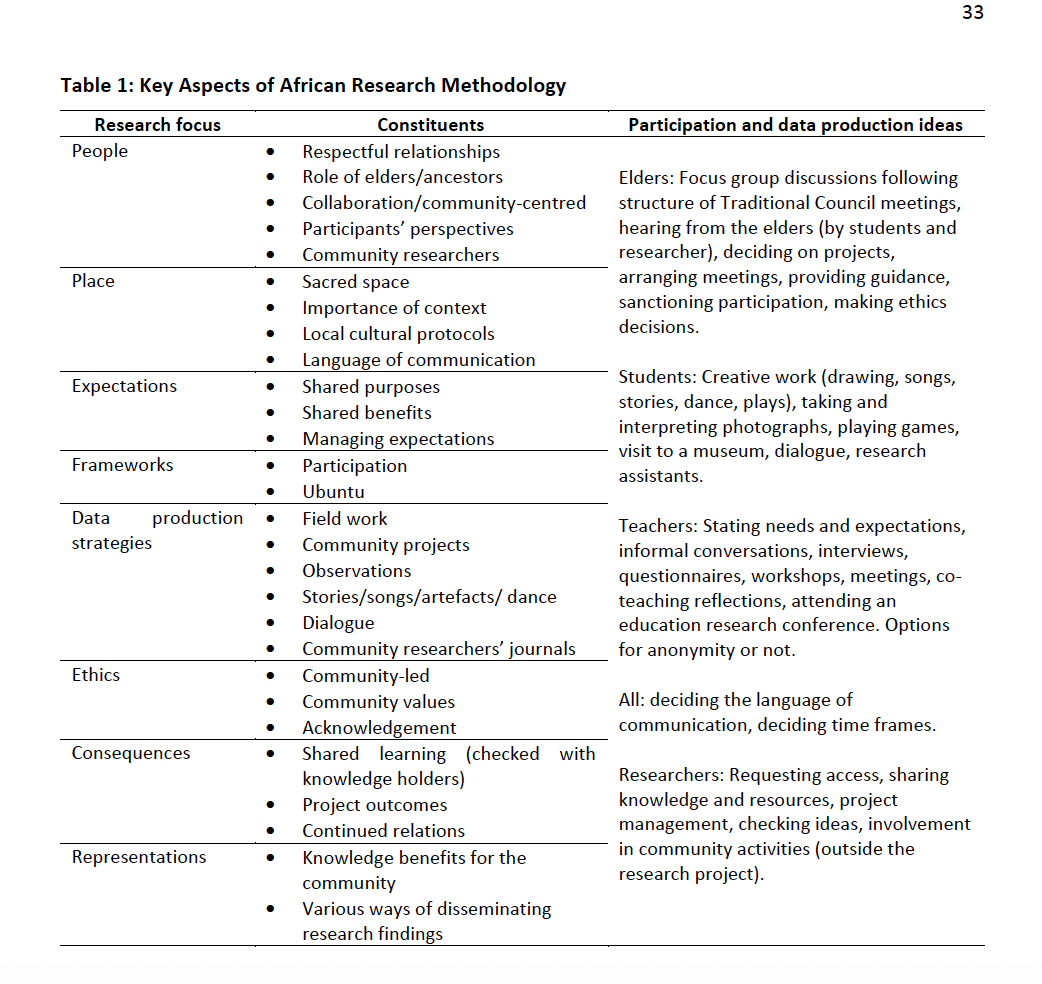
Participatory Action Research (PAR)
Participatory research as “an emancipatory approach to knowledge production and utilization” (Mulenga, 1994:29). It is about involving households, families and communities (participants) in research that is part of their development. Participants identify and define the problem and contribute in ALL stages of the research process (Mulenga, 1994). Maguire and Mulenga (1994) said the main characteristics of participatory research are (1) involves the people themselves as researchers as they seek solutions to the problems which confront them in their daily struggle for survival (2) offers a way for researchers and oppressed people to join in solidarity and (3) to take collective action, both short and long term, for radical social change (4) It combines three activities, namely, research, education and action.
Human Factor (HF) Approach to Development
This theory was developed by Professor Claude Mararike, a social scientist at the University of Zimbabwe in the 1990s to the early 2000s. His central theory was that at the centre of development are human beings. If development is to occur, the human being must use different strategies appropriatet to their circumstances. But is the human being A is replaced by another human being B, then the development agenda will be human B’s. There is no way human B could use human A’s development agenda.
“African countries, though independent, cannot develop as they see fit as long as they continue to function as clients of development organizations and social institutions which have their own economic and political agendas. The call is for Africa to analyse critically the human factor content of development proposals offered by foreign development organizations. Only then can Africa adopt and adapt those models which agree with her own developmental goals. In no way should Africa accept development proposals which compromise her vision and mission statements of development. Development in Africa should only take place in the context of Africa’s own organizations and institutions. And the main component of all organizations and institutions are people. Africa must, therefore, first develop the Human Factor (HF) content in all organizations and institutions before she can put in operation her developmental machinery. Foreign organizations which have operated and continue to operate in Africa have introduced and continue to introduce development interventions whose primary agendas are, first, to destroy the African HF content and, secondly, to damage organizational and institutional capacities, in order to finally put in place their own organizations and institutions HF content and ensure that no further damage is done to her younger generations (Mararike, 1998, p. 87)”.
According to Mararike, modernisation and dependency theories were not African agendas, these were human B’s agendas. “Their aimsare to create clients for their own economic prosperity and political domination of the world by the West”, (p. 87).
“European colonialists must have known and, even today, continue to know that, no social, economic or political organization can function effectively if it is not manned by committed persons who have values and ideals of their own to believe in but those dictated to them by their former masters. One of the agendas of Africa’s colonizers and detractors, is therefore, to ensure that Africans do not and should not believe in the values and ideals of their own traditions and social institutions. How do they do it? Or how have they succeeded in doing this? Reference to African philosophy should help us to answer these questions (p. 87)”.
Cite as Mararike, C. G. (1998). African Philosophy and Human Factor Development. Harare: University of Zimbabwe Publications.
Kudyiswa/Kurutsiswa Theory of Decolonisation
This theory was developed by Professor Claude Mararike, a social scientist in 1998. The central thesis is that Africans, as well as other colonised regions of the world, underwent a process called kudyiswa, which basically means they were made to eat brain-damaging and behaviour-changing food or herbs. This is called ukudhliswa in Ndebele; guthaiga in Gikuyu and miti in Kikamba. Kudyiswa targets the brain, which is central to human thinking and behaviour. The only process to reverse this process is through kurutsiswa, a process of taking out the food and its effects. Kudyiswa is colonisation and kurutsiswa is decolonisation. Colonisation targets the human brain, similar to what Mbiti (1969) calls colonistaion of the mind or brainwashing. Education is one of the biggest sources of this deep form of colonisation.
Cite as Mararike, C. G. (1998). African Philosophy and Human Factor Development. Harare: University of Zimbabwe Publications.
Nziramasanga Educational Model
In 1999, Dr Caiphas Tizanaye Nziramasanga led a commission that recommended what an African education should look like. Excerpts from the Commission’s report are provided below, verbatim (Nziramasanga 1999, p. 24).
That education should be based on the peoples’ belief in Unhu/Ubuntu, starting at pre-school level and incorporating diverse cultures for national identity. That the new Zimbabwean philosophy should be embedded in Unhu/Ubuntu which has withstood the corrosion of time and the tempests of history. Unhu/Ubuntu should be the energising spirit in education, the family, in nation building and in international relations. That the new philosophy should focus on a holistic education which
- incorporates diverse cultures because we are a multi-cultural society
- fosters a holistic education for survival; that is, head, heart, hand and health to produce a balanced citizen
- encourages the transmission of selected values with special consideration to what comes through information and communication technologies
- inculcates values like, hard work, respect for others, honesty, good morals and patriotism
- prepares learners to be adaptable, self-reliant, creative and self – directed
- affirms that education is a right for all in accordance with the 1990 Jomtien commitment
- is an empowering tool for competitiveness in a global environment in the information and globalisation age
- is people-centred, promoting the family and is based on a cultural foundation and with a community based approach
- gives serious consideration to the mother tongue for use as medium of instruction in our schools, on the grounds that it is the vehicle for culture and transmits people’s experiences gathered over many centuries
The Commission agrees that the education philosophy should be based on Unhu/Ubuntu which implies a good person morally with such values as honesty, trustworthiness, discipline, accountability, respect for other people and elders, harmony and hospitality. These values stand the light of truth. Moral values are essential to stem the tide of immorality which threatens to destroy the fabric of society. The Commission recommends that the following be the characteristics of the product of an education system:
- a person who is honest and accountable to society
- a person who has morality and ability to learn from the philosophy of Unhu/Ubuntu.
- a person imbued with ideals of freedom, equality and tolerance and social responsibility
- a person who has skills of communication, negotiation and ability to resolve conflicts peacefully
- a person who is creative, innovative, self motivated and personally accountable
- a person who cherishes and upholds a team spirit
- a person who respects other people
- a person who has self-respect and respects property
- a person with respect for knowledge and appreciation of all cultures of Zimbabwe
- a person with a good work ethic and who strives to work hard for his own good and for the good of the family and the country
- in this information age the products of our schools should have skills to gather, sift, analyse and make critical judgement (p. 33)
Nziramasanga went further to recommend professional, practical, technical and environmental education and adequate support for marginalised groups – particularly those with disabilities and girls.
Cite as: Nziramasanga C. T. (1999). The Presidential Commission of Inquiry into Education and Training. Nziramasanga commission, Zimbabwe.
The Holistic Model of Educational and School Social Services (HOMES)
Cite as Mugumbate, R. (2024). Challenges in current approaches to school social work in Africa and a proposed holistic, decolonial and developmental model in School Social Work, Simbine SL and Muridzo NG (Eds). Rheinfelden: IFSW.
Principles of the HOMES model
Proposed by Rugare Mugumbate, the three principles of the HOMES model are (1) it is grounded in African philosophy of Ubuntu which values family, community, decolonisation, development and participation; (2) it acknowledges that the role of social work in schools is broadly educational, and should not be narrowed to the school. The educational objective mainly comes from the fact that what children learn contributes to their growth or lack of it; (3) the model is multidisciplinary and does not prefer the phrase school social work because this service is never offered by social workers alone. An exclusive space for social workers in schools in Africa does not look feasible. A number of professionals will be involved, including teachers, social workers, psychologists, counsellors, health workers, community workers, youth workers and cultural workers. The model has four pillars all contributing to school social services.
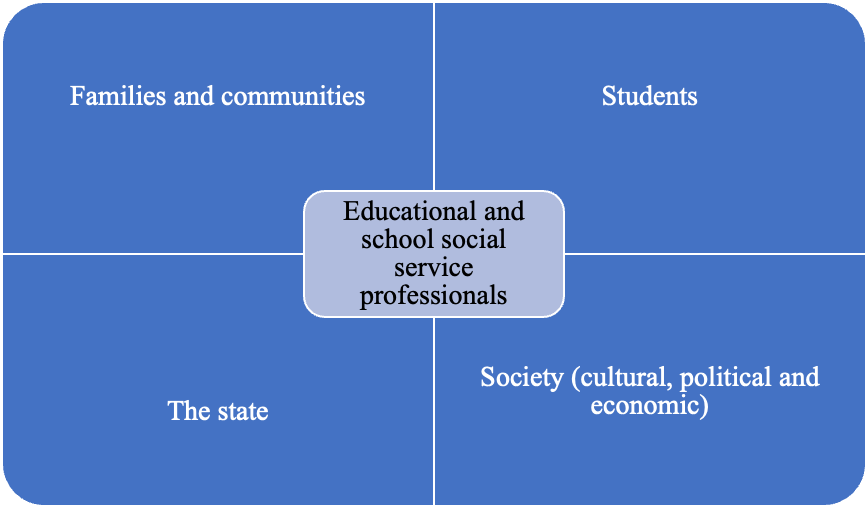
Options to implement the HOMES model
Option 1 – Working at the school and community level: This option has three steps. First, the school and promoter of social work at the school does an assessment of social needs and problems at the school as well as assets and existing strengths within the school system. The needs analysis involves children, families, community, professionals and the government officials working with the school. A needs analysis report is produced with a justification and recommendation for a social worker to be employed. Second, the report is shared with the government or school board and advocacy for a social worker position is done. Third, a social worker is employed, if approved. If not approved, the school will find ways to work with government social services departments or find resources to employ a social worker privately. This requires working with all stakeholders. The roles of the social worker are shown in Table 4.
Option 2 – Working at the state level: The social workers association in the country advocates for employment of public social workers in schools. Where an association is not available or unable to play this advocacy role, an advocacy committee of social workers could do this. In all cases, it is best to work with teachers, especially teachers unions, members of parliament supporting the idea and both Ministries or departments of education and social services. A needs assessment and a case for employing social workers should be developed with detailed information. A pilot program at selected schools, county, district or province can be a good starting point to advocate for.
An alternative approach is to advocate government social workers in the departments of social services, community work and social services to include school social work in their job descriptions. This strategy might be easy because it seeks to use existing resources, however, the challenge is that in other communities they do not even have social workers in their health, community work or social services departments. The roles of the social worker are shown in the text box.
Roles of social workers in the HOMES model
Examples of roles for school social work in the HOMES model
| Social: social assessment, screening and assistance with basic needs; dealing with gender violence and promoting rights and responsibilities. Educational: increasing school enrolment retention, attendance, retention and graduation rates; and advocate for suitable curricula. Transformational and decolonial: teacher skills development, promoting critical education that liberates, mentoring, advocating for a decolonised education, Africanising and indigenising pedagogy. Economic and developmental: promoting creativity, advocating for work-based education, placements and transition programs and promoting education for socio-economic development. Health, psychological and spiritual wellbeing: assessments and screening for mental health and disability, prevention programs, counselling, drug abuse, sexuality, preventing malnutrition and screening for maltreatment and abuse. Cultural: community projects, promoting cultural competence of teachers and promoting culturally safe practices in education. |
The work of the social worker focuses on the student, the teacher, the school, the community, the employer and the government.
Indigenous Health Theory
This theory is about valuing indigenous methods of healing, health and well-being. WHO defines indigenous health or ‘traditional health’ as ‘the sum total of knowledge, skills and practices based on the theories, beliefs and experiences indigenous to different cultures, whether explicable or not, that are used to maintain health, as well as to prevent, diagnose, improve or treat physical and mental illnesses’. Indigenous health values connection to land or environment, culture, spirituality, ancestry, family, and community. Over 70-80% of Africans use indigenous health for most of their health needs.
Allopathic medicine refers to the most dominant form of medicine today, that is a system dominated by medical doctors, pharmacists, therapists and nurses who treat symptoms and diseases using drugs, radiation, surgery and other methods – also called bio-, conventional or orthodox.
Key aspects of indigenous health include:
- It involves indigenous methods from the people and was developed over many years. These methods are continuously evolving and new methods come every day.
- Just like modern-science based medicine, indigenous health methods have side effects, but their side effects are less severe.
- The devaluing of indigenous medicine is largely for economic reasons. Innovations of the Global North try to keeps those of the Global South out of competition. There is competition for pharmacies, clinics, labs, patents, jobs, education, marketing, distribution and equipment.
- When white people colonised Africa, they put in place laws to prohibit use and growth of indigenous health. In Zimbabwe, South Africa, Zimbabwe, Zambia, Malawi, Namibia and other countries, they put in place Witchcraft Suppression Act (laws) and prohibited use and practice of indigenous health.
- The religion of Abraham with its three major sub-religions of Judaism, Christianity and Islam contributed significantly to devaluing and banning of indigenous health as part of the large religious colonisation of Africa.
- Indigenous medicine is capable of growth and improvement, but it faces several barriers including limited or no research funding, not included in school or university curriculum and stigmatisation.
- Each type of medicine can be an alternative or complementary approach to the other, for example, modern-science based medicine can be alternative or complementary to indigenous medicine, and vice versa.
- Both scientific and indigenous knowledge can be the basis of each other’s improvement. Most modern knowledge was based on indigenous knowledges. Actually, there is a very thin line between scientific and indigenous methods.
- There has been theft of indigenous knowledges and plants and they end up being commercialised.
- Modern medicine is based on trial and error and can be very unethical at times. Modern science has several scandals, and other parts of society have lost confidence in it. There are several conditions science has failed to explain and to treat.
- There is a huge economic cost of neglecting indigenous health methods. Universal health coverage can not be achieved without indigenous medicines.
- Indigenous health is holistic not narrow. It focusses on the physical, psychological, social, spiritual, cultural, biological and environmental aspects of health.
- It is natural not artificial.
- It takes a bottom up not top down approach to health.
- Socio-cultural acceptance of indigenous systems is high.
- Drug dependence and over-prescription are major issues with modern medicine.
In many countries there are centres, departments or programs to promote different methods of therapy. In 1978, at the Alma Ata conference, WHO recommended that indigenous health including indigenous birth attendance, should be incorporated into health national systems. For example, the WHO has the Global Centre for Traditional Medicine (GCTM) in India supported by a USD250 million grant from the Government of India. The USA has the National Center for Complementary and Integrative Health (NCCIH). Zimbabwe has the Traditional Medicines Council and a Traditional Medicines Act (law). Acceptance of CAM is at 52% and the overall use at 45% in western countries, will be much more in other countries. Traditional Chinese Medicine is a big industry. The African Union runs the African Traditional Medicine Day each year on 31 August and the WHO African Region has Guidelines for Registration of Traditional Medicines in the African Region. The period 2001–2010 was declared as the Decade for African Traditional Medicine. South Africa has a National Reference Centre for African Traditional Medicine for African Traditional Medicines (the NRCATM), the Traditional Health Practitioners Act (THPA) No. 22 of 2007 and a Directorate of Traditional Medicine (DTM).
The WHO Congress on Traditional Medicine was held in Beijing, China in 2008 and made the following declarations among others:
- Governments has a responsibility for the health of their people and should formulate national policies, regulations and standards to ensure safe, appropriate and effective use of TM and
- TM should be further developed based on research and innovation.
The current WHO Traditional Medicine Strategy for 2014–2023 has these goals:
- Harnessing the potential contribution of TM to health, wellness and people-centred care,
- Promoting the safe and effective use of TM by regulating, researching and integrating TM products, practitioners and practice into health systems where appropriate and
- Education and training of TM and CAM practitioners.
Types of indigenous and natural methods:
- Plant-based medicine e.g. herbs, moringa, oils, cannabis etc
- Soil-based medicine
- Animal-based medicine
- Diet-based therapy e.g. ketogenic diet
- Spiritual-based or faith-based healing e.g. prayer in any religion not just Abrahamic religions
- Wisdom-based treatments
- Mind-body therapy e.g. yoga
- Energy-based therapy e.g. biofield therapy
- Ceremony-based therapy
- Art-based therapy
- Talk-based therapy e.g. counselling
- Community-based therapy
- Body-based procedures e.g. circumcision for disease prevention
- Movement therapies
- Homeopathic medicine – from Germany
- Osteopathy – massage
- Naturopathy – uses various forms of treatment, it is holistic
- Chiropractice
- Acupuncture – from China
- Ayurveda – from India, a method that combines panchakarma (‘five actions’), yoga, massage, acupuncture, herbs etc to achieve holistic treatment
Resources:
African Traditional Medicine: South African Perspective by Mmamosheledi E. Mothibe and Mncengeli Sibanda https://africasocialwork.net/wp-content/uploads/2022/11/African-Traditional-Medicine-South-African-Perspective.pdf
African Traditional Medicine Day 2022, https://www.afro.who.int/regional-director/speeches-messages/african-traditional-medicine-day-2022
Regional Committee for Africa, 63. (2013). Enhancing the role of traditional medicine in health systems: a strategy for the African Region (Document AFR/RC63/6). WHO. Regional Office for Africa. https://apps.who.int/iris/handle/10665/94185
Holistic and Integrative Health Model
This model values both indigenous and modern scientific medicine. The WHO and cost countries support the holistic and integrative health model. The acknowledge that contemporary health systems and services must embrace all forms of treatment for universal health coverage is to be achieved.
African Renaissance Theory
According to Thabo Mbei, former South African President, the renaissance is when African worldviews, economies, society and technologies become the pillars of African society again. Mbeki is credited with this theory. Mbeki (2004), in a popular speech titled I am an African, said
Whatever the setbacks of the moment, nothing can stop us now!
Whatever the difficulties, Africa shall be at peace!
However improbable it may sound to the sceptics, Africa will prosper!
Whoever we may be, whatever our immediate interest, however much we carry baggage from our past, however much we have been caught by the fashion of cynicism and loss of faith in the capacity of the people, let us err today and say – nothing can stop us now!
The renaissance is about:
- revival of African identity
- regeneration of self-confidence
- reconfiguration of governance and global engagement and development to end poverty
- rebirth of African politics and conflict resolution
- revitalisation of culture
- replacement of unjust systems and arrangements
- reimagining a democracy that is still representative and maintains accountability but is suited to Africa
The renaisance idea has been praised but many but others see it as an ambitious theory.
Ibrahim Index of African Governance (IIAG)
The Ibrahim Index of African Governance (IIAG) is a tool that measures and monitors governance performance in African countries. The Mo Ibrahim Foundation (MIF) (2007) defines governance as:
The provision of political, social and economic public goods and services that every citizen has the right to expect from their government, and that a government has the responsibility to deliver to its citizens.
In the IIAG, country performance in delivering governance is measured across 79 indicators organised into four key components: Security & Rule of Law, Participation, Rights & Inclusion, Foundations for Economic Opportunity and Human Development. The methodology used is available here.
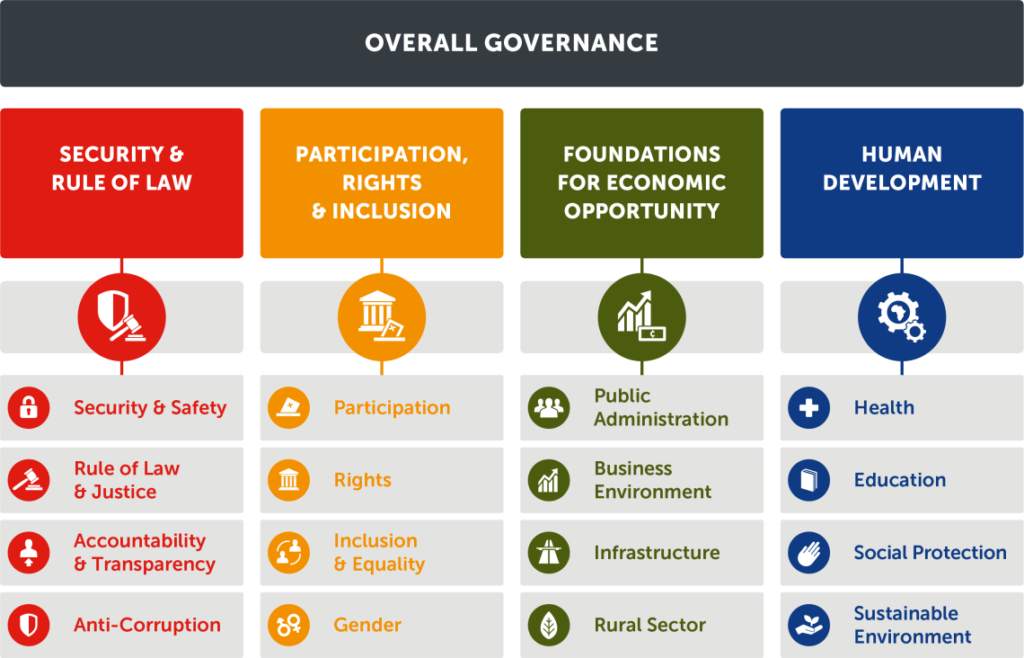
African Theory of Education
African indigenous education model
| Principle | Meaning |
| Preparationism or preparedness (obwetekatekyi in Rukiga Language in Uganda) | Prepare children for future economic, social, political and cultural roles in in the family, the tribe or the clan, community and society. |
| Functionalism (omugasho) | Education must serve a function to the learner, family, community and society in which it takes place |
| Communalism (kukorera hamwe) | Sense of community, cooperative learning and the view that it takes a whole community to teach. |
| Perennialism (ekimazire obwire bureingwa) | Valuing knowledge from the past or looking back to what African philosophers said |
| Holisticism (kutwara ekintu hamwe) | Which means valuing knowledge of the past or looking back to what African philosophers said. |
Epistemic Decolonisation Theory
Colonial education results in epistemic dependence (dependence on other peiople’s knowledge), ontological exiling (separating people from their knowledge), epistemicide (killing of other people’s thinking), inguicide (killing languages of others), culturecide (killing other cultures) and ‘namecide’ (Ndlovu-Gatsheni, 2020, 2018). The solution is epistemic decolonisation which happens as follows:
- Return to the base/locus of enunciation – local langauges and philosophy
- Shifting the geographical and biographical sources of knowledge/moving the centre
- Decolonising the normative foundation of critical theory
- Rethinking thinking itself
- Learning to unlearn in order to relearn
Cite as:
Ndlovu-Gatsheni, S. J. (2018). Epistemic Freedom in Africa : Deprovincialization and Decolonization. Milton: Taylor & Francis Group.
Ndlovu-Gatsheni, S. J. (2018). THE DYNAMICS OF EPISTEMOLOGICAL DECOLONISATION IN THE 21ST CENTURY: TOWARDS EPISTEMIC FREEDOM1. Strategic Review for Southern Africa = Strategiese Oorsig Vir Suider-Africa, 40(1), 16–45. Read or View PDF
Ndlovu-Gatsheni, S. J. (2020). Decolonization, Development and Knowledge in Africa : Turning over a New Leaf. London Taylor & Francis.
Kwanza Spirituality Theory
Also referred to as Karenga’s Model of Decolonial Spirituality, Kwanza is a celebration of family, culture, community, spirituality and heritage. It is a vehicle for decolonisation and celebrating in an Afrocan way. Founded in 1966, Kwanzaa (from matunda ya kwanza which translates means first fruits in Swahili) is a festival and holiday celebrated by over 18 million African-Americans annually, starting from 26 December and ending with the Karamu feast on January 1. It is also celebrated in other parts of the world. Dr Maulana Karenga (also known as Ronald McKinley Everett) founded Kwanza in 1966. As an African-American, he was constantly disturbed by how often black people celebrate western holidays, histories, religions and ideas while neglecting their own. Western holidays include Christmas, Easter and many others. In Africa, first fruits or harvests are celebrated by thanking God and sharing food through feasts. This became the background to the Kwanza holiday.
Kwanza involves decorations in red (blood of Black people’s struggles for freedom), black (black people) and green (land of the people); wearing African-style textiles and art; and a family feast called karamu on December 31.
Seven principles (nguzo saba) of Kwanzaa
Kwanzaa principles were derived from African values, histories and cultures. The principles are:
- Umoja (Unity): To strive for and to maintain unity in the family, community, nation, and race.
- Kujichagulia (Self-Determination): To define and name ourselves, as well as to create and speak for ourselves.
- Ujima (Collective Work and Responsibility): To build and maintain our community together and make our brothers’ and sisters’ problems our problems and to solve them together.
- Ujamaa (Cooperative economics) To build and maintain our own stores, shops, and other businesses and to profit from them together.
- Nia (Purpose): To make our collective vocation the building and developing of our community in order to restore our people to their traditional greatness.
- Kuumba (Creativity): To do always as much as we can, in the way we can, in order to leave our community more beautiful and beneficial than we inherited it.
- Imani (Faith): To believe with all our hearts in our people, our parents, our teachers, our leaders, and the righteousness and victory of our struggle.
The seven symbols of Kwanzaa
- Kikombe cha umoja (unity cup): Celebrants drink from this cup in honor of their African ancestors. Before drinking, each person says “harambee,” or “let’s pull together.”
- Kinara (the candle-holder, which holds seven candles): It symbolizes stalks of corn that branch off to form new stalks, much as the human family is created.
- Mazao (fruits, nuts, and vegetables): These remind celebrants of the harvest fruits that nourished the people of Africa.
- Mishumaa saba (the seven candles that represent the seven principles): A different candle is lit each day. Three green candles on the left; three red candles on the right; and in the middle is a black candle.
- Mkeka (a mat): The symbols of Kwanzaa are arranged on the mkeka, which may be made of straw or African cloth. It symbolizes the foundation upon which communities are built.
- Vibunzi (plural, muhindi) (ear of corn): Traditionally, one ear of corn is placed on the mkeka for each child present.
- Zawadi (gifts): Traditionally, educational and cultural gifts are given to children on January 1, the last day of Kwanzaa
What does this mean for Africa?
Most people on the African continent may not even heard about Kwanzaa but there are seven connections they can identify with:
- Kwanzaa is part of pan-Africanism and the decolonization project, particularly decolonizing culture, religion and the mind.
- Kwanzaa provides an alternative to popular western, eastern and middle-eastern holidays, and allows people to look more critically at holidays that they celebrate that are foreign to them. Non-African holidays are founded on non-African ideologies, religious stories and symbols. Most of them, including religious holidays, celebrate whiteness and were part of the colonial project, and are today part of the neo-colonial project.
- Every celebration of non-African religions is a celebration and promotion of foreign values, most of those values have been internationalized through colonisation and assumed to be universal and global yet every people have their own values.
- Kwanzaa celebrates African foods, sharing of (of cups and food), African colours and clothing and designs. This contributes to identity and commerce.
- Land and agriculture, fight for freedom and Blackness are central to Africa.
- The celebration of first rains, first crops or fruits and the harvest is cultural to Africa.
- Foreign holidays have never truly been ingrained in Africans’ minds. For example, Christmas day is largely seen as a family not religious holiday. It is a time to be with family, both immediate, extended and tribal but also community.
Kwanzaa might have started in the US, but it has cultural, de-colonial, historical, psychological and religious meaning for Africa.
In Karenga’s words
Karenga said “One of its central tenets is that culture is the fundamental source of a people’s identity, purpose and direction… At the heart of this project is the continuing quest to define and become the best of what it means to be both African and human in the fullest sense.
This involves an ongoing search for models of excellence and paradigms of possibilities in every area of human life, but especially in the seven core areas of culture: history; spirituality and ethics; social organization; political organization; economic organization; creative production (art, music, literature, dance, etc.) and ethos. It also involves creating a language and logic of liberation, one of opposition and affirmation, and a corresponding liberational practice to create a just and good society and pose an effective paradigm of mutually beneficial human relations and human possibility… In all of this we seek to contribute to our people’s collective vocation to create a just and good society, speak our own special cultural truth and make our own unique contribution to the forward flow of human history. And through this historic work and struggle, we feel certain that we as a people will define and understand ourselves as a people who speak truth, do justice, respect our ancestors and elders, support and challenge our children, care for the vulnerable, relate rightfully to the environment, struggle for what is right, honor our past, engage our present and plan for and welcome our future) (Karenga, 2019, online).
Made in Africa Evaluation (MAE) approach
The MAE seeks to identify and develop a uniquely African approach to evaluation. It emphasizes that context, culture, history, and beliefs shape the nature of evaluations, specifically in the diverse, often complex African reality. The MAE was developed by the African Evaluation Association (AfrEA). Its objective is to promote and adapt to an African evaluation framework – an approach initiated from inside the continent and overwhelmingly supported from outside Africa. Read more.
What are some basic components of the approach?
“Decolonisation of evaluation involves the restructuring of evaluation knowledge production, such that African people may actively participate in the construction of ‘what is evaluated when it is evaluated, by whom, and with what methodologies’ (Chilisa et al. 2016). This can be referred to as Afrocentric evaluation, and it therefore follows that the development and mainstreaming of these evaluation practices require African evaluators to embark on a journey of decolonising and indigenising monitoring and evaluation (M&E) knowledge production in Africa. This can be achieved by identifying and building Afrocentric means of knowledge generation and/or analysis and indigenous methods of collecting data. This indigenisation of research methodology requires the participation of local communities, making sure that both monitoring and evaluation measure in order to assess the success and shortcomings of development interventions as experienced by African communities and populations. This is critical to ensure that intervention designs and frameworks reflect the priorities and needs of the Africans”, Dlakavu, Mathebula, & Mkhize, 2022, p. 2.
MAE promotes African knowledge or indigenous knowledge systems, including use of local languages. Communities are allowed to use the data for their development and to own it, thus, achieving data sovereignty (Ndlovu-Gatsheni, 2018). “Another means of decolonising and indigenising evaluations is to involve community members in the design and implementation of the evaluations, not as participants but decision-makers and partners who have a voice through the evaluation preplanning evaluability assessment, evaluation planning and implementation as well as the findings dissemination processes. This includes developing innovative and inclusive processes to ensure that communities’ values, priorities and needs are encompassed in all decision-making processes”, Dlakavu, Mathebula, & Mkhize, 2022, p. 8.
MAE supports Afrocentric and decolonial development theory as opposed to modernisation theory promoted by the West (Ndlovu-Gatsheni, 2013). Using MAE ensures that development indicators are contextual and are aligned to values and aspirations of Africans (Chilisa, 2015).
“There is unequal North–South power imbalance that is characterised by the dominance of Global North knowledge systems and practices at the expense of Global South knowledge systems and practices. Monitoring and evaluation practice in Africa is currently based on Global North development theory, values, culture and neoliberal ideology.”, Dlakavu, Mathebula, & Mkhize, 2022, p. 6.
“Made in Africa Evaluation tools can be used to uncover the historical events, unjust systems and structures, belief systems and values that continue to be inherent in the Africa contexts. In particular, the development and enactment of national M&E policies that prescribe the aforementioned Afrocentric evaluation practice would provide a favourable legal framework that further enables the decolonisation of African evaluation practice (Chilisa 2015:14)”, Dlakavu, Mathebula, & Mkhize, 2022, p. 5.
“Chilisa et al. (2016) asserts that decolonisation of development and evaluation requires African resistance to the blind borrowing of Western developmental values and standards to evaluate programmes in Africa. Likewise, African policy analysts, researchers and evaluators must have capacity to understand Africa’s varied development experiences and prevailing socio-economic conditions to enable them to carry out their own context-relevant evaluations and promote the adaptation of evaluation tools, instruments, strategies, theories and models that are relevant to African settings. In essence, the onus is on African development and evaluation practitioners, actors and institutions to adopt the participatory data collection methodologies mentioned in this section of the article, which recognise and illuminate local cultures, IKSs, African philosophies and African conceptualisation of what development is”, Dlakavu, Mathebula, & Mkhize, 2022, p. 6.
Frehiwot (2019) said this in relation to MAE:
- Made in Africa evaluation must begin with a critical decolonization of monitoring and evaluation in Africa.
- Monitoring and evaluation in Africa should be underpinned by African voices, literature and experiences.
- Made in Africa evaluation must challenge the very nature of the power relationship in the field of monitoring and evaluation.
- African evaluators and evaluators serving Africa must critically examine their own bias towards the communities they are serving.
- Made in Africa evaluation must evolve organically while recognizing institutions and communities as partners.
While Mbava (2019, p. 13) had this to say:
- African ownership of the evaluation process is important as the theory and practice of evaluation in African contexts has for a long time been externally driven.
- The extent to which African worldviews, values systems, knowledge and perspectives are incorporated in current evaluation is contested.
- African values and worldviews need to guide and shape evaluation in African contexts.
- Shifting the status quo can move evaluation enquiry towards ontological and epistemological justice.
“The use of the Ubuntu philosophy to situate Made in Africa evaluation will respond to the following critical question: “Whose philosophy and ideology will underpin the evaluation process and tools? It is through the notion of African personhood that the evaluator and the evaluating agency would view themselves as a mere extension of the community or project being evaluated. This humanistic approach to understanding Africa through African philosophy can ensure that African made evaluation can move beyond a rubber stamp. Ubuntu is not the only philosophy or evaluation tool that can be researched; it is an example of how the use of African philosophy, systems and institutions can strengthen the question for Made in Africa evaluation”, Frehiwot (2019), p.
The main aspects or focus of the approach:
- Decolonisation of evaluation and evaluators, which means the transformation of evaluation knowledge and practices from global North dominance.
- Indigenisation, which means to make it African focused.
- Participation and evaluation based on mutual respect.
- Use of local knowledge, philosophy of Ubuntu, theories etc.
- Contextuality which means relevance to local situation, aspirations and priorities.
- Internationalisation of MAE.
How can you use the approach?
- If you are a lecturer, teach it to decolonise evaluation, monitoring and research and education in general.
- If you are an evaluator, monitor or researcher in your organisation or a consultant, use it to guide your evaluation or research approach and in your report provide details how the MAE approach was used and why.
- If you are a student, rad more and practice this approach in class and during fieldwork.
- If you are a manager doing work evaluations, often called employee performance appraisals, make sure you review your frameworks, forms or tools using MAE ideas.
- If you review journal articles, book chapters or subject outlines etc, use the MAE approach.
“African evaluation and evaluators must reclaim their voice, which should be a true reflection of African idiosyncrasy and not just a carbon copy of evaluation practices imported to Africa”, Mjiba Frehiwot, 2019
The information below is from these sources:
Chilisa, B., 2015, A synthesis paper on the Made in Africa evaluation concept, African Evaluation Association, Accra.
Chilisa, B., Major, T.E., Gaotlhobogwe, M. & Mokgolodi, H., 2016, ‘Decolonizing and indigenizing evaluation practice in Africa: Toward African relational evaluation
approaches’, Canadian Journal of Program Evaluation 30(3). https://doi.
org/10.3138/cjpe.30.3.05
Dlakavu, A., Mathebula, J. & Mkhize, S., 2022, ‘Decolonising and indigenising evaluation practice in Africa: Roadmap for mainstreaming the Made in Africa Evaluation approach’, African Evaluation Journal 10(1), a620. https://doi.org/10.4102/aej.v10i1.620
Frehiwot, M. (2019). Made in Africa Evaluation: Decolonializing Evaluation in Africa. eVALUation Matters, Third Quarter, p. 23-31.
Mbava, N. P. (2019). Shifting the Status Quo: Africa Influencing Global Evaluation Practice. eVALUation Matters, Third Quarter, p. 13-21.
Ndlovu-Gatsheni, S.J., 2013, ‘Perhaps decoloniality is the answer? Critical reflections on development from a decolonial epistemic perspective’, Africanus 43(2), 1–12.
Ndlovu-Gatsheni, S.J., 2018, ‘The dynamics of epistemological decolonisation in the 21st century: Towards epistemic freedom’, Strategic Review
Women Empowerment Framework or Longwe Framework for Gender Analysis
Developed by Sara Hlupekile Longwe of Zambia in 1995, this is one of the world’s most persuasive gender theories. The framework is used to teach, plan, evaluate, learn and research gender issues. Longwe was awarded the 2003 Africa Prize for Leadership for her work in gender empowerment.

Sara Hlupekile Longwe , a feminist who developed the Women Empowerment Framework or Longwe Framework for Gender Analysis.
Cite as: Longwe, H. S. (1995). Women’s Empowerment Framework or Longwe Framework. Lusaka, Zambia.
Longwe, S., & Clarke, R. (2024). The process of women’s empowerment. Gadsden Publishers.
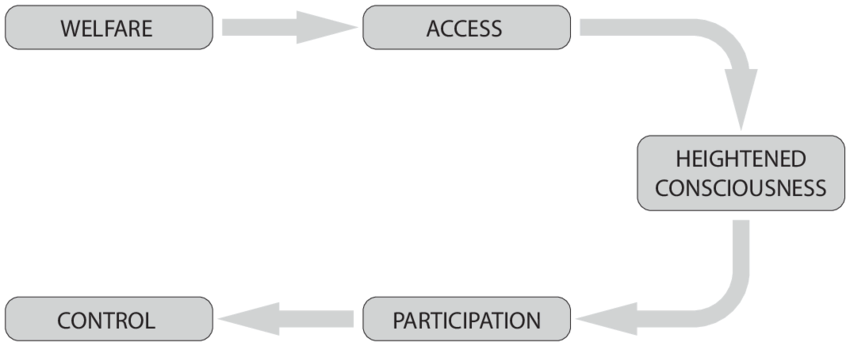
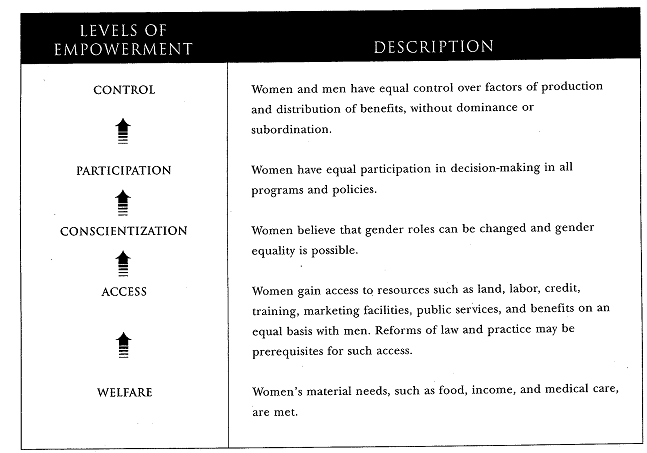
Longwe’s Women Empowerment Tool
Longwe asserts that it is not only important to assess the levels of women’s empowerment which a development intervention seeks to address. It is also important to identify the extent to which the project objectives are concerned with women’s development, to establish whether women’s issues are ignored or recognised. Longwe uses a very specific definition of ‘women’s issues’, meaning all issues concerned with women’s equality in any social or economic role, and involving any of the levels of equality (welfare, access, conscientization, participation, control). In other words, an issue becomes a ‘women’s issue’ when it looks at the relationship between men and women, rather than simply at women’s traditional and subordinate sex-stereotyped gender roles.
The Longwe Framework does not specify whether development interventions should target women-only, men-only, or mixed groups. Women’s empowerment must be the concern of both women and men, and the degree to which the project is defined as potentially empowering women is defined by the extent to which it addresses women’s issues.
Longwe identifies three different levels of recognition of women’s issues in project design:
Negative level: At this level, the project objectives make no mention of women’s issues. Experience has shown that women are very likely to be left worse off by such a project.
Neutral level: This is also known as the conservative level. Project objectives recognise women’s issues, but concerns remain that the project intervention does not leave women worse off than before.
Positive level: At this level, the project objectives are positively concerned with women’s issues, and with improving the position of women relative to men.
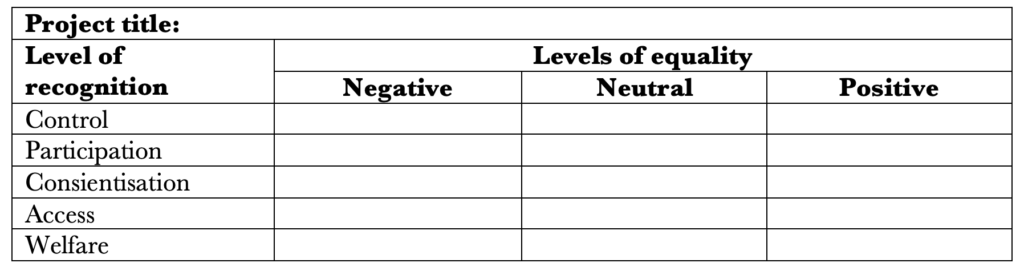
Cite as: Longwe, H. S. (1995). Women’s Empowerment Tool. Lusaka, Zambia.
Longwe’s Empowerment Framework
The framework applies to development work, social work, community work, welfare work and gender work. It is used globally. It was primarily developed as a pool to promote empowering work for women and to evaluate such work.
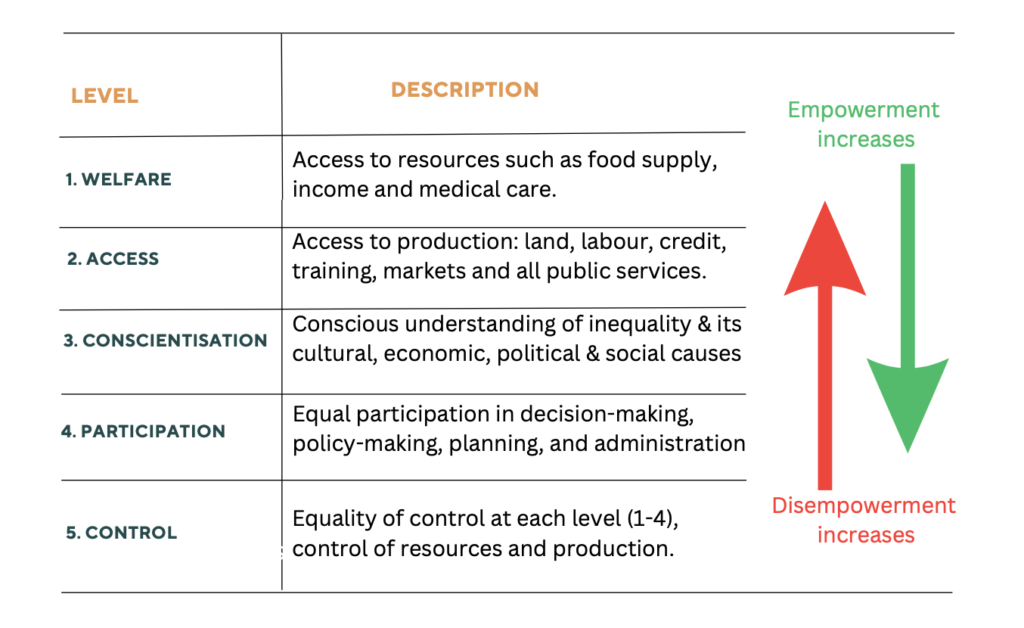
Cite as: Longwe, S., & Clarke, R. (2024). The process of women’s empowerment. Gadsden Publishers.
African Feminism
African feminism is a feminist epistemology that validates the experiences of women of Africa against the Western feminist discourse. African feminism addresses the guides multiple issues faced by Black women and focuses on providing justice. Goredema argues that there is:
… a discernible difference between women who were colonised and those who were deemed the colonisers, and a social movement that aims to raise a global consciousness which sympathises with African women’s histories, present realities and future expectations.
Goredema, 2010: 34
For westerners, experiences of fighting in the liberation wars ans struggles against colonial oppression and dispossesion are not common but for Afriocan women they are. Wesyern feminist is devid of all these experiences that are important to Black women.
Goredema, R. (2010) African feminism: the African woman’s struggle for identity, African Yearbook of Rhetoric, 1(1): 33–4.
Green Belt Movement (GBM) Model
The GBM is one of the most effective and empowering indigenous grassroots organizations globally. It was started by Wangarĩ Muta Maathai in Kenya in 1977. Their mission is to mobilize community consciousness for self-determination, justice, equity, reduction of poverty, and environmental conservation, using trees as the entry point.
Their model, as derived from their five principal areas of work or core programs and four areas of activity, is as follows:
- Pan African identity (training workshops, protection of culture and economy)
- Civic education and advocacy (human rights, land rights, environmental justice)
- Environment/natural resources and ecosystems (education, conservation, protection, restoration e.g. tree planting and maximum use e.g. water harvesting and eco-tourism e.g. Green Belt Safaris (GBS)
- Gender and development (improving livelihoods and advocacy)
Tesfaye’s Developmental Social Work Curricula
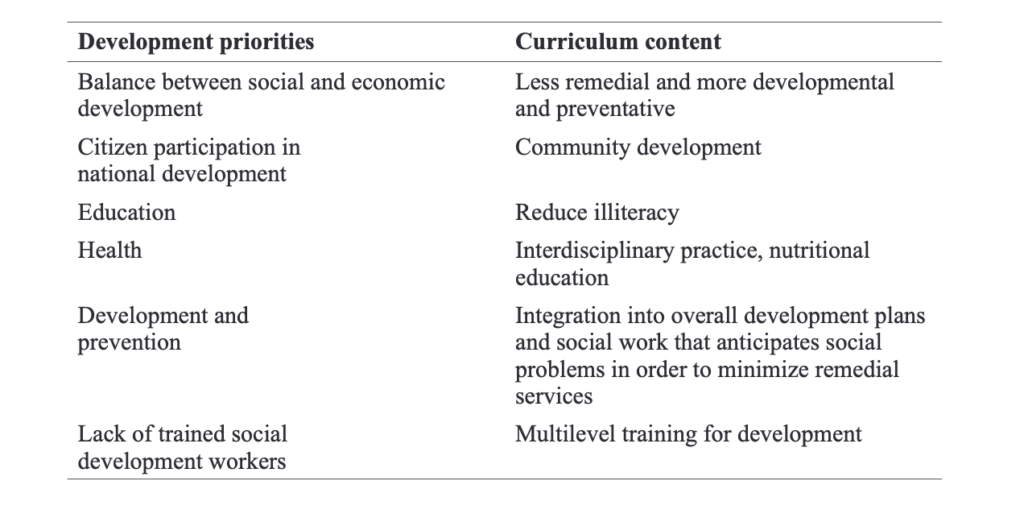
Diagram from Kreitzer (2013).
Ajayi’s model of decolonising higher education
- Educate people to uphold and respect traditional systems instead of training elites to uphold colonial administrations and in return exploiting their own people;
- Deliver African-centred curricula that address the needs of the country instead of keeping European curricula that don’t address the needs of the developing country;
- Reduce the hierarchy of the university structures and manage- ment instead of keeping university structures and management as replicas of European universities;
- Provide education for all Africans instead of just the elites.
Ajayi, J. E. A., Lameck, K. H., Goma, G., & Ampah, J. (1996). The African Experience with Higher Education. Accra: Association of African Universities.
Tree of life model by Ncazelo Ncube
Ncabelo Ncube-Mlilo worked with children at Masiye Camp in Zimbabwe during the peak period of HIV/AIDS. It was a period of grief and orphanhood due to deaths resulting from HIV/AIDS. Ncube developed the tree of life idea to ensure that children tell their stories in a culturally appropriate manner and in a way that does not put grief at the centre. To tell their stories, the children drew trees and label the trees to show their relations, good things and bad things in their life. The tree is metaphorical, it is beatiful, strong, green but it also faces storms and there are bugs that give the tree some problems. The points below were copied verbatim from Ncube, N. 2006. The Tree of Life Project. Using narrative ideas in work with vulnerable children in Southern Africa. The International Journal of Narrative Therapy and Community Work 2006 No. 1, 3-16.
- Roots: Children were invited to think about and write on their Tree of Life significant figures from their ancestry, origins and family history.
- Trunk: The trunk of the tree was a prompt for children to draw representations of significant events that had shaped their lives: these were either positive events or events that could be regarded as difficult or that evoked a painful memory.
- Leaves: The leaves of the tree represented important people or significant relationships in an individual’s life. At Masiye Camp we introduced the metaphor of fallen leaves to represent important people that had been lost to the child (e.g. parents who had died).
- Branches: The branches of the tree were a prompt to elicit the child’s thoughts, ideas and wishes about the direction which he/she would like go in life.
- Fruits: The fruits stood for the achievements that the child had accomplished in his or her life; the things that he/she was proud of.
- Bugs: The bugs of the tree, which would sometimes eat parts of the fruit and destroy the leaves, were designed to represent the problems and challenges that children were facing in their day-to-day lives.
Other parts to that could accompany the tree of life are the ground, the forest, the environment, the tree as a shelter or shade and storms. These could be defined as the participants or trainer desire.
The advantages of the model are:
- Children participate and get engaged more
- Creates richer descriptions of life
- Inclusive, allows all to contribute
- Culturally relevant, for example, recognises ancestry, African spirituality etc
- It is a creative activity
- Educates the professionals
- Children educates each other
- A safer way for children to talk about or express difficulties
The metaphor of the tree can be used with all age groups and with all sorts of social problems. It has been used globally.
Discussion with Tree of Life pioneer Ncazelo Ncube-Mlilo
Ncabelo said the psychology degree she received at university was not helpful when dealing with children and often resulted in poor interventions and outcomes. Even with a degree, she found her self not competent and skilled to respond to psychosocial issues the children presented. The texbooks and lectures did not prepare her t be useful as a professional in her own society. This motivated the Tree of Life intervention and it has been successful.Aspects of Tree of Life that derive from Ubuntu
- Culture
- Relations
- Metaphor
- Ancestry
- family
- Stories
- Orality
- Trees
- Collectity
Shaka Zulu Theory of Leadership and Management
A leader, military strategist, tactician and innovator, Shaka kaSenzangakhona (King Shaka Zulu) is regarded as one of the best military leaders on earth. Shaka was born in 1787 but died in 1828. His father was Senzangakhona and his mother was Nandi. Nandi was considered an illegitimate wife. His brothers from other mothers were Dingane and Mpande. Although his short rule resulted in numerous death, as was the case during the time in all parts of the world, his legacy in management has been monumental. His life objective was to expand the territory of the Zulu people, and transform the Zulu chiefdom into a kingdom that was dominant in the bottom of Africa through unification of other kingdoms through consensus and where this fails through force, including war. Such neighbouring kingdoms included the Ndwandwe clan of Chief Zwide KaLanga and the Mthethwa clan of Chief Dingiswayo Kajobe. His model of leadership was:
- Personal traits
a. He was very strict and sought obedience
b. He valued mentoring, he himself received mentoring from Dingiswayo,
c. He valued women and gave them training and roles in the army
d. He was secretive - Strategies and techniques
a. Impi strategy – he organised his amabutho (army) into impi or groups or regiments
b. Better weapons – created s shorter spear, the assegai and redesigned the shield to be larger and stronger
c. Impi-ebomvu – total war leading to complete defeat and incorporation (he believed an enemy should be totally defeated or absorbed)
d. Impondo zankomo – meaning bullhorn method was his main technique of circling the enemy
e. His other main technique was close range, direct combat
f. Intelligence gathering
g. He valued training, and it was very tough
h. Speed was valued
i. Reorganisation of the army e.g. bringing in young, retiring old members
j. Introduced color-coding to make it easy to recognise the regiments – shields and clothes colours
k. Introduced merit-based promotion
l. Sharing of loot among fighters and communities
m. Promoted nationhood, beyond clans
n. Review and continuous improvement of tactics – defeated in battle, Dingiswayo’s army adopted Zulu tactics but then Shaka introduced new tactics of depriving them of food (grain and cattle) and surprise attack - Contingencies
a. Unuva – he always had a reserve regiment (unuva or loins) during a fight, made up of older members. They were asked to look back, and not look at those fighting
b. Woman regiment necessary especially for re-location of the people should need be
c. Having a large army
d. The community was a source of supplies
He combined his personal traits and management style to come up with a formidable military force that grew his clan’s land into the largest in the bottom of Africa with the largest military force. He defeated many in battle, even when he was outnumbered. He was assassinated by Dingane with the help of the Europeans, who then became King, and was succeeded by Cetshwayo whose bloodline has the current Zulu Kingship. Dingane used Shaka’s strategies and defeated Europeans in battle at Isandlwana hill. The British army had 5000 troops, 1500 cattle and 400 African sell-outs (or forced) to fight on their side. In less than two hours, 2000 enemies were killed, at the end the British were defeated.
Integrated Musha/Nyumba Theory
Musha means homestead Shona langauge and nyumba in Swahili. Musha is the permanent home for Africans and it is in the village. Musha is the first and smallest geographical unit of Afrocan society. It is a place to live, enjoy culture and a rest place for deceased ones.
This socio-economic development theory promotes nyumba as a place for farming activities throughout the whole year while incorporating science and technology to make musha an economic enterprise that generates income for each family to sustain its livelihood and benefiting the community and the nation.
The theory combines culture, community, technology and enterprise. An integral musha/nyumba promotes household trade to enhance family livelihoods and helps in creating an active and vibrant village and regional economy (Taranhike, 2021)’.
Characteristics of an integrated musha/nyumba are:
- It maintains the communal way of life – doesn’t disrupt the African cultural social fabric because people do not move out of their community in search of employment
- Promotes family unity and community cohesion – people earn a living while they are in their family homestead setting which is grounded in nature
- People live in harmony with nature – harvesting sunshine to produce solar energy, and harvesting both rainwater and underground water in order to ensure that farming is carried out throughout the whole year using drip irrigation, keeping bees for honey and pollination, soil conservation,
- Growing traditional crops that are drought resistant
- Growing high value crops such as garlic, ginger, turmeric, etc, thereby even enabling the rural folk to earn foreign currency as these crops can be exported
- Rural tourism – draws on African values of hospitality and respect
- Reversing colonisation and urbanisation – making African rural communities proud of who they are, their culture and their history.
- Combines indigenous and exogenous knowledges
- Processing and value addition – instead of selling raw produce
‘As a whole, the Integral Kumusha provides a holistic and integrated approach in rural development and enhancing livelihoods, starting with the traditional homestead within the community, living in harmony with nature while promoting our culture and improving knowledge co-creation through science and technology and using the Integral Kumusha as an enterprise to generate income for the home, the community and the nation at large’, (Taranhike, 2021).
Taranhike, D. S. (2021). Integral Kumusha: A Case of Buhera – Towards Self-Sufficiency in Zimbabwe via Nhakanomics. PhD Thesis. Da Vinci University and TRANS4M Academy for Integral Transformation
Disadvantage Expectations Theory (Tarajio Hasara)
At work, in the family, in the community e.g. in class or village and in society, some people are advantaged, creating an expectation of disadvantage for others. That expectation of disadvantage, or tarajio hasara, can be measured by a simple scale of 0-1 with 0.0 referring to expectation of advantage while 0.1 is expectation of the least disadvantage. 1.0 is the highest expectation of disadvantage. A question to measure disadvantage could be:
On a scale of 0-1, what is your expectation of disadvantage?
A scale of 0-10 or 0-100 can be used, then reduced to 0-1.
Mitumba Theory
Mitumba means second hand and was initially used to refer to second hand clothing that was coming from Europe to Africa but also second hand vehicles, gadgets, equipment and books. The theory of mitumba came from this everyday use of the concept. Mitumba theory refers to second hand knowledge (philosophies, ethics, values, ideas, beliefs, culture, language, language accent, spirituality, religion, theories and literature), much of it coming from the West but also the East and Middle-East. Mitumba is an extension of aid and charity. The major challenge with mitumba is that it stifles local production, makes people dependent. Many people have contributed to this theory, notable being Ngugi wa Thiongo. Wa Thiongo refers to it as mitumba culture and classifies it as neocolonialism but also goes further to say we Africans are responsible for it, ‘we have exchanged made in Africa for used in Europe.’
Adede, D. (2016). Mitumba: The second-hand economy in Africa. Journal of African Business, 17(2), 155-171.
Mazrui, A. A. (2001). The politics of cultural identity in Africa. Journal of African Studies, 30(1), 1-15.
Ngugi wa Thiongo (1986). Decolonising the mind: The politics of language in African literature. Heinemann.
Theory of Zunde Ramambo
Zunde Ramambo, a traditional Shona practice of storing grain for the community, embodies a rich cultural, social, and spiritual significance. The Theory of Zunde Ramambo posits that this practice represents a complex system of reciprocity, resilience, and community building.
Key Components:
- Ubuntu (just and connected humanity (family, community and society), environemnt and spirituality, the philosophy comes from from Black people of Africa): Zunde Ramambo represents a reciprocal relationship between the community and the land, where the community gives back to the land through offerings and respect, and the land provides for the community’s needs.
- Ushingi (Resilience, from Shona): The practice of storing grain for times of scarcity demonstrates the community’s ability to adapt and respond to environmental and social challenges.
- Ukama/Ujamaa (Family/Community/Familyhood, from Shona/Swahili): Zunde Ramambo fosters a sense of community and belonging, as individuals contribute to and benefit from the collective storage and management of grain, representing a communal approach to resource management.
- Kiroho (Spiritual Significance, from Swahili): The grain stored in Zunde Ramambo is believed to hold spiritual significance, representing the community’s connection to the divine and the ancestors.
- Nguva (Cyclical Time, from Shona): Zunde Ramambo operates on a cyclical understanding of time, where the past, present, and future are interconnected, and the community’s actions are informed by this understanding.
- Sankofa (Looking back to move forward, from Akan): The community’s ability to learn from the past and adapt to changing circumstances is embodied in the practice of Zunde Ramambo.
- Izithakazelo (Respect and gratitude, from Zulu): The practice of Zunde Ramambo is characterized by respect and gratitude for the land, the ancestors, and the community.
Implications:
- Community-led Development: The Theory of Zunde Ramambo highlights the importance of community-led initiatives and self-determination in development projects.
- Environmental Stewardship: The reciprocal relationship between the community and the land emphasized in Zunde Ramambo promotes a stewardship approach to environmental management.
- Cultural Preservation: The theory underscores the significance of preserving cultural heritage and traditional practices, such as Zunde Ramambo, for future generations.
- Food Sovereignty: Zunde Ramambo represents a model for community-led food systems, challenging external control and promoting local self-determination.
- Community Empowerment: The Theory of Zunde Ramambo empowers communities to take ownership of their development and resource management.
- Ringson, J. (2017). Zunde raMambo as a traditional coping mechanism for the care of orphans and vulnerable children: Evidence from Gutu District Zimbabwe. African Journal of Social Work, 7(2), 52–59.
- Muyambo, T., & Marashe, J. (2020). Indigenous knowledge systems and sustainable development: The case of Zunde Ramambo (Isiphala Senkosi) as food security in Chipinge, Zimbabwe. INDILINGA—African Journal of Indigenous Knowledge Systems, 19(2), 232–244.
- Masitera, E. (2023). The Shona People’s ‘Zunde raMambo’ (King’s Granary) as a model for social responsibility: A task for higher education systems. In M. J. Tosam & E. Masitera (Eds.), African Agrarian Philosophy (pp. 1–17). Springer.
- Chitengu, T. (2018). Zunde raMambo: A traditional social welfare system in Zimbabwe. Journal of Social Development in Africa, 33(1), 53–66.
- Muparutsa, T. (2016). Zunde raMambo as a community-based coping mechanism for drought in Zimbabwe. Journal of Environmental Science and Health, Part C, 34, 53–61.
Batho Pele Principles
South African Department of Public Service and Administration (DPSA). (1997). White Paper on Transforming Public Service Delivery (Batho Pele White Paper). Pretoria: Government Printer. Retrieved from https://www.dpsa.gov.za
Cite as South African Government (2025). Batho Pele. https://www.dsd.gov.za/index.php/about/batho-pele
Batho means people and pele means first. The 8 Batho Pele principles were put in place by the South African Government for the transformation of public service delivery. While the principles were created for government service providers, they are applicable in the commercial, private, voluntary non-government and all other sectors in Africa and globally. The 8 are:
- Consultation
- Service Standards
- Courtesy
- Access
- Information
- Openness and Transparency
- Dealing with complaints
- Giving Best Value
| # | Principle | Description |
| 1 | Consultation | Citizens should be consulted about the quality of public services and how they can be improved. |
| 2 | Service Standards | Clear service standards must be established so that the public knows what to expect. |
| 3 | Access | Services should be available and accessible to all, particularly those in rural or disadvantaged areas. |
| 4 | Courtesy | Public servants should treat people with dignity and respect. |
| 5 | Information | Citizens must receive full, accurate, and timely information about services and their rights. |
| 6 | Openness and Transparency | Government departments should be open about how they operate and how decisions are made. |
| 7 | Redress | There should be mechanisms in place to address grievances and rectify mistakes. |
| 8 | Value for Money | Public resources must be used efficiently to deliver quality services at the lowest cost. |
Africa Solarpunk Model
by OKOROAFOR Christabel Ebubechukwu, Bachelor of Science student, Social Work Department, University of Nigeria
Thesis of the model
This model proposes solarpunk as an optimistic, practical framework for sustainable development in Africa. It argues that by combining renewable technology with traditional African values of community and environmental stewardship, the continent can address climate change while creating equitable societies. The approach rejects dystopian narratives, instead offering tangible solutions rooted in African philosophy (Ubuntu) and values such as omoluabi (a full person) and sankofa (learning from the past to build the future).
Actionable strategies
- Renewable energy transition: Prioritising solar, wind and hydropower to provide clean, affordable energy for urban and rural communities
- Sustainable food systems: Implementing permaculture and urban farming to combat food insecurity
- Eco-conscious infrastructure: Developing green architecture and water management systems adapted to local needs
- Community empowerment: Supporting grassroots initiatives like ecovillages and cooperative renewable energy projects
Other important issues
- Policy integration: Governments must create supportive frameworks through renewable energy incentives and sustainable urban planning
- Cultural relevance: Solutions must incorporate indigenous knowledge and local contexts
- Social equity: Ensuring marginalised groups benefit from green transitions
- Education: Building environmental awareness through community programmes and school curricula
With this solarpunk model, Africa can pioneer an alternative development path – one that harmonises modern technology with ecological balance and social justice. The approach recognises that environmental sustainability cannot be achieved without addressing systemic inequalities and valuing African wisdom.
From: Okoroafor C E (2024). Creating a sustainable future for the African child: a solarpunk concept. People centred –The Journal of Development Administration (JDA), 9(2),45-57. https://dx.doi.org/10.4314/jda.v9i2.2
Restorative learning decolonised curriculum
The restorative learning model supported by these researchers from South Africa originates from Ndlovu-Gatsheni who said “You need to unlearn that one geographical space in the world cannot be teacher of the world. And then relearn that all human beings are born to valid and legitimate
knowledge.” Key elements of the restorative learning model are:
- Decolonising curricula, i.e. learning outcomes (why we teach), pedagogy, content and assessments.
- Decolonising pedagogy, i.e. transforming how we teach.
- Decolonising content, i.e. what we teach
- Decolonising teachers through unlearning and relearning
- Decolonising assessments, i.e., how we evaluate learning
- Using decolonised languages
- Using decolonised philosophy
- Using African history
- Developing decolonised policies
- Decolonising graduations, i.e. graduation attire, process, songs etc
- Decolonising literature i.e. books, biographies, encyclopedia, dictionaries, research, media etc
- Decolonising the learning environment e.g. infrastructure, statues, names of buildings etc
Readings
Omanga, D. (2020). Decolonization, decoloniality, and the future of African studies: A
conversation with Dr. Sabelo Ndlovu-Gatsheni. https://items.ssrc.org/from-ourprograms/decolonization-decoloniality-and-the-future-of-african-studies-aconversation-with-dr-sabelo-ndlovu-gatsheni/
Simmonds S and Ajani OA (2022). Restorative learning for fostering a decolonised curriculum attuned to sustainable teacher education. Journal of Education (Durban), 88, 145-158. https://doi.org/10.17159/2520-9868/i88a09
Models to calculate decolonisation
Model decolonisation calculator for tertiary education institutions
Instructions: There are 10 questions. Read the question. Select an answer (score) between 0 and 10. Add the scores. Use the scale to understand your result. The calculator can be used by individuals or groups. If used by individuals, comparison is recommended. This calculator can be used in any former colonised region or country of the world. Where used, ‘locally’ or ‘local’ refers to the country or region, as long as the country or region was colonised. The calculator primarily designed for African tertiary institutions including universities, colleges and institutes for use by Chancellors, Presidents, Principals, Senators, Advisors, Deans but also Principals, Directors, Administrators, Librarians, Academics, Students and Alumni.
- Literature – out of every 10 books you have in your libraries (includes online library), how many are written and published locally? Locally means your country and continent.
- Staff – out every 10 staff you have, how many are local?
- Philosophy – out of every 10 students, how many use local philosophy. For example, in the philsosophy is Ubuntu.
- Theories – out of 10 theories used by your staff and students, how many are local or developed locally?
- Journals – out of 10 journals that your university (or government) has accredited, how many are published in Africa?
- Research – out of every 10 research done by staff and students, how many use local research methods?
- Research funding – out of every 10 funded research done by staff and students, how many is funded locally or in Africa?CPD programs in your country, how many have decolonial objectives and outcomes?
- Indigenous – on a scale of 0 – 10, how would you rate the indigenous nature of education in your country? This includes using local languages, orature and involving the community.
- Suited to African problems – on a scale of 0-10, how would you rate suitability of your education to addressing local problems?
- Future – when you think about the future of the education taht your institution provides, how likely is it to be decolonial?
Scale: 0-49 = Colonial; 50-74 Transitioning to Decolonial; 75 = Decolonial; 90 = Indigenous
Model decolonisation calculator for social work and development educational institutions
Instructions: There are 10 questions. Read the question. Select an answer between 0 and 10. Click Calculate to get a result. Click Reset to restart. Use scale to understand your result. The calculator takes 5 minutes to finish. The calculator can be used by individuals or groups. If used by individuals, comparison is recommended. This calculator can be used in any former colonised region or country of the world. Where used, ‘locally’ or ‘local’ refers to the country or region, as long as the country or region was colonised. The calculator primarily refers to social work education institutions so it is suitable for use by Principals, Directors, Administrators, Librarians, Academics, Students and Alumni but can also be used by Deans and Vice-Chancellors.
- Literature – out of every 10 books you have in your libraries (includes online library), how many are written and published locally? Locally means your country and continent.
- Staff – out every 10 staff you have, how many are local?
- Philosophy – out of every 10 students, how many use local philosophy. For example, in the philsosophy is Ubuntu.
- Theories – out of 10 theories used by your staff and students, how many are local or developed locally?
- Fieldwork – out of 10 fieldwork placements, how many are developmental (focused on preventing poverty, building income and production)?
- Research – out of every 10 research done by staff and students, how many use local research methods?
- Continous Professional Development (CPD) – out of every 10 CPD programs in your country, how many have decolonial objectives and outcomes?
- Indigenous – on a scale of 0 – 10, how would you rate the indigenous nature of social work and development in your country? This includes using local languages, orature and involving the community.
- Developmental – on a scale of 0-10, how would you rate the developmental nature of social work and development in your country?
- Future – when you think about the future of social work and development training and practice in the next 10 years, how likely is it to be decolonial, developmental and indigenous?
Scale: 0-49 = Colonial; 50-74 Transitioning to Decolonial; 75 = Decolonial; 90 = Indigenous
Theory of the colonial library
Valentin-Yves Mudimbe, the distinguished Congolese philosopher, philologist, and theorist of decolonial thought.
- The colonial library as imposed knowledge
The colonial library refers to the body of knowledge systems—religious, academic, bureaucratic, and popular—that emerged during colonialism and continue to define Africa through foreign categories. It contains religious texts such as the Bible and Qur’an, anthropological and missionary writings, colonial diaries and reports, administrative documents, academic journals and textbooks, and entire education systems. Through this library, Africa has been falsely defined as philosophyless, religionless, scienceless, languageless, cultureless, libraryless, worth enslaving, and ripe for colonising. These assumptions were not only imposed by the West but have also been absorbed and perpetuated by Eastern and Middle Eastern powers.
- Epistemic violence and distorted frameworks
The way Africa is understood from outside is largely wrong because it is viewed through the colonist’s lens. This is a form of epistemic violence: Africa’s knowledge is seen as beneath or outside other knowledges. Mudimbe argued that to decolonise knowledge and improve Africa’s lived realities—including poverty reduction, dignity, and sovereignty—we must first deconstruct this colonial library. This means dismantling it physically (in institutions and curricula) and metaphorically, as it exists in the minds of Africans, Europeans, Asians, and Arabs alike.
- Decolonisation, intellectual autonomy and creative reconstruction
Africa needs intellectual autonomy and must reevaluate how it is known. It must begin to share its true philosophy and knowledge systems with the world. Mudimbe warned that colonial frameworks must not be maintained or reproduced, yet today’s tools—including artificial intelligence—are actively reproducing them. We have to be vigilant, not complacent, Mudimbe insisted. We must creatively deconstruct, not reproduce. This process of creative reconstruction involves developing new frameworks that centre African epistemologies while critically engaging with global knowledge systems on more equitable terms.
- Mudimbe, V.-Y. (1988). The invention of Africa: Gnosis, philosophy, and the order of knowledge. Indiana University Press.
- Mudimbe, V.-Y. (1994). The idea of Africa. Indiana University Press.
- Mudimbe, V.-Y. (1991). Parables and fables: Exegesis, textuality, and politics in Central Africa. University of Wisconsin Press.
- Mudimbe, V.-Y. (1997). Tales of faith: Religion as political performance in Central Africa. University of London, Athlone Press.
Nego-feminism
Nego-feminism is a culturally grounded African feminist theory that prioritises negotiation, compromise, and communal harmony over individualistic confrontation. Developed by Dr. Obioma Nnaemeka, it functions as both a “feminism of negotiation” and a “no-ego feminism,” focusing on the strategic art of “giving and taking” to achieve gender equity without fracturing the essential social bonds of family and community. By working within or around existing cultural structures rather than seeking their immediate destruction, it provides a pragmatic framework for social functioning, liberation, and shared development.
Core principles
- Negotiation as a tool for change: Using dialogue and strategic middle ground to improve the status of women while maintaining community cohesion.
- Communal interdependence: Recognizing that the progress of women is inextricably linked to the well-being and prosperity of the entire community, including men.
- No-ego approach: Setting aside personal or individualistic pride to focus on collective goals and sustainable social outcomes.
- Pruning of patriarchy: Strategically navigating traditional power structures to remove harmful practices while preserving positive cultural values.
- Indigenous knowledge integration: Centring African mental models and family-based spirituality in the pursuit of social work and development.
Steve Biko’s Black Consciousness Theory
Stephen ‘Steve’ Biko’s Black Consciousness Theory, developed in South Africa during the 1960s and 1970s, is a philosophy of psychological and political liberation centred on the premise that true freedom for Black people must begin with the liberation of the mind. Biko argued that colonialism and apartheid had psychologically conditioned Black people to internalise inferiority and dependency, making the oppressed complicit in their own oppression. Black Consciousness called on Black people to reject white-defined identities, reclaim pride in African heritage, and develop collective consciousness rooted in self-determination, ultimately envisioning a humanist society built on the full liberation of all people.
Key arguments:
- Psychological oppression is as damaging as physical oppression and must be consciously dismantled
- Black people must redefine themselves on their own terms, rejecting imposed identities
- Black solidarity across ethnic subgroups is essential for collective liberation
- White liberals cannot lead Black liberation as they operate from positions of privilege
- African culture and identity are inherently valuable and their reclamation is a political act
- Community self-reliance and Black-led institutions are fundamental to genuine empowerment
Strengths: Stephen ‘Steve’ Biko’s theory is widely regarded as a powerful and enduring framework for understanding liberation, offering a unique focus on psychological empowerment that has profoundly influenced anti-oppressive social work practice, community development, and postcolonial thought across Africa and globally.
Shortcomings: Black Consciousness Theory has been criticised for potentially reinforcing racial essentialism by defining identity primarily through race, and its rejection of white liberal alliance has been seen as strategically limiting, narrowing the broader coalition needed for systemic change.
Credo Mutwa’s theoretical framework
Mutwa’s theoretical framework has 3 theories which are the balance of the two minds, experiential storytelling and living museums, and intuitive revelation. Vusamazulu Credo Mutwa (1921–2020) was a prominent South African sangoma, author, and artist who sought to document and preserve African indigenous knowledge (Edwards, 2015; Hlongwane & Weber, 2021; Podolecka, 2023). Born in Zululand, he transitioned from being an English-trained Christian teacher to a shamanic practitioner after receiving a calling from his grandfather (Mutwa, 2003). He became a “keeper of folklore” and a spiritual leader renowned for his prophecies and cultural installations (Hlongwane & Weber, 2021; Mutwa, 2003).
The balance of the two minds
The general theory posits that the human psyche consists of two distinct mentalities: the mother mind, representing feminine energy, and the warrior mind, representing masculine energy (Global Oneness Project, 2008; Rapitsenyane, 2023). Mutwa argues that human health and environmental survival depend on balancing these two internal forces (Rapitsenyane, 2023). The theory assumes that every human, regardless of gender, possesses both minds (Rapitsenyane, 2023). It further assumes that the ego is a “deformed” byproduct of an imbalanced warrior mind and that this psychic disharmony is the primary driver of the modern climate crisis (Rapitsenyane, 2023).
Key points
- Dual psyche consisting of the mother mind and the warrior mind (Rapitsenyane, 2023).
- Linear versus web thinking (Global Oneness Project, 2008; Rapitsenyane, 2023).
- Ego as a conquering mind arising from psychic imbalance (Rapitsenyane, 2023).
- Subjectivity of nature where all entities are viewed as living subjects (Global Oneness Project, 2008).
- Ecological salvation achieved through the awakening of the mother mind (Rapitsenyane, 2023).
The warrior mind is logical and strategic, operating in a linear “2+2 is 4” fashion (Global Oneness Project, 2008). In contrast, the mother mind is intuitive and considerate, thinking “sideways, upwards, and downwards” (Global Oneness Project, 2008). Mutwa suggests that modern society has over-activated the warrior mind, leading to an ego-driven desire to conquer and objectify nature (Rapitsenyane, 2023). The theory provides a holistic framework connecting individual psychology to global ecological health and emphasizes cultural concepts like ubuntu and ukama (Edwards, 2015; Horsthemke, 2015). Critics characterize his ideas as superstition or fertile imagination lacking scientific evidence (Horsthemke, 2015). Additionally, his cultural villages were sometimes viewed as aligning with the tribalist rhetoric of the apartheid era (Hlongwane & Weber, 2021).
Pedagogical theory
Mutwa’s pedagogical theory emphasizes the preservation of indigenous wisdom through experiential learning, oral storytelling, and the creation of “living museums” (Hlongwane & Weber, 2021; Mutwa, 2003). He views education as a spiritual initiation rather than academic instruction (Mutwa, 2003). The theory assumes that ancestral wisdom is encoded in folklore and myths which must be preserved through active practice (Mutwa, 2003). It also assumes that the natural world is a living classroom where plants and stones are “growing people” capable of instruction (Mutwa, 2003).
Key points
- Storytelling as a form of spiritual initiation (Mutwa, 2003).
- Living museums as open-air classrooms for African culture (Hlongwane & Weber, 2021).
- Experiential learning through direct dialogue with nature (Mutwa, 2003).
- Artistic transmission using sculpture, painting, and plays like uNosilimela (Mutwa, 2003; Podolecka, 2023).
- Inner self connection attained by quieting the mind to receive divine energy (Mutwa, 2003).
Mutwa established living museums like Kwa-Khaya Lendaba to serve as physical sites for preserving “African culture” (Hlongwane & Weber, 2021). His pedagogy involves teaching students to “talk to” and “thank” trees, treating nature as a person rather than an object (Mutwa, 2003). This approach challenges colonial “scientific racism” by centering indigenous identity (Mutwa, 2003; Rapitsenyane, 2023). It offers a culturally relevant educational model that effectively preserves oral history and fosters a deep connection to ancestral roots (Edwards, 2015). Some aspects of his teaching, such as using a “slap” to demand a student’s attention, are seen as outdated or confrontational (Mutwa, 2003). Scholars also debate whether his narratives represent authentic Zulu tradition or his own inventions (Podolecka, 2023).
Epistemological theory
This theory argues that true knowledge is accessed through intuition, ancestral communication, and a collective spiritual reservoir (Edwards, 2015; Mutwa, 2003). Mutwa prioritizes “felt” truths and inspiration over strictly rationalist logic (Global Oneness Project, 2008; Mutwa, 2003). The theory assumes that a divine essence exists within all objects and that knowledge is revealed through spiritual tuning (Mutwa, 2003). It posits that ancestors act as guardians and conduits of universal truths (Edwards, 2015; Mutwa, 2003).
Key points
- The hidden lake as a vast reservoir of universal knowledge (Mutwa, 2003).
- Umbilini as the “hot coiled snake” energy used to access psychic power (Edwards, 2015; Mutwa, 2003).
- Animistic knowing where stones and trees share dormant future knowledge (Global Oneness Project, 2008; Mutwa, 2003).
- Ancestral consciousness providing guidance through dreams and visions (Edwards, 2015; Mutwa, 2003).
- Mother mind epistemology that perceives reality as an integrated whole (Global Oneness Project, 2008; Horsthemke, 2015).
Knowledge is retrieved from the “hidden lake” by summoning “umbilini” energy through deep meditation and drumming (Edwards, 2015; Mutwa, 2003). This allows the “mother mind” to engage in “web thinking,” perceiving the interconnectedness of all life—minerals, plants, and humans—rather than viewing the world as “shattered fragments” (Global Oneness Project, 2008; Horsthemke, 2015). The theory provides a powerful alternative to Western anthropocentrism, promoting a profound sense of “oneness” and interconnectedness with the cosmos (Edwards, 2015; Horsthemke, 2015). The theory relies heavily on subjective experiences that cannot be empirically verified (Horsthemke, 2015). Furthermore, Mutwa’s claims regarding “Chitauri aliens” altering human communication are viewed by many as conspiratorial or purely mythological (Podolecka, 2023).
References
Edwards, S. (2015). Some Southern African views on interconnectedness with special reference to indigenous knowledge. Indilinga: African Journal of Indigenous Knowledge Systems, 14(2), 272-283.
Global Oneness Project. (2008). Credo Mutwa: The mother mind. [Video]. YouTube. https://www.youtube.com/watch?v=Vv3R6hddPfI.
Hlongwane, A. K., & Weber, T. (2021). Re-historicising Credo Mutwa’s Kwa Khaya Lendaba cultural village in Soweto. In H. Judin (Ed.), Falling monuments, reluctant ruins: The persistence of the past in the architecture of apartheid (pp. 212-233). Wits University Press.
Horsthemke, K. (2015). Animals and African ethics. Palgrave MacMillan.
Mutwa, V. C. (1969). My people, my Africa. John Day Co.
Mutwa, V. C. (1996). Isilwane: The animal. Struik.
Mutwa, V. C. (2003). Zulu shaman: Dreams, prophecies, and mysteries. Destiny Books.
Podolecka, A. (2023). History of the Bantu peoples by Credo Mutwa–Zulu tradition or Mutwa’s invention? Rocznik Orientalistyczny, 2023(2), 120-138.
Rapitsenyane, D. B. (2023). “Awakening the mother mind”: Exploring the relationship between ego and the climate crisis. HTS Teologiese Studies/Theological Studies, 79(3), a8065. https://doi.org/10.4102/hts.v79i3.8065.
Rooted Tree Development Theory (Kugarika)
Rooted Tree Development Theory or kugarika, developed by VG Chivaura, conceptualises development as rooted growth rather than movement or imitation. Like a tree, societies develop by deepening their roots in their own land, history, culture, Indigenous knowledge and worldview while growing their social and technical capabilities. Development is therefore a process of self-determined growth that strengthens the foundations of society while extending its capacity to generate collective wellbeing.
Propositions
- Philosophical and epistemological foundation: Development must be grounded in African Indigenous worldviews, Ubuntu philosophy and knowledge systems, which provide the basis for understanding humanity, wellbeing, society, nature and development itself.
- Rootedness and self-determination: Sustainable development emerges from people’s own histories, cultures, knowledge, resources and capabilities, enabling them to define and direct their futures.
- Growth and transformation: Development is continuous growth from and through one’s roots, not a linear movement towards externally defined models of progress.
- Two-dimensional development: Development requires the mutually reinforcing advancement of social and technical dimensions.
- Collective flourishing: Development should deepen social, cultural and material capabilities while producing human dignity, justice, reciprocity, sustainability and intergenerational wellbeing.
Principles
Rootedness in place, culture, history and Indigenous knowledge; self-determination in defining development; humanisation of development; balance between social and technical advancement; sovereignty over knowledge, resources and development priorities; and reciprocity through benefits that extend across people, communities and generations.
Two dimensions
Social development includes human wellbeing, relationships, culture, identity, justice, participation and collective life. Technical development includes knowledge application, science, technology, production, infrastructure, economic capability and material transformation. Deep roots provide the foundation for growth; the trunk represents collective capability; branches represent social and technical development; and the fruits represent wellbeing and flourishing. This formulation builds directly on Chivaura’s conception of African development as being rooted and growing like a tree.
References
Chivaura, V. G. (2006). African Indigenous worldviews and ancient wisdom: A conceptual framework for development in Southern Africa. In Indigenous Peoples’ Wisdom and Power. Routledge.
Chivaura, V. G. (2014). Development in African worldview is not lateral or a movement from one place to another. The Patriot, 27 June–3 July.
Ubuntu Community Garden Model (UCGM)
Level and value: Community (ujamaa), with links to Environment (umvelo).
Proposed by: Mtandao (2026), drawing on the experience of its practitioners.
In one sentence: The UCGM uses gardens to feed families, build community, care for the land and honour spirituality, and it offers two options: a communal garden, or household gardens with joint marketing by the community.
Basis of the model
The model is new, but it draws on practice. Mtandao practitioners have advised, led, managed or practised with community gardens, and some were members of households that took part in the gardens.
Key ideas
- Family and household (ukama): families and households grow food for nutrition and share roles, and elders pass on knowledge of seeds and soils.
- Community (ujamaa): the community decides together, a guardian or committee looks after the garden, and part of the harvest supports people in need.
- Society (ujamii): the garden links to markets, services and local government, with fair prices.
- Environment (umvelo): compost, water saving, local seeds and care for soil and trees.
- Spirituality (uroho): ceremonies at planting and harvest give thanks to the land, the ancestors and the Creator.
The two options
| Feature | Option 1: communal garden | Option 2: household gardens with joint marketing |
|---|---|---|
| Land | One shared plot held by the community under a guardian. | Each household has its own garden at home or on its own plot. |
| Who grows | Members work together on a shared roster. | Each household grows what it chooses, with advice from the group. |
| Who owns the harvest | The group. It is shared by agreed shares among members, people in need and the group’s costs. | Each household owns what it grows. |
| Marketing | The group sells the surplus together. | The community collects the produce, and sells it together through one sales point, one price list and shared transport. |
| Income | Pooled, then shared by agreed rules, with some kept for the garden and for people in need. | Each household is paid for its own produce, minus a small contribution to shared costs and a community fund. |
| Best when | Land is limited, the work needs many hands and the group is strong. | Households have land near their homes and want control of their own gardens. |
Table 1: The two options of the UCGM
Steps to start
- Meet families and elders, and list the land, skills, seeds and water the community already has.
- Choose Option 1, Option 2, or Option 1 for some crops and Option 2 for others.
- Appoint guardians or a committee.
- Agree the rules for work, harvest sharing, the share for people in need and the settling of disputes by returning what is owed and repairing relationships.
- Plan water, seeds and compost, and the ceremonies for planting and harvest.
- Set up marketing, then review each season and change the rules together.
Use in social work and development
Use the model in community work on food security, nutrition, income and social connection. Social workers and development workers help the community to choose an option, set fair rules, include people who are often left out, such as older adults, people with disabilities and women-headed households, and link the garden to markets and services.
Limits
The model has not yet been formally evaluated. It depends on secure access to land and water, and on trust between members. In Option 1 some members may do more work than others, and in Option 2 households with more land or labour may gain more. The rules should address both. Selling produce also depends on markets that are close enough and prices that are fair.
See also: Integrated Musha/Nyumba Theory, Theory of Zunde Ramambo, African Asset Theory, Ubuntu Land Laws (Ubuntu Tenure), Ubudlelane Philosophy, Green Belt Movement (GBM) Model, Bottom-Up Approach
Cite as: Mtandao. (2026). Ubuntu Community Garden Model (UCGM). Africa Social Work and Development Network. https://africasocialwork.net/african-theories-of-social-work/#ubuntu-community-garden-model
On your page the theory is called the Integrated Musha/Nyumba Theory, so I used that name in See also. It is placed first in the list because it is closest to the household level.