About|Join|Contacts
About Us
Mtandao creates, aggregates and disseminates information and resources to facilitate Social Work and Development on the African continent. We believe in African indigenous knowledges and recognise their roles in building an African social and development work knowledge base that emancipates social work students, academics, practitioners, librarians, publishers, leaders, communities and researchers. At the centre of this facilitation is use of African languages and values such as those espoused in Ubuntu.
At our organisation, we are dedicated to transforming how knowledge drives social change across the continent. We actively challenge dominant discourses by dismantling paternalistic, Western-centric narratives that have historically framed Africa through a lens of deficit, replacing them with powerful counter-narratives centered on indigenous knowledge, local agency, and self-determination. Through the power of aggregation, we act as a critical champion of knowledge, intentionally curating an accessible archive that amplifies marginalised African voices and legitimises localised social work frameworks over imported methodologies. Finally, our commitment to democratic dissemination ensures that these vital resources are never locked behind institutional walls, but are instead placed directly into the hands of frontline practitioners, equipping them with the practical and linguistic tools necessary to advocate for lasting, systemic social development.
To join our network, send an email to asw@africasocialwork.net
Join us
To join our network, send an email to asw@africasocialwork.net
Key Values
We value:
- A pan-African focus to our work
- Least-cost activities and initiatives
- Alignment with the work of the African Union (AU)
- Using Ubuntu which is Africa’s philosophy
- Decolonising
- Collaboration
History and Motivations
The Network was formed in 2020 in response to the COVID-19 pandemic. During the pandemic, there was an heightened need to share resources online to facilitate learning about COVID-19 in particular but also to support students and lecturers with classroom and fieldwork resources. Another reason was to provide practitioners with continuous professional learning and development opportunities. The Network has achieved this through the activities stated in the next section.
When the Network started, it was primarily focused on social work but then realised that this excluded development. In 2022, we started to include development in our work and branding and in 2023 we included development in our name and logo to become Africa Social Work and Development Network (ASWDNet)
The pan-African focus that we have adopted in our work has its history in the work of the Association of Social Work Education in Africa (ASWEA) which was formed in Alexandria, Egypt, in 1965 and operated from 1973-1989. It was a non-profit organisation dedicated to social work education in Africa. Its members included schools of social work and individuals working in community, agricultural and rural development workers training. By 1978, ASWEA had African Unity (OAU) observer status, 50 social work and development training institutions and 100 individual academics from 50 countries. The objectives of ASWEA were to address issues related to social work education, including dominance of Western social work curricula and provide opportunities for member schools to meet regularly to discuss social work’s role in national development planning.
Major Activities
- Main website rich in decolonised social work and development content – biographies, journals, library, policies, dictionary, index of journals, in-depth information about Ubuntu, theories, philosophy, methods of research, fieldwork forum, country specific information and many other resources.
- E-newsletter emailed to members and an extended audience of close to 1000 subscribers.
- Blog
- Lectures and presentations on YouTube.
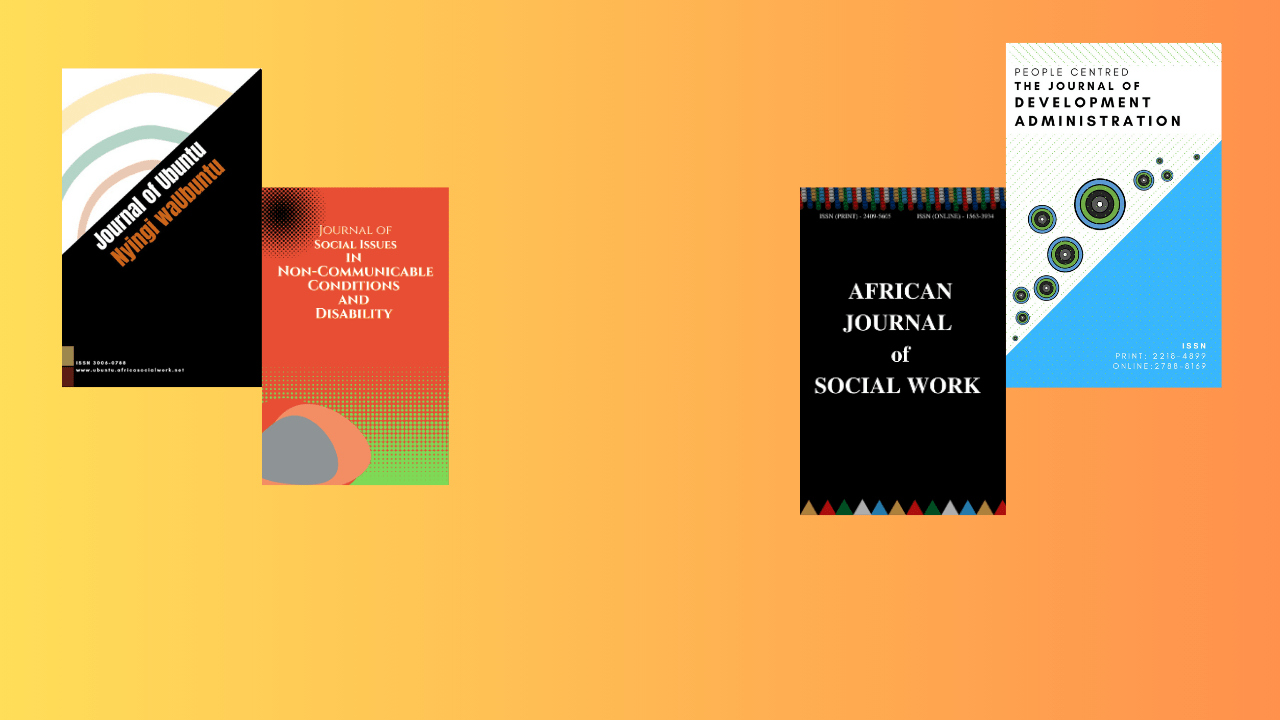
- We host four journals each with its website, including the African Journal of Social Work which is AJOL and SCOPUS accredited, the Journal of Development Administration which is AJOL accredited, the Journal of Social Issues in Non-Communicable Conditions and Disability (SINCCD) and Journal of Ubuntu/Nyingi waUbuntu. Each journal has an Board.
- Africa Day Indaba – on or around Africa Day in May each year
- Annual Ubuntu Lecture – November each year
- Annual students conference during Day of the African Child – beginning 2023
- Ubuntu Research Group (URG)
- African Independent Ethics Committee (AIEC)
- Kuumba | Mentoring Group (K|MG)
- Annual Social Work and Development Awards
- Online courses – starting 2023
- Decolonisation Calculators (DECAs)
Main Innovations
We are proud to have conceptualized and introduced the following
- Decolonisation Calculators (DECAs)
- Ubuntu Lecture
Structure
The Network has a very simple but very effective structure to support work that is done remotely and online.
| Convening Officer/Director Responsible for convening events, committees, and taskforces and directing the Network. | Communications Officers Responsible for communication with members and committees |
| Members |
| Committees | Taskforces | Groups | Boards |
Collaborations and Funding
We value collaboration in our work and constantly seek new partners. If you are interested in partnering with us, please contact us.
- Association of Schools of Social Work in Africa (ASSWA)
- Zivo Publishers
- National Association of Social Workers (Zimbabwe)
The Network receives no funding for its work but welcomes financial support to expand its work. Currently, work is driven by volunteers, and we always use available cost-free opportunities.
Members
The Network has over 150 registered members. Joining is free.
Who can become a member
Members have a social work qualification or development or have proven experience in social developmental work. Membership is limited to people from an African country or the African diaspora. In some circumstances, membership can be offered to a non-African. Members are usually social workers, development workers, community workers, counsellors, psychologists, social welfare workers, social development workers, cultural service workers and social administrators.
Membership Application Information
To apply for membership, email the following information to asw@africasocialwork.net with the subject Application for Membership or this online form.
- First name and family name. Include name of respect if available. Include preferred name if your first name is not your preference.
- Your social work or development qualification/s
- Motivation statement or testimonial (what is it that attracts you to Mtandao/ASWDNet, what do you bring, how do you hope to contribute etc). Selected testimonials will be featured on our website.
- Referee (name and email) – Your referee should be (1) another social worker (2) a person working in welfare, development, social or human services
Benefits and Contributions of Members
- As a member, you can cite your ASWDNet membership on your profile, email signature/footer, CV or other documents.
- You can use or attach the logo of the ASWNet available below as evidence of your membership. The logos are available here.
- Use services of the Africa Independent Ethics Committee (AIEC) free of charge.
- Create content:
- Being interviewed (text, audio or video) on a selected social work and development topic or experience or writing a biography. You can view previous interviews and biographies here.
- Contribute to the history of social services, welfare and social work of your country (book chapter or web content). Examples – Egypt Zimbabwe South Africa
- Become a blogger (use this link to submit your first blog, we will then help you create your blog account on the ASWDNet website).
- Contribute to the African Journal of Social Work; Journal of Social Development; the Journal of Social Issues in Disability and Non-Communicable Conditions of Journal of Ubuntu/Nyingi waUbuntu as an author or reviewer.
- Participate in Kuumba, our mentoring program.
- Participant in events, please visit our events page. These events include the Africa Day Indaba in May, Annual Ubuntu Lecture in November and Students Conference in June.
- Information about Social Work in Africa is found here.
- Connect with us on social media
Creating Resources on Mtandao website
Please see instructions here. To create resources, you need to be subscribed to the website as a contributor or author. Please send us an email if you are ready to contribute. You can also contribute without logging in by emailing us your content.
Logos, Badges and Backgrounds for use by Members
Members can copy, download and resize the logo for use.
Members can also copy the text below and insert or paste as a hyperlink.
I am a member of Mtandao – Africa Social Work Network
Backgrounds for online meetings
Select your preferred background and download it then insert into you meeting application, for example Zoom (Click Virtual Backgrounds), Teams (Click Background Effects), Google Meet (click Effects).


Use the menu below for further information.
- ‘Sidi’
- “Dongo”
- 12 Steps to Get Published
- A critical analysis of the challenges faced by young people with neurodevelopmental disorders in accessing Sexual Reproductive Health Services in Zimbabwe. A case of Zimcare Trust, Zimbabwe
- Aboriginal Countries
- Academics
- Academics Honorary Program (AHP)
- Africa
- Africa Philosophy
- Africa Religion (uAfrica)
- Africa Research Ethics and Malpractice Statement (AREMS)
- Africa Social Work and Development Awards
- African Anthem (African Union)
- African Independent Ethics Committee (AIEC)
- African Research Ethics and Malpractice Statement (AREMS)
- African symbols and alphabets
- African Theories
- Afro-Caribbeans
- Afro-Latinos
- Afrocentric Mentoring Project (AfroME)
- Afrocentric Mugumo Tree
- Algeria
- Andrew Chad Nyanguru (28 Mar 1953-14 May 2014)
- Angola
- Approaches to assessing learning
- Arega Yimam (-c1989)
- Association of Social Work Education in Africa (ASWEA) – 1971 to 1989
- ASSOCIATIONS
- ASWDNet Guide to Writing (Academic Research Brief| Proposal | Thesis)
- ASWDNet Guide to Writing (Journals)
- ASWDNet Guide to Writing and Publishing
- Awards for Academics
- Awards for Practitioners
- Benin
- Bernin
- Biography of Social Development in Africa
- Blog
- Book Publishing
- Book_Professional Social Work in Zimbabwe
- Bookshop
- Botswana
- Burkina Faso
- Burundi
- Cabo Verde
- Call for Special Issue on Environmental Social Work
- Call for special issue on research methodology
- Cameroon
- Case Studies and Reports
- Catalogue
- Central African Republic
- Certificate Request
- Chad
- Charlotte Makgomo-Mannya Maxeke (1871-1939)
- Checkout
- Chitendero, Unhu Netsika Dzavatema VomuZimbabwe
- Communities
- Community
- Comoros
- Congo
- Congo, Democratic Republic
- Connect With Us
- Consultancy
- Contact
- Contact us
- Contacts
- Continuous Professional Development (CPD)
- Cote D’Ivoire
- Covid-19
- COVID-19
- Current and Past Issues
- Dambiro – Test page
- Data Collection, Use and Privacy Policy – ASWDNet
- Decolonisation Calculator – Fieldwork
- Decolonisation Calculator for Research (Deca-R)
- Decolonisation Calculator for Tertiary Institutions (DECA-TI)
- Decolonisation Calculators (DECAs)
- Development in Africa
- Developmental Work Database
- Djibouti
- DR Congo
- Dr Edmos Mthethwa
- Dr Noel Garikai Muridzo
- Edwell Kaseke
- Egypt
- Email, data and social media policy for Mtandao staff, members and subscribers
- Environmental Social Work
- Equatorial Guinea
- Eritrea
- Eswatini
- Ethics Information
- Ethiopia
- Events
- Expert Papers, Guidance Papers and Novel Conclusions
- External factors influencing academic success among students with Visual Impairments at one University in Masvingo, Zimbabwe
- Factors influencing knowledge of the management strategies for hypertension among middle-aged adults in rural areas of Anambra state, Nigeria
- Fieldwork Resources
- Forum | Asikhulume
- Funda KiSwahili
- Fundi – The African Dictionary and Encyclopaedia of Social Work and Development
- Future of Social Work in Africa
- Gabon
- Gambia, The
- Ghana
- Gibson Mthuthuzeli Kent (1932-2004)
- Gidraph G Wairire
- Glossary
- Glossary of Publishing Terms
- Guidelines
- Guinea
- Guinea-Bissau
- Haiti
- How to do Mfundo courses
- Instructors
- Instructors
- Jairos Jiri (1921 – 1982)
- John Samuel Mbiti (1931-2019)
- Joshua Mqabuko Nyongolo Nkomo (19 June 1917 – 1 July 1999)
- JOURNAL OF DEVELOPMENT ADMINISTRATION (JDA)
- Journal of Social Issues in Non-Communicable Conditions and Disability
- Journal of Ubuntu
- Journal Policy and Guidelines
- Journals
- Jukwa (Forum)
- Kenneth Buchizya Kaunda
- Kenya
- Kenya
- Kuumba (Mentoring)
- Lecture Resources
- Lecture Slides
- Lectures
- Lesotho
- Liberia
- Liberia
- Library | Database
- Libya
- Lovemore Mbigi
- Madagascar
- Mai Musodzi Chibhaga Ayema (1885-1952)
- Malawi
- Mali
- Masterclass test page
- Mauritania
- Mauritius
- Mayotte of Comoro
- Melanesia
- Members
- Mental Health Masterclass
- Mentees
- Mentoring
- Mentoring Timeline
- Mentors
- Mfundo Terms and Conditions
- Mfundo|Training
- Morocco
- Mozambique
- Mtandao
- Mtandao Knowledge Base
- Namibia
- Newsletter
- Ngugi wa Mirii (1951 – May 3, 2008)
- Niger
- Nigeria
- nnose
- Nnoseng Ellen Kate Kuzwayo (1914 – 2006)
- Notes
- Notes for Students
- Our Ubuntu-inspired Comments Policy
- Outcomes
- Owia Bulletin
- Papua New Guinea
- People Centred – The Journal of Development Administration
- Phillip Manyanye Bohwasi
- Political Social Work Group
- Political Social Work Group (PSWG)
- Post-publication support for authors
- Practitioners
- Privacy and Cookie Policy (Ubuntu-inspired)
- Professor Rodreck Mupedziswa
- Profile
- Psychosocial needs of carers of children with cerebral palsy in Lesotho
- Publication Ethics and Malpractice Statement (JDA)
- Publisher/Journal Checker
- QR Codes Short Codes
- Qualitative data levels of analysis
- Reflection and critical thinking model and template
- Regina Gelana Twala (1908-1968)
- Register
- Research Methods
- Research Questions Bank
- Research Strategies
- Researchers
- RESEARCHERS
- Resources
- Reviewers
- Rifa – Africa knowledge heritage
- Rwanda
- Sanga Development Foundation (SDF)
- Sankofa – Made in Africa Evaluation (S-MAE)
- Sao Tome and Principe
- Search Results
- Selassie Seyoum Gebre (1936-)
- Senegal
- Shopping and Bookshop
- Sierra Leone
- Social Problems Survey
- Social Work and Development Student Conference (SWDSC)
- Social Work Education institutions (SWEI) in Africa
- Social Work for Children
- Social Work in Africa
- Social Work Journals and Other Serial Publications in Africa (ASWDNet Index)
- Somalia
- South Africa
- South Sudan
- Students
- Submissions Page
- Sudan
- Supervision
- Supervision
- SURVEY OF SOCIAL PROBLEMS AND CHALLENGES FOR AFRICA
- Sychelles
- Tanzania
- Templates, Models, Frameworks, Assessment Tools and Questionnaires
- Term Conditions
- TEST HD QUIZ
- Testimonials
- The Gambia
- The San Code of Research Ethics (San Code)
- Theories
- Tips for Prospective Doctoral Students
- Togo
- TRAINING INSTITUTIONS
- Tunisia
- Types of University Assessments
- Ubuntu
- Ubuntu Annual Lecture
- Ubuntu Bibliography
- Ubuntu Fundraising and Charity Principles
- Ubuntu Interview Guide Sample
- Ubuntu Research Group (URG)
- Ubuntu Survey
- Uganda
- Umoja waAfrica (African Union)
- User instructions (Mtandao website)
- Ushahidi
- Ushahidi Platform
- Uwongo
- Uzoma Odera Okoye, Dr
- Values and Ethics in Africa
- Violence and psychological well-being of school learners in South Africa
- Virtual/Online/Remote Field Placement with the ASWNet in Africa
- Wakanda
- Wangari Muta Maathai
- Wassie Kebede
- West Papua
- Western Sahara
- Western Sahara (SADR)
- What we do
- Winnie Madikizela-Mandela 1936–2016
- Writing a journal article could be as easy as making fufu, nsima, ugali or matoke!
- WSWSD Conference Nairobi | Mtandao Exhibition
- Zahia Marzouk (1906 – 1988)
- Zambia
- Zimbabwe