
Qualitative data levels of analysis
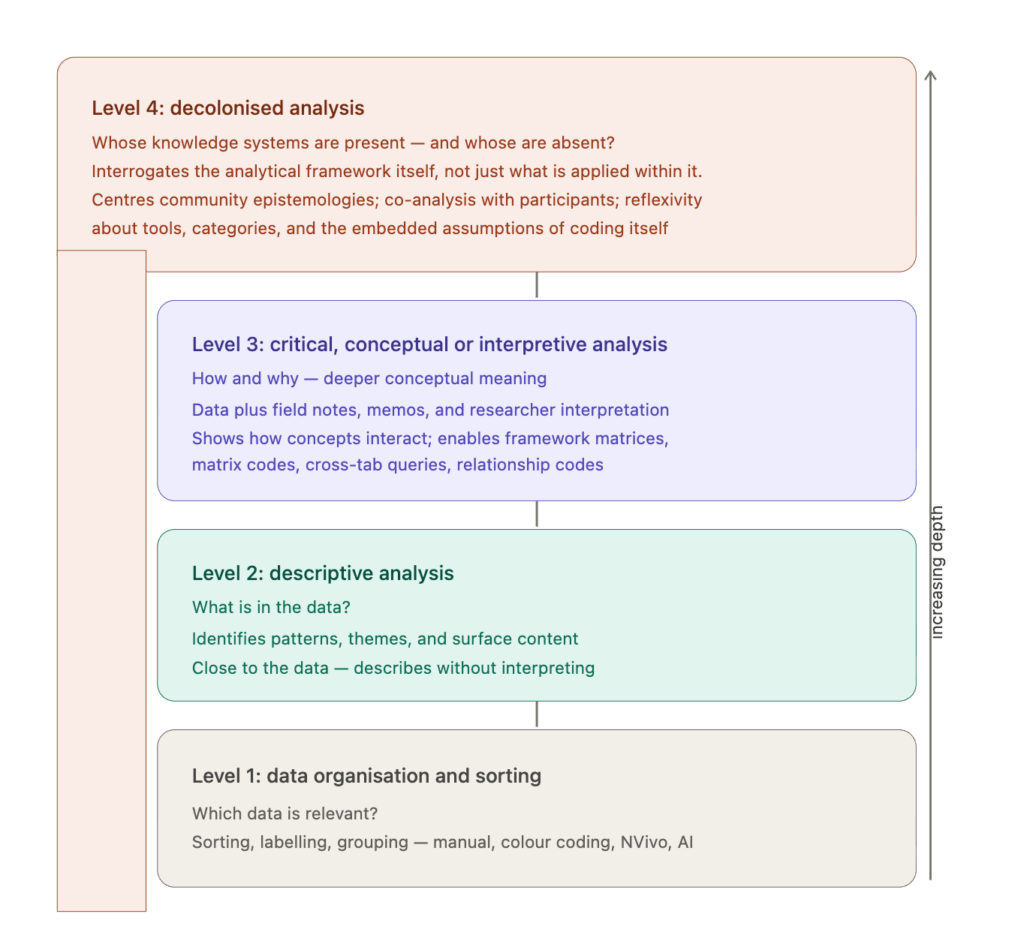
Qualitative data can be coded in many ways: manually by listening or reading and writing codes by hand, rearranging cut sections of printed transcripts, or sorting material on paper; semi-manually through colour coding transcripts on screen or on printed sheets, or reorganising extracts in Word or Excel; or with greater machine assistance through software such as NVivo, or with AI and other advanced tools.
Regardless of the method, coding qualitative data operates across three established levels of analysis, with a fourth level increasingly recognised in critical and postcolonial research traditions. Each level serves a distinct purpose. The levels are not always sequential — a researcher can work at level three without having completed levels one or two — but understanding what each demands, and what each produces, shapes the quality and depth of the final analysis.
The three core levels
Level 1: Data organisation and sorting
The first level addresses a single question: which data belongs where? The researcher is sorting, labelling, and grouping material. This is the most mechanical of the three levels and produces no analysis on its own. Its value lies in making the dataset navigable and preparing it for deeper work.
At this level the researcher is deciding which data is relevant and how to organise it — whether by theme, participant, time point, or another principle. The work is essentially clerical, though the decisions made here shape everything that follows.
Level 2: Descriptive analysis
The second level shifts the question to: what is in the data? The researcher is now identifying patterns, recurring themes, and the surface content of what participants said or did. This level stays close to the data itself. It tells you what is there without yet interrogating what it means.
Descriptive analysis is useful and necessary, but it is limited. A report that operates only at this level summarises the data rather than analyses it. Readers are shown what participants reported; they are not shown why it matters or how the pieces connect.
Level 3: Critical, conceptual or interpretive analysis
The third level is the most powerful and the most useful. The question changes from what to how and why. Crucially, this level is not about the data alone. It combines the data with the researcher’s own thinking, drawn from field notes and memos made throughout data collection, transcription, listening, and the earlier coding stages.
At this level the researcher is uncovering deeper conceptual meanings and showing how ideas connect and interact. It is where analysis becomes genuinely analytical: producing framework matrices, matrix codes, cross-tab queries, and relationship codes. Memoing is substantially more rigorous here, because those interpretive thoughts and reflections are treated as data in their own right rather than incidental notes.
Level 3 can be reached without having formally completed levels 1 and 2, though both often support it. The distinction between a researcher who operates at level 2 and one who reaches level 3 is the difference between reporting the data and theorising from it.
Level 4: Decolonised analysis
A fourth level is increasingly recognised, particularly in Indigenous, postcolonial, and critical research traditions. Even the most rigorous interpretive analysis at level 3 can operate within an unexamined Western epistemological framework. The researcher interprets data, but through whose conceptual lens? Using whose definitions of rigour, validity, and what counts as knowledge?
Level 4 asks: whose knowledge systems are present in this analysis, and whose have been erased or subordinated? It moves beyond how and why to ask — according to whom, and at whose expense? It interrogates the analytical framework itself, not merely what is applied within it.
In practice this involves centring Indigenous or community-held ways of knowing as legitimate analytical categories rather than treating them as data to be explained by outside theory. It may mean co-analysis with participants or communities, so interpretation is not something done to people but with them. It requires reflexivity not only about the researcher’s positionality but about the entire research infrastructure — including the coding tools used, such as NVivo or AI, which carry embedded assumptions about how language, meaning, and categories work.
The connection to the earlier levels is direct. Even the act of creating a code is an act of categorisation rooted in a particular worldview. Level 4 asks whether those categories are appropriate, whether they are representative, or whether they have been imposed. Some methodologists treat this as a discrete level that follows level 3; others argue it is better understood as an orientation running through all levels. Either way, naming it explicitly makes it far more likely to happen.
Relationships between the levels
The levels increase in analytical depth from one to four. Level 1 deals with which data; level 2 deals with what; level 3 deals with how and why; level 4 deals with whose framework governs the entire enterprise.
They are not strictly sequential. A researcher may move between them, return to earlier levels as new insights emerge, or begin at level 3 if the conceptual work is already underway. What matters is awareness of which level the analysis is operating at, and whether the work is being pushed toward the depth the research question actually requires.
The strongest analyses combine rigorous organisation and description with genuine interpretive depth and, where appropriate, a critical examination of the analytical framework itself.