Joint African Conference of IFSW & ASSWA in Malawi (2027): How Mtandao members can take part
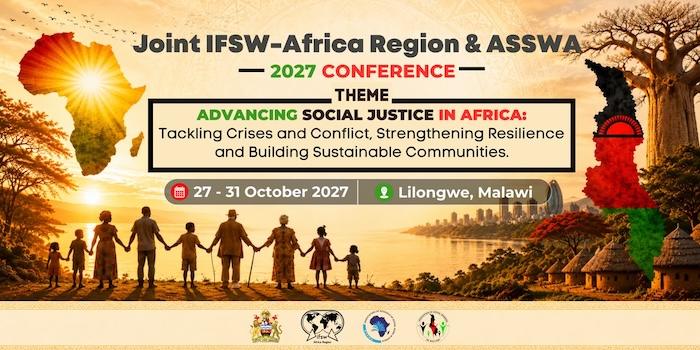
The International Federation of Social Workers (IFSW) Africa Region and the Association of Schools of Social Work in Africa (ASSWA) will hold a joint conference in Lilongwe, Malawi, from 27 to 30 October 2027. Pre conference events take place on 26 October. The co hosts are the Government of Malawi’s Ministry of Gender, Community Development and Social Welfare and the Association of Social Workers in Malawi (ASWIM). The conference theme is advancing social justice in Africa by tackling crises and conflict, strengthening resilience and building sustainable communities, rooted in Ubuntu. This post lists the conference sub-themes that match the work of Mtandao, the Africa Social Work and Development Network (ASWDNet), and the ways members can take part.
Key dates and fees
The call for abstracts opened on 1 November 2026 and closes on 31 March 2027. Registration also opened on 1 November 2026.
Super early bird: 1 November to 31 December 2026
Early bird: 1 January to 30 April 2027
Standard: 1 May to 30 September 2027
Late: October 2027
Africans pay 100 United States dollars (USD) early and 150 USD late. Participants from outside Africa pay 150 USD early and 200 USD late. Students pay 50 USD. Local participants pay 150,000 Malawi kwacha (MK) and local students pay MK50,000. The organisers will publish details on group rates, student rates and refunds later.
Conference sub-themes and Mtandao’s work
The conference has six sub-themes. Each abstract must select one.
Social work in humanitarian, crisis and climate contexts: This sub-theme covers conflict and humanitarian settings, disaster risk reduction, climate displacement, gender, psychosocial support and community recovery. Mtandao members have written on the 2026 Ebola outbreak, on the San Code of Research Ethics and its rule to enter communities through the door and not the window, and on land based practice.
African centred, Indigenous and decolonial social work practice: This sub-theme covers Indigenous knowledge systems, Ubuntu and other African philosophies, culturally responsive practice, decolonising social work education and locally grounded approaches. Most of Mtandao’s work falls under it. Examples are the Ubuntu framework of five levels of development (family, community, society, environment and spiritual), Indigenous research methods and the Annual Ubuntu Lecture.
Strengthening social work systems, education and innovation: This sub-theme covers workforce development, regulation, continuing professional development, education, leadership, digital change and Artificial Intelligence (AI). Mtandao’s Mfundo online courses, its work on Ubuntu and AI, and members’ teaching with simulation and Indigenous assessment belong here.
Social protection, family strengthening and inclusive community wellbeing: This sub-theme covers social protection, child protection, family strengthening, disability, safeguarding and mental health. Work on the Friendship Bench, on families in polygamous and informal unions, and on children who lose caregivers belongs here.
Community participation, social justice and sustainable development: This sub-theme covers grassroots leadership, participation, social accountability, green social work, livelihoods and poverty reduction. Mtandao separates social work, which is largely welfare, from social development, which is creative and preventive. Papers on that distinction, and on indigenous food systems and enterprise, belong here.
Research, evidence, policy and future directions for African social work: This sub-theme covers research methods, monitoring and evaluation, policy and knowledge translation. Papers on African research methods, open access publishing and knowledge sovereignty belong here.
Ways to take part
Present a paper
Submit an individual or co authored paper. Abstracts need a title, the authors’ names, affiliation and country, a sub-theme and an abstract of 250 to 300 words. Mtandao encourages members to co author across countries. Students, community practitioners and elders who contributed to the work can be co authors.
Run a workshop
Workshops are one of the four submission types. Members can run practical sessions on Ubuntu practice, Indigenous research methods, decolonising assessment, storytelling as a method, or group and community work. A workshop abstract should state what participants will do during the session and what they will learn.
Show research through posters
Posters suit early career researchers, students and practitioners with findings from one project. They also suit models, maps, community projects and fieldwork photographs. Photographs of people need their consent.
Demonstrate African centred teaching
Educators can submit a workshop or paper that shows how they teach. Examples include learning circles, proverbs and storytelling in class, land based learning, simulation with African case material, and assessment designed with Indigenous knowledge holders. The abstract should report what students learned and how the teaching was assessed.
Showcase community based organisations and welfare institutions
Community based organisations (CBOs), non government organisations and welfare institutions can present their own African centred methods. Mtandao encourages CBOs to present both their welfare work and their development work. Welfare work includes relief and care. Development work includes building income, assets, leadership and local systems. Examples include savings groups, burial societies, elder councils, children’s homes that place children with extended family, and community food projects. Organisations can submit a paper, poster or workshop under sub-theme 4 or 5. They can co present with practitioners and community members.
Promote publications
Members can bring recent books, chapters and journal issues to share in sessions and during breaks.
Publish your conference paper
After the conference, presenters can develop their papers into full articles and submit them to Mtandao’s journals.
People Centred: The Journal of Development Administration (JDA): JDA publishes work on development administration, community development, livelihoods and inclusive development in Africa. It is diamond open access, with no fees for authors or readers.
Journal of Social Issues in Non Communicable Conditions and Disability (SINCCD): SINCCD publishes work on the social side of non communicable diseases and disability in Africa, including research, practice, education, policy and service user experiences. It is open access and submission is free.
Journal of Ubuntu (Nyingi waUbuntu): The journal publishes work on all levels of Ubuntu, from family and community to society, environment and spirituality, across all disciplines. There are no fees to publish.
African Journal of Social Work (AJSW): AJSW publishes research on social work practice, education and policy in Africa.
Each journal has its own author guidelines, and the ASWDNet referencing style applies. Authors should check the guidelines on the journal website before they submit.
Exhibit
The conference website does not list exhibition packages yet. It asks partners and sponsors to complete a form on the key dates and partners page. Organisations that want a stand, a book table or a display should use that form or write to the organisers.
Chair sessions and review abstracts
The organisers have not yet named the organising and scientific committees. Members with conference experience can write to the organisers to offer to chair sessions or review abstracts.
Network
The conference brings together social workers, educators, students, researchers, government officials and community organisations from across Africa. Members can meet co authors, plan joint research, recruit reviewers and set up links between schools of social work. Mtandao will share details of any member meeting closer to the date.
Before you submit
Choose the sub-theme that best fits your work, since each abstract can select only one.
Keep to the 250 to 300 word limit.
Register before 31 December 2026 to pay the lowest fee.
Check visa rules for Malawi and plan travel funding in good time.
Send questions to info@ifswafrica2027.com.
Use the form below to subscibe to Owia Bulletin.