African-centred practices in human services using the Ubuntu framework
Values underpinning the Ubuntu framework
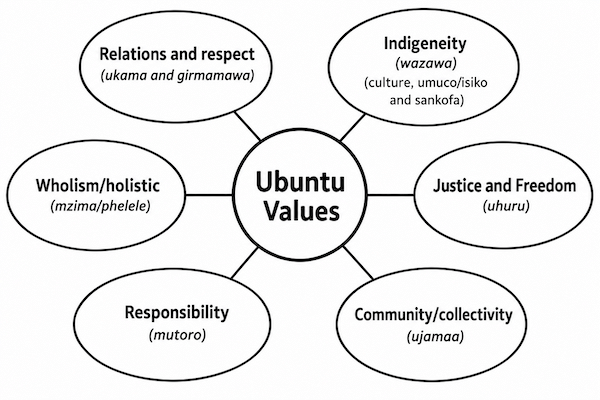
The Ubuntu framework understands human wellbeing as relational, reciprocal and collective/communityness. It assumes that a person’s wellbeing is shaped by just relationships with family, community, society, the natural environment, and the spiritual world. Human services therefore do not focus only on individuals but recognise multiple levels of life that influence wellbeing. Justice and freedom refers to being free and independent from colonisation and injustice, and promoting fairness in laws, practices, relationships, land, the environment, economics and politics. Indigeneity refers to valuing African identity, culture, ways of knowing and ways of doing, while drawing on the past to inform and shape the future. Wholism refers to valuing the interconnectedness of people, their past and future, the environment and spirituality.Communityness refers to the understanding that people exist within networks of relationships. Support, identity, and responsibility are shared within families, communities, and societies. Human services grounded in Ubuntu therefore emphasise collective wellbeing rather than individualistic solutions. Reciprocity refers to mutual care and interdependence. Support flows in multiple directions across generations and social groups. Those who receive support today are expected to contribute to others when able. Responsibility emphasises moral obligations to others, the community, and future generations. In the Ubuntu worldview, individuals are accountable not only to themselves but also to the collective.
These values shape a wide range of African-centred practices used globally in social services, community development, mental health, justice, and wellbeing. These practices can be organised using the Ubuntu framework across six levels: individual, family, communal, societal, environmental, and spiritual.
Individual level
At the individual level, African-centred approaches support personal identity, resilience, and healing while recognising that the individual is embedded in relationships with family, community, society, environment and spirit. Examples include:
- Tree of life storytelling or drawing is a narrative therapy approach in which individuals represent their lives using a tree metaphor that includes roots, trunk, branches, and leaves. The approach has been used in work with refugee and migrant children in schools and community organisations in Johannesburg, Cape Town, and Adelaide, Australia through programmes linked to Dulwich Centre.
- Sankofa reflective practice encourages individuals to reflect on the past in order to inform the future. Sankofa-based reflective work has been used in youth development and diaspora identity programmes in Accra and Washington, D.C. through organisations connected with African American Cultural Heritage Action Fund.
- Kuumba self-actualisation practice is used in mentoring and youth empowerment programmes inspired by the Nguzo Saba framework developed by Maulana Karenga. These programmes are widely implemented during Kwanzaa celebrations in cities such as Chicago and Toronto.
- Ubuntu reflective dialogue is used in counselling and leadership development programmes in South African universities such as University of Johannesburg and University of Cape Town.
- African drumming therapy is used in trauma recovery programmes in community health organisations in Harare and London, including workshops organised through diaspora arts organisations.
- Story circles or autobiographical storytelling are widely used in cultural healing programmes across the African diaspora, including community storytelling projects at National Museum of African American History and Culture in Washington, D.C..
Family level
At the family level, practices strengthen relationships, support parenting, and maintain intergenerational continuity. Examples include:
- Family indaba refers to structured family dialogue used to resolve conflicts, discuss responsibilities, and strengthen relationships. Variations of this approach are used in family mediation programmes in South Africa and Zimbabwe.
- Intergenerational storytelling enables elders to share histories and cultural knowledge with younger generations. Programmes supporting this practice exist in community organisations such as South African History Archive in Johannesburg.
- Kuumba multigenerational mentoring connects youth with older mentors within extended family or community networks. Mentorship models inspired by this approach are used in youth programmes run by Big Brothers Big Sisters of South Africa.
- Collective child-rearing practices remain common in extended family structures across rural communities in Kenya, Ghana, and Zimbabwe.
- Rites of passage programmes are implemented by diaspora organisations such as Association for the Study of Classical African Civilizations in youth identity programmes in Chicago.
- Family councils inspired by the dare model are used informally in families in Zimbabwe and have influenced mediation practices in community social work.
Community level
At the community level, African-centred approaches focus on participation, collective problem solving, and mutual support. Examples include:
- Friendship bench is a community mental health intervention in which trained grandmothers provide problem-solving therapy on benches in public spaces. The programme was developed by Dixon Chibanda at the University of Zimbabwe and is widely implemented in Harare and other communities. It is now implemented internationally through Friendship Bench programmes in places such as New York City.
- Community indaba dialogues are gatherings where community members meet to discuss issues and make collective decisions. This approach has been used in governance and reconciliation processes in South Africa.
- Dare community justice forums remain important in traditional dispute resolution in rural communities in Zimbabwe.
- Baliano consultation method is used in participatory research and community development projects where facilitators collect views from individuals and groups and then bring them together for collective discussion.
- Ubuntu restorative circles are used in schools and community justice programmes in Johannesburg and Durban.
- Harambee collective action initiatives are widely used in community development in Kenya where communities mobilise labour and resources to build schools, clinics, and other infrastructure.
- Community healing rituals have been used in post-conflict settings in Rwanda and Sierra Leone.
Societal level
At the societal level, African-centred practices influence governance, justice systems, and institutional responses to social problems. Examples include:
- Ancestral jurisprudence refers to legal reasoning informed by ancestral wisdom and cultural norms. Elements of this thinking continue to shape customary law systems in countries such as Ghana and Botswana.
- Restorative justice based on Ubuntu influenced reconciliation processes following apartheid in South Africa through the work of the Truth and Reconciliation Commission led by Desmond Tutu.
- Truth-telling commissions have also been used in transitional justice processes in countries such as Liberia and Sierra Leone.
- Participatory governance through indaba processes continues to influence community consultations in local governance structures in South Africa.
- Pan-African solidarity frameworks support collaboration between African and diaspora communities through organisations such as the African Union based in Addis Ababa.
- Ujamaa cooperative economics was promoted by Julius Nyerere in Tanzania and continues to influence cooperative development programmes.
Environmental level
At the environmental level, the Ubuntu framework recognises the relationship between human wellbeing and the environment. Examples include:
- Country or land as teacher pedagogy emphasises learning from land and ecological systems. Community-based environmental learning programmes inspired by this idea have been implemented in rural education projects in Kenya and Zimbabwe.
- Sacred forests and sacred sites protection practices continue in communities such as the Osun sacred forest preserved in Osogbo in Nigeria.
- Community agroecology and cooperative farming programmes operate in rural development initiatives in Tanzania and Ethiopia.
- Under-the-tree indaba learning spaces have been used in environmental education and community learning initiatives inspired by the legacy of Wangari Maathai and the Green Belt Movement in Kenya.
- Indigenous ecological knowledge transmission occurs through community education in pastoralist societies in Namibia and Botswana.
Spiritual level
The spiritual level recognises the connection between the living, ancestors, and future generations.
- Ancestral remembrance practices remain central to spiritual life in many African societies including communities in Zimbabwe and Ghana.
- Libation ceremonies are widely practised in cultural gatherings across West Africa and diaspora communities in cities such as London and Atlanta.
- Community indigenous prayer circles are common in faith-based organisations such as the South African Council of Churches in Johannesburg.
- Spiritual cleansing rituals are practised by indigenous healers in communities across South Africa and Zimbabwe.
- Healing through indigenous spiritual leadership continues in institutions representing indigenous healing systems such as the Traditional Healers Organization in South Africa.
Cross-cutting African-centred methodologies
Several African-centred methodologies operate across multiple levels of the Ubuntu framework. These approaches influence individuals, families, communities, and institutions simultaneously.
- Ubuntu Acknowledgement: Acknowledging the sources of Ubuntu knowledge before events and on publications. Examples are here.
- Indaba dialogue methodology supports consultation, discussion, and collective decision-making across families, communities, and governance systems.
- Dare deliberative practice provides a structured space for collective reasoning, mediation, and conflict resolution.
- Storytelling as knowledge transmission enables communities to preserve history, transmit knowledge, and support healing across generations.
- Ritual-based healing approaches address psychological, social, and spiritual wellbeing at the same time.
- Collective decision-making practices ensure that community voices shape responses to social problems.
- Community mentorship structures support leadership development and social responsibility across generations.
Together, these practices illustrate how African-centred human services operate across multiple dimensions of life while remaining grounded in the six values of Ubuntu – justice and freedom, indigeneity, wholism, responsibility, community and collectivity, relations and respect at the individual, family, societal, community, environmental and spirtual levels.
Use the form below to subscibe to Owia Bulletin.