
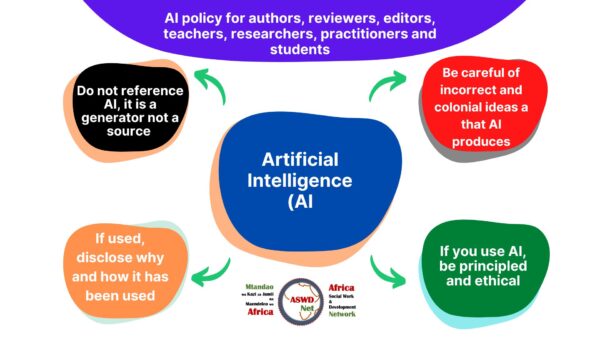
Artificial Intelligence (AI), technocolonial and decolonisation in African Social Work Education and Practice
- The Historical Context of Social Work in Africa
- Understanding Technocolonialism in AI
- African Knowledge Systems as Foundations for AI
- Towards a Decolonised AI Governance Framework
- Practical Applications in Social Work Practice
- Integrating Ubuntu and AI Ethics
- Transforming Social Work Education
- The Path Forward
In the dynamic landscape of global technology and social work practice, a crucial conversation is emerging across Africa about the need to decolonise artificial intelligence (AI) and ensure it reflects African values, knowledge systems, and practical realities.
This post calls for a fundamental reimagining of how AI technologies are developed, implemented, and integrated into social work education and practice throughout the continent. The journey towards decolonising AI in African social work is not about rejecting Western technology entirely but about transforming it to serve African contexts, communities, and cosmological understandings.
The Historical Context of Social Work in Africa
To understand the imperative for decolonising AI in African social work, we must first acknowledge the colonial origins of social work education and practice on the continent. Social work was introduced to Africa as part of the colonial project, often mirroring the approaches of missionary activities that sought to ‘civilise’ rather than empower local populations. This historical legacy has left social work in many African countries struggling with models that are culturally inappropriate and contextually irrelevant to the realities of African communities. Western social work emphasises individual intervention over collective approaches, contrary to many African understandings of community and mutual responsibility. This misalignment becomes particularly problematic when technologies like AI—developed primarily in Western contexts with Western biases—are incorporated into practice without critical adaptation.
Understanding Technocolonialism in AI
The concept of technocolonialism represents the modern manifestation of colonial patterns through digital technologies. This occurs when technological systems developed in the West are imposed on African societies without regard for local contexts, needs, or knowledge systems. We see examples of this in initiatives like Facebook’s ‘Free Basics’ app, which provided limited internet access while promoting primarily Western services and content, often unavailable in African languages. This digital colonialism creates dependency relationships and reinforces power imbalances where African countries become consumers rather than co-creators of technology. In social work practice, this technocolonial approach risks importing AI tools that perpetuate Western values and worldviews while marginalising African approaches to helping, healing, and community wellbeing.
African Knowledge Systems as Foundations for AI
Fortunately, Africa possesses rich indigenous knowledge systems that offer alternative frameworks for conceptualising and working with AI technologies. The Ifá divination system of the Yoruba people, for example, demonstrates sophisticated computational thinking that predates Western computing by centuries. Ifá utilizes a binary structure similar to modern computing, with eight palm nuts or cowries generating 256 possible outcomes (odu), each corresponding to extensive oral verses that guide decision-making. What makes Ifá particularly relevant for social work is its interpretive nature—the binary output alone does not provide answers but requires skilled interpretation within specific community contexts and with consideration of the client’s circumstances. This contrasts sharply with many Western AI systems that tend toward automated decision-making without human mediation. Ifá instead emphasizes dialogue, interpretation, and community participation—elements that align closely with social work values of client self-determination and contextual understanding. Similarly, the concept of Sankofa from the Akan people of Ghana reminds us of the importance of learning from the past to build a prosperous future, suggesting that decolonising AI requires looking backward to indigenous knowledge systems to move forward ethically .
Towards a Decolonised AI Governance Framework
A growing movement of scholars and practitioners is developing frameworks to assess and guide the decolonisation of AI in African contexts. The decolonisation scale proposed by Ayana and colleagues offers a helpful tool for evaluating where countries and institutions fall on the spectrum from decolonization-resistant to decolonization-transformative approaches. The most transformative approaches not only acknowledge the need for decolonisation but actively address its root causes and work to transform AI governance structures . This involves centering African voices in AI development, adapting technologies to local contexts and languages, and ensuring that AI systems reinforce rather than undermine African values and social structures.
Practical Applications in Social Work Practice
What might decolonised AI look like in everyday social work practice across Africa? Imagine community-based alert systems that use natural language processing to understand local dialects and communicate resource information to vulnerable communities. Envision predictive tools that incorporate indigenous indicators of wellbeing rather than merely importing Western metrics. Consider decision-support systems for social workers that draw on African ethical frameworks like Ubuntu rather than exclusively Western models of ethics. These technologies would honour the collective wisdom of communities while addressing practical social work challenges like resource distribution, case assessment, and service delivery. In Ghana, for instance, social work practitioners already incorporate local dispute resolution strategies and traditional authority systems into their practice. A decolonised AI might amplify these approaches rather than replacing them with standardized Western models. Such technology would need to be developed through participatory design processes that engage elders, community leaders, and local social workers as co-creators, not merely as end-users.
Integrating Ubuntu and AI Ethics
The philosophical framework of Ubuntu which is the basis of thought for Black Africans (“I am because we are”) offers a powerful foundation for reimagining AI ethics in social work. Unlike Western AI ethics that often prioritizes individual privacy and autonomy, Ubuntu emphasizes relationality, community harmony, and mutual responsibility. An Ubuntu-informed AI would measure its success not by efficiency alone but by how well it strengthens community bonds, supports collective decision-making, and distributes benefits across the network of relationships. This approach aligns with social work’s commitment to social justice but grounds it specifically in African philosophical traditions . Similarly, the Afrocentric paradigm in social work provides values and ethics that can guide AI development, emphasizing interconnectedness, spirituality, and reciprocity, elements often absent in Western technological design. In making these principles central to AI systems, African social workers can develop technologies that resonate with local values while addressing global challenges.
Transforming Social Work Education
Decolonising AI in social work requires fundamental changes to social work education across Africa. This involves moving beyond token inclusion of indigenous knowledge to fundamentally rethinking curricula, teaching methods, and assessment strategies. Decolonised social work education would train students to critically evaluate technologies, understand their cultural and political implications, and participate meaningfully in technology design processes. This educational transformation must include decolonising research methodologies as well, embracing approaches that honor oral traditions, community wisdom, and indigenous ways of knowing. Rather than treating Western research methods as universally applicable, social work education should equip students to draw on African epistemologies when studying and addressing social problems.
The Path Forward
The journey toward decolonised AI in African social work is both necessary and challenging. It requires confronting powerful interests, rethinking established curricula, and investing in locally-led innovation. However, the potential rewards are immense—AI technologies that truly serve African communities, reinforce indigenous knowledge systems, and transform social work practice into something more culturally relevant and effective. This process begins with critical awareness of colonial patterns in technology and social work, followed by conscious commitment to doing things differently. It requires centering African voices in technology development, honoring indigenous knowledge systems, and building systems based on African values and realities. Most importantly, it demands humility—recognizing that Western approaches do not have all the answers and that ancient African knowledge systems hold wisdom essential for our technological future. As we look to the future of social work in Africa, the decolonisation of artificial intelligence represents not just a technical challenge but a moral and ethical imperative. By grounding AI development in African knowledge systems like Ifá, embracing ethical frameworks like Ubuntu, and prioritizing community participation in design processes, we can create technologies that serve rather than subordinate African communities. This approach transforms AI from a tool of technocolonialism into an instrument of liberation—one that amplifies indigenous knowledge, strengthens social work practice, and contributes to a more equitable future for all Africans. The time has come for social workers, technologists, communities, and policymakers to work together in building AI systems that reflect Africa’s rich cultural heritage and contemporary aspirations. Through this collaborative effort, we can ensure that artificial intelligence becomes a true partner in addressing social challenges while honoring the wisdom of African ancestors and knowledge systems. This is the promise of decolonised AI—technology that serves humanity in all its cultural diversity rather than imposing a homogenized vision of progress.
*This article was created using an AI tool with several prompts and reviews to ensure that decolonising content was not included in the final publication. An example was the definition of Ubuntu which is mischaracterised in AI apps to reflect a western colonial view of African philosophy.
Use the form below to subscibe to Owia Bulletin.