

The illusion of liberation and modernisation under Mobutu Sese Seko: Lessons for social work and social development
Mobutu Sese Seko ruled Zaire, now the Democratic Republic of the Congo (DRC), from 1965 to 1997. His regime is often studied through its public image: The leopard skin hat, the renamed country and the ban on Christian names. These decolonisation steps matter, but they can hide how the state actually worked. This post argues that Frantz Fanon’s warning about the pitfalls of national consciousness gives the most accurate account of the regime. It also uses Ukuru theory and Samkange’s Ubuntu political theory, both African frameworks, to explain what the regime did to people and what it owed them.
Gbadolite case study: the cost of modernisation
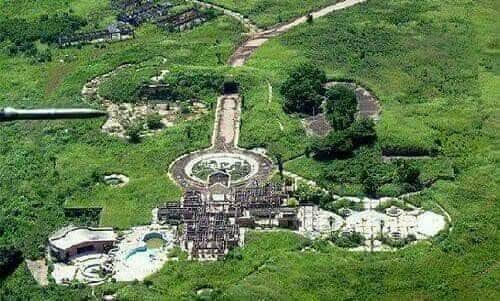
Gbadolite, Mobutu’s birthplace, was a village of 1,500 people living in mudbrick huts in the early 1970s. A new town was built there with houses, schools, hospitals, a five star hotel and three palaces. The buildings copied European royal models, which is why the press called the site the Versailles of the jungle. His private palace had paintings, sculptures, stained glass, imitation Louis XIV furniture and marble from Carrara in Italy. A tiered fountain in the Versailles style used to play instrumental music. Two swimming pools were surrounded by loudspeakers playing Gregorian chants or classical music. Gregorian chant is unaccompanied sacred singing in Latin, sung in unison, which developed in medieval Europe for Roman Catholic worship and is named after Pope Gregory I. The palace employed 700 to 800 chauffeurs, chefs, servants and other staff, plus more than 300 soldiers. The town had a 3,200 metre runway for the supersonic Concorde. Mobutu would charter the aircraft from Air France. A nuclear bunker could house more than 500 people. The palaces were built with public money for his personal use. Rebels looted the opulence in 1997, and soldiers looted it again in 1998. The interim governor of the province told AFP that people began to loot the palace during the First Congo War. The looting involved soldiers and members of the community. For this post, the site shows Fanon’s point in physical form. The new ruling class did not build something of its own. It copied the courts of European monarchs, at the expense of a population that had little access to services.
Other lenses on the Mobutu regime
Several thinkers explain parts of the regime well. Achille Mbembe, a Cameroonian historian and political theorist, wrote about the postcolony and about necropolitics. His work shows how postcolonial rulers kept the coercive machinery of colonial rule and presented it through local symbols and public spectacle. Mobutu’s mass rallies, praise songs and the evening news that opened with his image descending through clouds fit this pattern.
Homi Bhabha, a scholar born in India, wrote about colonial mimicry. His concept points to a contradiction in Mobutu’s rule. Mobutu spoke against Western cultural influence while building a palace complex at Gbadolite that the press called the “Versailles of the jungle”. Its excess echoed King Leopold II of Belgium, who had once held the Congo as his personal property.
These frameworks describe the symptoms of Mobutu’s rule. Fanon explains the structure underneath them.
Fanon and the national bourgeoisie
In The Wretched of the Earth (1961), Fanon gave a chapter to the pitfalls of national consciousness. He warned that independence without a change to the economic and administrative structure of the colonial state would hand power to a national bourgeoisie. In his account, this class produced little. It acted as an intermediary between the former colony and foreign capital, took over the posts and privileges the Europeans left behind, and used the party and the leader to enrich itself.
Mobutu’s Zaire matched this prediction closely. The extractive economy built under Belgian rule, centred on copper, cobalt and diamonds, stayed in place. What changed was who sat at the top. Between 1971 and 1972, the policy of Authenticité renamed the country, the river and the currency Zaire, required citizens to drop Christian names, and replaced the Western suit with the abacost, a collarless jacket promoted as national dress. Behind this cultural programme, a small political class close to the president grew rich. Rural households carried the costs, much as they had under colonial administration.
Reading Mobutu through Ukuru theory
Ukuru theory is documented by the Africa Social Work and Development Network (ASWDNet). Ukuru means dominance, oppression or colonisation. Its opposite is uhuru, meaning freedom, and the dominator is the mukuru. The theory holds that dominance can operate at individual, community, societal or global level, and that it silences voices, beliefs, values and histories.
The theory also names the psychosocial effects of dominance. These include conformity, where the silenced adopt the voice and values of the mukuru; silencing and self silencing, where people set limits on themselves and others; parallelism, where people use African ways alongside Western ones or act against what they value; imitation; identity erosion; and an enslaved mindset.
The theory is useful here because it does not require the mukuru to be foreign. Under Mobutu, the dominator was a Congolese president, and the effects the theory describes continued. Parallelism is the clearest case. Zaire looked African in its names, dress and public ceremony, while its economy and security depended on Western backing. Mobutu served as a Cold War ally of the United States, Belgium and France and used that support to stay in power. Conformity and self silencing followed from a single party state in which public life required praise for the leader and dissent carried real risk.
Samkange and the duty of a leader
Stanlake Samkange and Tommie Marie Samkange, writing in Zimbabwe, set out an Ubuntu political philosophy in Hunhuism or Ubuntuism (1980). Their work gives three maxims. The first says that being human means affirming the humanity of others and building respectful relations with them. The second says that when a choice has to be made between wealth and the preservation of another person’s life, life must be chosen. The third says that a leader holds status and power because of the will of the people under them. ASWDNet applies this third maxim to any person with authority, including heads of families, institutions and nations, and also to social workers because of the statutory power they hold over service users.
Measured against these maxims, Mobutu’s regime fails on each count. Its leader held power through force and foreign backing, not through the will of the people. Its public rituals demanded praise and did not build respectful relations. Its leading figures accumulated wealth while health services, schools and roads collapsed. Samkange’s framework adds something Fanon does not: A positive standard for what a leader owes the people, drawn from African thought.
An alternative reading
A fair assessment has to consider what Mobutu was attempting. Ngũgĩ wa Thiong’o argued in Decolonising the Mind (1986) that the most important area of colonial domination was the mental universe of the colonised. Fanon made a related point about the psychological damage of colonial rule. Read this way, renaming the country, its landmarks and its people was an attempt to undo the inferiority that Belgian rule had taught.
Zairianisation, announced in 1973, went further. It transferred foreign owned plantations, shops and small businesses to Zairian owners, with the stated aim of putting the economy in Congolese hands. On its own terms, it was a claim to economic sovereignty and Black pride.
Aesthetic change and structural continuity
The record does not support the alternative reading. Many of the transferred businesses went to politicians and officials close to the president, few of whom ran them productively. Shortages and economic decline followed, and by 1976 the government had begun returning some businesses to their former owners. Zairianisation did not move economic control to ordinary Congolese. It moved it to the class Fanon had described.
Fanon explains why the colonial structure survived independence. Ukuru explains what that survival did to people: Conformity to a new mukuru, lives split between public slogans and private hardship, and silence about both. Samkange shows what was missing: A leader who answers to the people and who values life above wealth. Mobutu changed the national vocabulary. He did not end ukuru.
Lessons for social work and social development
Social development work deals with social policies, structures and institutions, not only with individual cases. Social workers and development practitioners can ask: Who controls land, resources and decisions after the change, and who answers to the community?
Samkange’s third maxim also applies to practitioners. Social workers hold statutory power over families, and that power rests on the consent and interests of the people they serve. Practice that follows Ubuntu keeps that accountability in view.
Leaders or community and society, including nations, are amongst us. As we lead, we have to remain people centred, and put the interests of families, communities, society and environment.
More importantly, the Mobutu scenario helps us to understand the levels and depth of decolonisation illustrated below.
The 5 levels of decolonisation: Blank table
| Level | Depth 1: Symbols | Depth 2: Practices | Depth 3: Control | Depth 4: Renaissance | Depth 5: Permanence |
|---|---|---|---|---|---|
| Family | |||||
| Community | |||||
| Societal | |||||
| Environmental | |||||
| Spiritual |
Readers can copy it into a document or spreadsheet and fill each cell for their own setting, such as a school, a service, a country or a research project. The five test questions from the earlier section could sit beneath it as a guide.
Definitions of the five depths
- Symbols: The visible signs of identity, such as names, languages, dress, slogans, flags and ceremonies. A change at this depth alters how things look and sound, but not how they work or who holds power.
- Practices: The methods, rules and routines by which things are done, including teaching, care, healing, research, law and decision making. A change at this depth means African knowledge and values shape how the work is carried out.
- Control: Ownership of, and decision power over, land, resources, institutions, knowledge and services. A change at this depth means families and communities hold that power and leaders answer to them.
- Renaissance: A state where African worldviews, knowledge and institutions lead life, sustain themselves and produce new theories, methods and models. This draws on the renaissance step in the Africa decolonisation theory on the ASWDNet page.
- Permanence: A state where the change is secured in law, funding, institutions and daily life, so it lasts through changes of leader, funding cuts and outside pressure, and passes across generations.
The 5 levels of decolonisation: Completed table
The table below was completed using the story of Ubuntu but other examples were added.
| Level | Depth 1: Symbols | Depth 2: Practices | Depth 3: Control | Depth 4: Renaissance | Depth 5: Permanence |
|---|---|---|---|---|---|
| Family | African names and languages at home | Ubuntu in family decisions, learning from elders, African cultural and religious practice at home | Family and elders decide on land, inheritance and belief | Ubuntu is the default way of family life and passes to the next generation | Ubuntu family life passes through several generations without outside support |
| Community | Local language in signs, services and library displays | Community led programmes, dare and indaba, indigenous healers as colleagues, library collections that include African authors, languages and orature | Communities own and decide on local resources, services, research, archives and collections | Communities produce their own theories, methods and services, and others learn from them | Community structures, knowledge and services continue after the founders, funders and programmes have gone |
| Societal | National names, dress and slogans | Laws, curricula, publishing and national library policy shaped by African values | The people own the economy and institutions, leaders answer to them, and artefacts and archives taken during colonisation are returned | African values are the basis of law, economy and governance, and the society shares its models with others | African values are written into law and funded, so a change of government does not undo them |
| Environmental | Renaming places, rivers and landmarks | Land use and conservation guided by African environmental values and rituals | Colonised land is returned to families and communities as guardians, and communities hold guardianship of land, water, forests and minerals | Land and resources are restored under African environmental values, and damage from colonisation is repaired for future generations | Guardianship of land, water, forests and minerals is secured in law and custom for future generations |
| Spiritual | African names and religious symbols in public life | African religions lead in schools, health services and public ceremonies, and other religions take a supporting place | African religions and spiritual leaders hold real authority, including over land, burial and healing | African spiritual life leads in ritual, teaching and public life with confidence, and develops new forms | African spiritual life is taught, led and passed on by its own institutions across generations |
Further in depth readings
- African theories (Africa Social Work and Development Network)
- Bhabha, H. K. (1994). The location of culture. London: Routledge.
- Fanon, F. (1963). The wretched of the earth. New York: Grove Press. (Original work published 1961)
- Mbembe, A. (2001). On the postcolony. Berkeley: University of California Press.
- Mbembe, A. (2019). Necropolitics. Durham: Duke University Press.
- Ngũgĩ wa Thiong’o (1986). Decolonising the mind. London: James Currey.
- Samkange, S., and Samkange, T. M. (1980). Hunhuism or Ubuntuism: A Zimbabwe indigenous political philosophy. Salisbury: Graham Publishing.
Use the form below to subscibe to Owia Bulletin.