Skip to content
  • Home
  • About|Join
  • Ethics
  • Events
  • Certificates
  • OwiaNews
  • Journals
  • DecoloniseCalculators
  • Mfundo|CPD
  • FundiDictionary
  • Awards
  • Ushahidi
  • DACCS
  • Kuumba
  • Submit
  • WSWSD Conference Nairobi | Mtandao Exhibition
  • Mental Health Masterclass
  • Catalogue
  • Consultancy
  • Shop
  • Twitter
  • Facebook
  • LinkedIn
  • YouTube
  • Academia AJSW
  • Instagram
Africa Social Work and Development Network | Mtandao waKazi zaJamii naMaendeleo waAfrica
Africa Social Work & Development Network | Mtandao waKazi zaJamii naMaendeleo waAfrika

Africa Social Work & Development Network | Mtandao waKazi zaJamii naMaendeleo waAfrika

Mtandao creates, aggregates and disseminates information and resources to facilitate Social Work and Development Work in Africa.

  • ACADEMICS
    • Lecture Resources
    • Lectures
    • Fieldwork Resources
    • Approaches to assessing learning
    • Types of University Assessments
    • Book Publishing
      • Book_Professional Social Work in Zimbabwe
    • ASWDNet Guide to Writing (Journals)
    • ASWDNet Guide to Writing and Publishing
  • PRACTITIONERS
    • Values and Ethics in Africa
    • Africa Social Work and Development Awards
    • Continuous Professional Development (CPD)
    • Templates, Models, Frameworks, Assessment Tools and Questionnaires
    • African Theories
    • Supervision
  • STUDENTS
    • Social Work and Development Student Conference (SWDSC)
    • 12 Steps to Get Published
    • Tips for Prospective Doctoral Students
    • ASWDNet Guide to Writing (Academic Research Brief| Proposal | Thesis)
    • Writing a journal article could be as easy as making fufu, nsima, ugali or matoke!
    • Lectures
  • RESEARCHERS
    • Research Methods
    • Qualitative data levels of analysis
    • African Independent Ethics Committee (AIEC)
    • Research Questions Bank
    • Publisher/Journal Checker
    • Research Strategies
    • Reviewers
    • Ubuntu Research Group (URG)
    • Kuumba (Mentoring)
      • SURVEY OF SOCIAL PROBLEMS AND CHALLENGES FOR AFRICA
      • Mentees
      • Mentors
      • Guidelines
    • Afrocentric Mentoring Project (AfroME)
      • Team
      • Partners
      • Call for Applications for the Afrocentric and Decolonial Social Work Mentoring Project (now closed)
  • ASSOCIATIONS
  • TRAINING INSTITUTIONS
  • COMMUNITIES
    • Ubuntu Fundraising and Charity Principles
    • COVID-19
    • Social Work for Children
    • Funda KiSwahili
  • MEMBERS
  • Africa Philosophy
  • African Theories
  • Research Methods
  • Library | Databases
  • Social Work
    • Social Work Education institutions (SWEI) in Africa
    • Biography of Social Development in Africa
      • Charlotte Makgomo-Mannya Maxeke (1871-1939)
      • Zahia Marzouk (1906 – 1988)
      • Regina Gelana Twala (1908-1968)
      • Mai Musodzi Chibhaga Ayema (1885-1952)
      • Nnoseng Ellen Kate Kuzwayo (1914 – 2006)
      • Joshua Mqabuko Nyongolo Nkomo (19 June 1917 – 1 July 1999)
      • Jairos Jiri (1921 – 1982)
      • Kenneth Buchizya Kaunda (1924-2021)
      • John Samuel Mbiti (1931-2019)
      • Gibson Mthuthuzeli Kent (1932-2004)
      • Winnie Madikizela-Mandela 1936–2016
      • Ngugi wa Mirii (1951 – May 3, 2008)
      • Andrew Chad Nyanguru (28 Mar 1953-14 May 2014)
      • Professor Rodreck Mupedziswa
      • Edwell Kaseke (1954-2017)
      • Lovemore Mbigi
      • Selassie Seyoum Gebre (1936-)
      • Arega Yimam (-c1989)
      • Dr Noel Garikai Muridzo
      • Dr Edmos Mthethwa
      • Phillip Manyanye Bohwasi
      • Wassie Kebede
      • Gidraph G Wairire
      • Wangari Muta Maathai
      • Uzoma Odera Okoye, Dr
    • Social Work Journals and Other Serial Publications in Africa (ASWDNet Index)
    • Association of Social Work Education in Africa (ASWEA) – 1965 to 1989
    • Future of Social Work in Africa
    • Environmental Social Work
  • Development
    • Developmental Work Database
  • Ubuntu
    • Ubuntu Research Group (URG)
    • Ushahidi Platform
    • Ubuntu Fundraising and Charity Principles
    • Ubuntu Bibliography
    • Ubuntu Survey
    • Ubuntu Annual Lecture
    • Ubuntu Interview Guide Sample
  • Africa
    • African Anthem (African Union)
    • Umoja waAfrica (African Union)
    • African symbols and alphabets
    • Fundi – The African Dictionary and Encyclopaedia of Social Work and Development
    • Africa Religion (uAfrica)
    • Africa Research Ethics and Malpractice Statement (AREMS)
    • The San Code of Research Ethics (San Code)
  • Blog
    • Our Ubuntu-inspired Comments Policy
    • Become a Blogger
    • Admin ASWDNet
    • Babekazi
    • Professor Roy@Indigenous Social Work
    • Mutape J.D.S Sithole
    • Alemayehu Gebru from Ethiopia, Jimma City
    • Rugare Mugumbate
    • Decolonise
    • Writing and Publishing
    • Development
    • Toto
    • Ms. Alexandra Thokozile Mliswa (MSc,LLB, BA)
    • Environmental work
    • Africa religion | Spirituality
    • Kudzai Mwapaura blogger
    • All Posts Basket

[aioseo_breadcrumbs]

When Resilience Becomes a Burden: The Hidden Struggles of Women Researchers in Africa Admin ASWDNet
Borderless borders: how Dangote’s African Renaissance Group is putting muscle behind Mbeki’s African Renaissance Theory Development
Social Development Award Statement by Vongai P Mangwiro Admin ASWDNet

Until land colonisation is resolved in South Africa (SA), the country will remain the most unequal society on earth and the struggle will continue

Posted on 23 May 202529 May 2025 By aswnetadmin

The land question resulting from colonisation is at the heart of current disputes between the United States of America (USA) and SA. Sadly, it has taken time to resolve the land issue and poverty persists. Until the land disparities are addressed, disenfranchised Black people will be discontent, event resorting to violence as a call for justice. In 1994 apartheid ended, but it is clear now dealing with apartheid without dealing with colonisation is a fruitless effort. Our ancestors were dispossessed of land when White people came, made to work on White farms to create wealth that their present generations are enjoying today, yet they refuse to even share the land.

If President Trump is sincere, he should address the land disparities in South Africa, not ignore them and call for the arrest of those seeking their rights. It is absurd Black farmers are not even viewed as farmers simply because they were left with very tiny pieces of land of none when their country was colonised. At least, Black South Africans, including radical ones, are saying, LET US SHARE THE LAND EQUALLY, they are not telling White people who include the Africaner population the current USA leadership has offered refugee status to, to go away and become refugees.

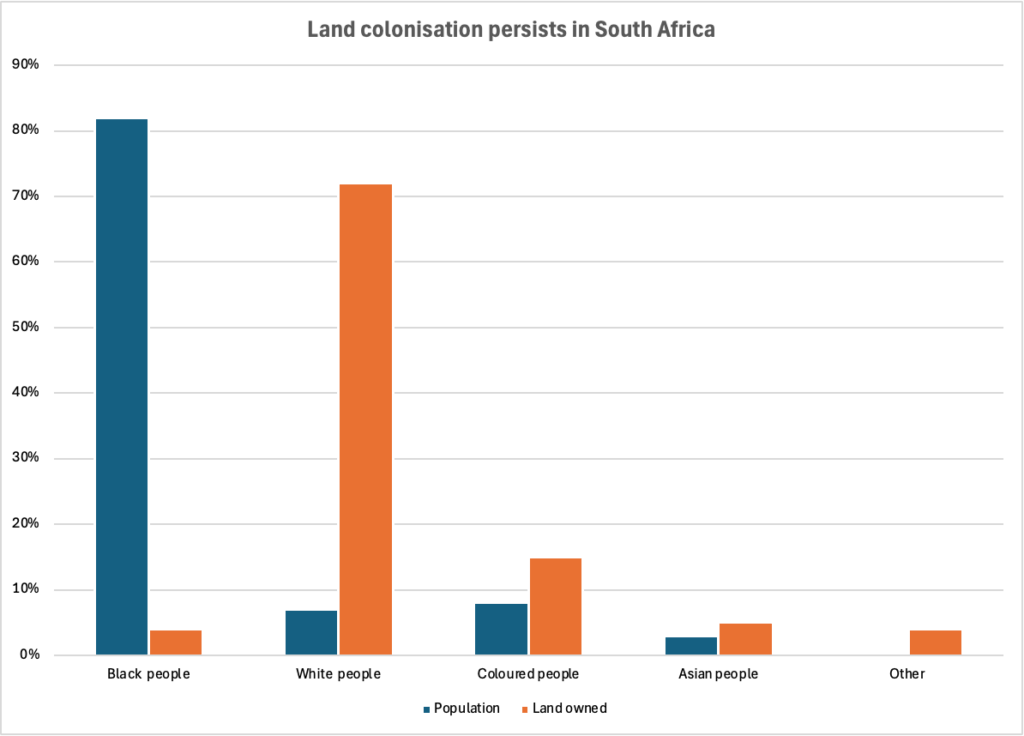
Black peopleWhite peopleColoured peopleAsian peopleOther
Population82%7%8%3%0%
Land owned4%72%15%5%4%

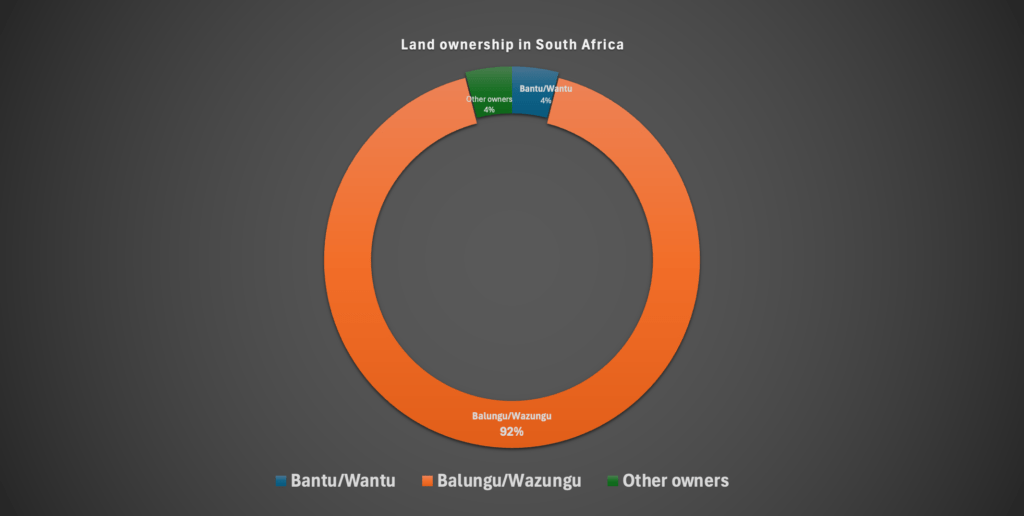
The African definition of white people is lungu or zungu. waZungu and baLungu refer to all light skinned foreigners, including those of Europeans, Asian, Middle Eastern ancestry and people with mixed racial ancestry. If the African definition is used, it shows how horrible land colonisation is in South Africa— balungu, own 92% of land in South Africa.

RaceBantu/WantuBalungu/WalunguOther owners
% land owned4%92%4%
% population82%18%–

In our profession of social work and development, justice is revered as a key value. Is justice the same for all races? Are other injustices, for example, land injustice ignorable for Black people? Decolonisation is also valued in social work and development. The question is, are these values, for all races?

Julius Sello Malema, the radical land return advocate yet, said:

We are not saying get out of South Africa to go to the ocean or to become refugees, we are saying return the land, let us be equal.

We are not afraid of billionaires or imperialists. They will not dictate to us how we fight for the liberation of our people.

I don’t care about your sanctions; I will never stop fighting for black people to be equal to white people. If that makes me an international criminal, I am proud to be one.

Land colonisation and decolonisation in South Africa

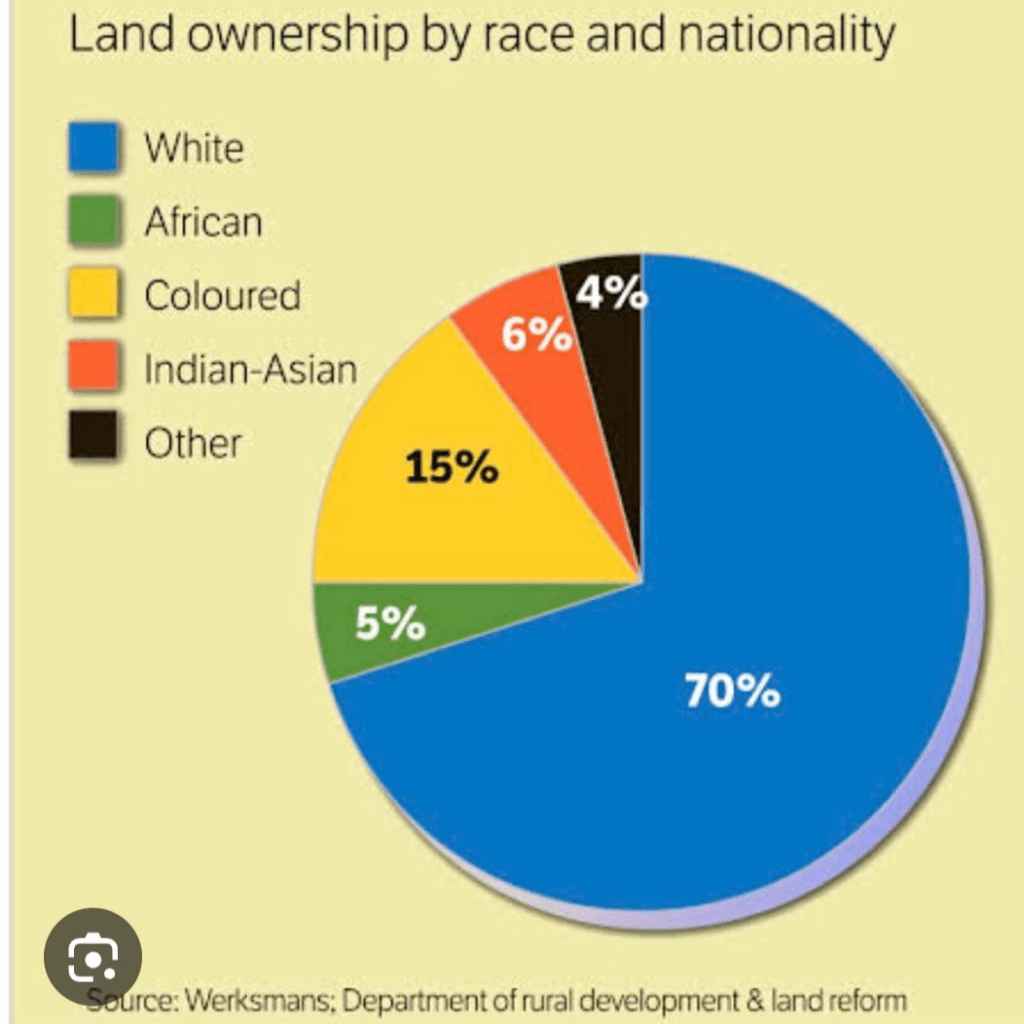
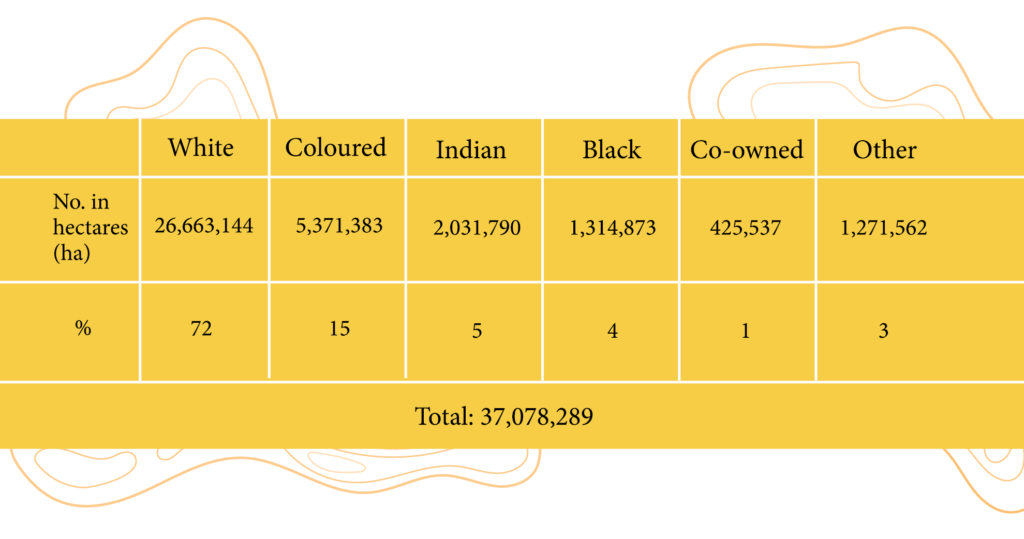
South Africa has a history of colonial conquest that relegated the Black majority into crowded urban and rural reserves. The 1913 Native Lands Act made it illegal for Black Africans to acquire land outside of these reserves, which became known as “Homelands”. Meanwhile, Black Africans account for 80 percent of South Africa’s population, these homelands comprise just 13 percent of the land. Under apartheid, eighty-five percent of South African land was reserved for white people, who then accounted for an estimated seventeen percent of the population. For many Black South Africans, it is unconscionable that the white minority owns 72 percent of the agricultural land, while the Black majority owns a mere 4 percent. The EFF seeks to address these concerns and take back the majority stronghold on these lands (Osman, 2019). Image/table below from This Land Is the Land of Our Ancestors.

The ANC. (African National Congress, SA’s liberation party) was concerned with land from the beginning; the Party was formed largely in reaction to the Glen Grey Act and the laws that followed. Cecil Rhodes initiated the Glen Act and many others, and now that his statues have fallen following #RhodesMustFall, land decolonisation must also be achieved. When the ANC took power, in 1994, it saw land reform as the “central and driving force of a program of rural development” meant to redress centuries of injustice (however, Mandela dropped the ball on land decolonisation, his biggest mistake). There would be a land-claims court to adjudicate restitution for anyone who had been dispossessed of property; in order to avoid conflict, a “willing seller, willing buyer” policy would be instituted, in which landowners were asked to voluntarily sell their land to the government so that it could be restored to those with legitimate claims. A system of tenure reform would secure formal property rights for people who had lived for decades in places that they could not legally own. And, finally, the ANC pledged to redistribute thirty per cent of the country’s farmland within five years. Twenty-five years later, it has managed roughly eight per cent. White South Africans own seventy-two per cent of the land held by individuals in the country. Land represents, in the most graphic way, racial inequality in South Africa—still. The ownership of land as entrenched in 1913 has not changed.

The failure of land reform is one of the reasons that South Africa is among the most unequal societies on earth. Unemployment is at thirty-seven per cent. Only thirteen per cent of South Africans earn more than six thousand dollars a year.
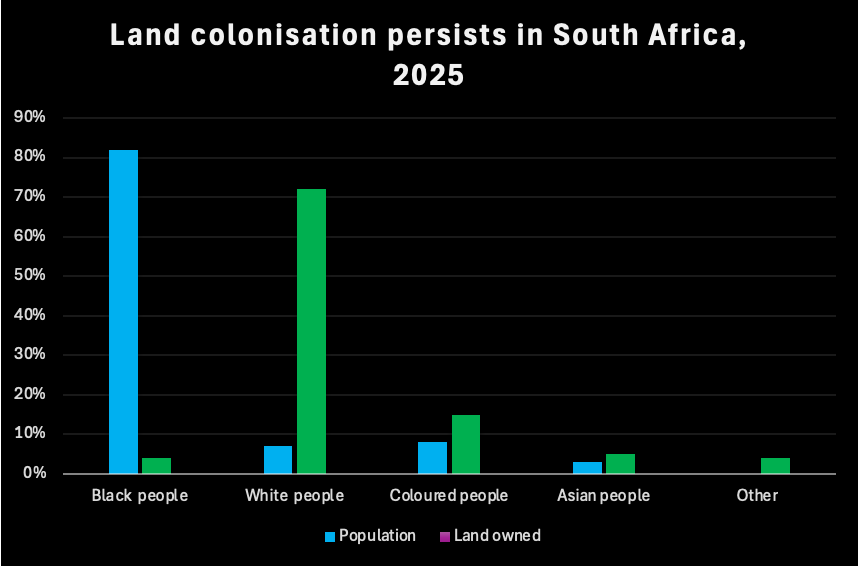
Levy (2019)

Use the form below to subscibe to Owia Bulletin.

Babekazi, Decolonise, Environmental work

Post navigation

Previous Post: Extended to 6 June – Call for abstracts for Day of the African Child Students Conference 2025
Next Post: Njema Afrika Siku

AFRICA-WIDE INSTITUTIONS

ASWEA logo

ASWEA 1965-1989

Umoja waAfrika (AU) Former OAU Toto/Brief | Agenda63

ADF

Part of ADB

ASSWA logo

ASSWA

Since 2005

PAWO (AU Arm)

Facebook | X

COUNTRY INFORMATION (SOCIAL WORK & DEVELOPMENT)

  • Algeria 🇩🇿
  • Angola 🇦🇴
  • Benin 🇧🇯
  • Botswana 🇧🇼
  • Burkina Faso 🇧🇫
  • Burundi 🇧🇮
  • Cabo Verde 🇨🇻
  • Cameroon 🇨🇲
  • Central Africa Republic 🇨🇫
  • Chad 🇹🇩
  • Comoros 🇰🇲
    • Mayotte of Comoro
  • Congo, DR 🇨🇩
  • Congo 🇨🇬
  • Cote D’Ivoire 🇨🇮
  • Djibouti 🇩🇯
  • Egypt 🇪🇬
  • Equatorial Guinea 🇬🇶
  • Eritrea 🇪🇷
  • Eswatini 🇸🇿
  • Ethiopia 🇪🇹
  • Gabon 🇬🇦
  • Gambia, The 🇬🇲
  • Ghana 🇬🇭
  • Guinea 🇬🇳
  • Guinea-Bissau 🇬🇼
  • Kenya 🇰🇪
  • Lesotho 🇱🇸
  • Liberia 🇱🇷
  • Libya 🇱🇾
  • Madagascar 🇲🇬
  • Malawi 🇲🇼
  • Mali 🇲🇱
  • Mauritania 🇲🇷
  • Mauritius 🇲🇺
  • Morocco 🇲🇦
  • Mozambique 🇲🇿
  • Namibia 🇳🇦
  • Niger 🇳🇪
  • Nigeria 🇳🇬
  • Rwanda 🇷🇼
  • Sao Tome and Principe 🇸🇹
  • Senegal 🇸🇳
  • Seychelles 🇸🇨
  • Sierra Leone 🇸🇱
  • Somalia 🇸🇴
  • South Africa 🇿🇦
  • South Sudan 🇸🇸
  • Sudan 🇸🇩
  • Togo 🇹🇬
  • Tanzania 🇹🇿
  • Tunisia 🇹🇳
  • Uganda 🇺🇬
  • Western Sahara (SADR)
  • Zambia 🇿🇲
  • Zimbabwe 🇿🇼
  • “Dongo”
  • ‘Wakanda’
  • Umoja waAfrica (African Union)
  • Afro-Caribbeans
    • Haiti
  • Afro-Latinos
  • Melanesia
    • Aboriginal Countries
    • Papua New Guinea
    • West Papua
  • Afro-Asians ‘Sidi’

Decolonisation Calculator (DECA). What is the rate of decolonisation of social work and development training, education and research in your country? Use this simple calculator.

COVID-19 FINAL UPDATE: Africa Infections: 12.3 million people. Deaths 260 000. World infections: 650 million. Deaths 6.7 million. Data aggregated by ASWDNet on 12 December 2022. View this COVID-19 references list for Africa.

Policies | Guidelines | Checklists

  • AI Policy
  • San Code of Ethics
  • Journal Writing Guide
  • Ubuntu Principles in Fundraising & Charity
  • Comments Policy
  • Publisher Checker
  • Decolonisation Calculator
  • African Research Ethics & Malpractice Statement
  • Privacy & Cookie Policy
  • Email, Data and Social Media Policy
  • When Resilience Becomes a Burden: The Hidden Struggles of Women Researchers in Africa
  • Borderless borders: how Dangote’s African Renaissance Group is putting muscle behind Mbeki’s African Renaissance Theory
  • Social Development Award Statement by Vongai P Mangwiro
  • Development Worker of the Year 2026 Statement by Bikila Tesfaye
  • IASSW membership and engagement survey (External communication)
  • Become a Blogger Blogging
  • Welcome to the AFRICASOCIALWORK.NET All Posts Basket
  • Become a Blogger All Posts Basket
  • The political, legal, radical and policy role of social work in Africa Admin ASWDNet
  • Egypt’s history of social work and social services All Posts Basket
  • Ubuntu and Social Work Resources All Posts Basket
  • Ubuntu Theories All Posts Basket
  • Ethiopian History of Social Work and Social Services All Posts Basket

Email Sign In


Website Log In


Mfundo | Courses | CPD Log In


Members Portal

COPYRIGHT © 2020 to 2030: Mtandao - Africa Social Work and Development Network (ASWDNet) | UBUNTU ACKNOWLEDGEMENT - We pay our respects to those who came before us, our Elders and forefathers and mothers, who are the sources and protectors (against colonisation) of the knowledge and wisdom that continue to shape lives, teaching, learning, research, and practice across generations. Because they were, we are. Asante. Siyabonga. Tatenda. Waaw. Àṣé.