Skip to content
  • Home
  • About|Join
  • Ethics
  • Events
  • Certificates
  • OwiaNews
  • Journals
  • DecoloniseCalculators
  • Mfundo|CPD
  • FundiDictionary
  • Awards
  • Ushahidi
  • DACCS
  • Kuumba
  • Submit
  • WSWSD Conference Nairobi | Mtandao Exhibition
  • Mental Health Masterclass
  • Catalogue
  • Consultancy
  • Shop
  • Twitter
  • Facebook
  • LinkedIn
  • YouTube
  • Academia AJSW
  • Instagram
Africa Social Work and Development Network | Mtandao waKazi zaJamii naMaendeleo waAfrica
Africa Social Work & Development Network | Mtandao waKazi zaJamii naMaendeleo waAfrika

Africa Social Work & Development Network | Mtandao waKazi zaJamii naMaendeleo waAfrika

Mtandao creates, aggregates and disseminates information and resources to facilitate Social Work and Development Work in Africa.

  • ACADEMICS
    • Lecture Resources
    • Lectures
    • Fieldwork Resources
    • Approaches to assessing learning
    • Types of University Assessments
    • Book Publishing
      • Book_Professional Social Work in Zimbabwe
    • ASWDNet Guide to Writing (Journals)
    • ASWDNet Guide to Writing and Publishing
  • PRACTITIONERS
    • Values and Ethics in Africa
    • Africa Social Work and Development Awards
    • Continuous Professional Development (CPD)
    • Templates, Models, Frameworks, Assessment Tools and Questionnaires
    • African Theories
    • Supervision
  • STUDENTS
    • Social Work and Development Student Conference (SWDSC)
    • 12 Steps to Get Published
    • Tips for Prospective Doctoral Students
    • ASWDNet Guide to Writing (Academic Research Brief| Proposal | Thesis)
    • Writing a journal article could be as easy as making fufu, nsima, ugali or matoke!
    • Lectures
  • RESEARCHERS
    • Research Methods
    • Qualitative data levels of analysis
    • African Independent Ethics Committee (AIEC)
    • Research Questions Bank
    • Publisher/Journal Checker
    • Research Strategies
    • Reviewers
    • Ubuntu Research Group (URG)
    • Kuumba (Mentoring)
      • SURVEY OF SOCIAL PROBLEMS AND CHALLENGES FOR AFRICA
      • Mentees
      • Mentors
      • Guidelines
    • Afrocentric Mentoring Project (AfroME)
      • Team
      • Partners
      • Call for Applications for the Afrocentric and Decolonial Social Work Mentoring Project (now closed)
  • ASSOCIATIONS
  • TRAINING INSTITUTIONS
  • COMMUNITIES
    • Ubuntu Fundraising and Charity Principles
    • COVID-19
    • Social Work for Children
    • Funda KiSwahili
  • MEMBERS
  • Africa Philosophy
  • African Theories
  • Research Methods
  • Library | Databases
  • Social Work
    • Social Work Education institutions (SWEI) in Africa
    • Biography of Social Development in Africa
      • Charlotte Makgomo-Mannya Maxeke (1871-1939)
      • Zahia Marzoukย (1906 โ€“ 1988)
      • Regina Gelana Twala (1908-1968)
      • Mai Musodzi Chibhaga Ayema (1885-1952)
      • Nnoseng Ellen Kate Kuzwayo (1914 โ€“ 2006)
      • Joshua Mqabuko Nyongolo Nkomo (19 June 1917 โ€“ 1 July 1999)
      • Jairos Jiri (1921 โ€“ 1982)
      • Kenneth Buchizya Kaunda (1924-2021)
      • John Samuel Mbiti (1931-2019)
      • Gibson Mthuthuzeli Kent (1932-2004)
      • Winnie Madikizela-Mandela 1936โ€“2016
      • Ngugi wa Mirii (1951 โ€“ May 3, 2008)
      • Andrew Chad Nyanguru (28 Mar 1953-14 May 2014)
      • Professor Rodreck Mupedziswa
      • Edwell Kaseke (1954-2017)
      • Lovemore Mbigi
      • Selassie Seyoum Gebre (1936-)
      • Arega Yimam (-c1989)
      • Dr Noel Garikai Muridzo
      • Dr Edmos Mthethwa
      • Phillip Manyanye Bohwasi
      • Wassie Kebede
      • Gidraph G Wairire
      • Wangari Muta Maathai
      • Uzoma Odera Okoye, Dr
    • Social Work Journals and Other Serial Publications in Africa (ASWDNet Index)
    • Association of Social Work Education in Africa (ASWEA) โ€“ 1965 to 1989
    • Future of Social Work in Africa
    • Environmental Social Work
  • Development
    • Developmental Work Database
  • Ubuntu
    • Ubuntu Research Group (URG)
    • Ushahidi Platform
    • Ubuntu Fundraising and Charity Principles
    • Ubuntu Bibliography
    • Ubuntu Survey
    • Ubuntu Annual Lecture
    • Ubuntu Interview Guide Sample
  • Africa
    • African Anthem (African Union)
    • Umoja waAfrica (African Union)
    • African symbols and alphabets
    • Fundi โ€“ The African Dictionary and Encyclopaedia of Social Work and Development
    • Africa Religion (uAfrica)
    • Africa Research Ethics and Malpractice Statement (AREMS)
    • The San Code of Research Ethics (San Code)
  • Blog
    • Our Ubuntu-inspired Comments Policy
    • Become a Blogger
    • Admin ASWDNet
    • Babekazi
    • Professor Roy@Indigenous Social Work
    • Mutape J.D.S Sithole
    • Alemayehu Gebru from Ethiopia, Jimma City
    • Rugare Mugumbate
    • Decolonise
    • Writing and Publishing
    • Development
    • Toto
    • Ms. Alexandra Thokozile Mliswa (MSc,LLB, BA)
    • Environmental work
    • Africa religion | Spirituality
    • Kudzai Mwapaura blogger
    • All Posts Basket

[aioseo_breadcrumbs]

How Annonciata Niyibizi Muhayimana created the Ingata of Life Narrative Model Admin ASWDNet
When Resilience Becomes a Burden: The Hidden Struggles of Women Researchers in Africa Admin ASWDNet
Borderless borders: how Dangote’s African Renaissance Group is putting muscle behind Mbeki’s African Renaissance Theory Development

Wazee Indaba – Day for Older Persons 2024

Posted on 21 October 202422 October 2024 By aswnetadmin

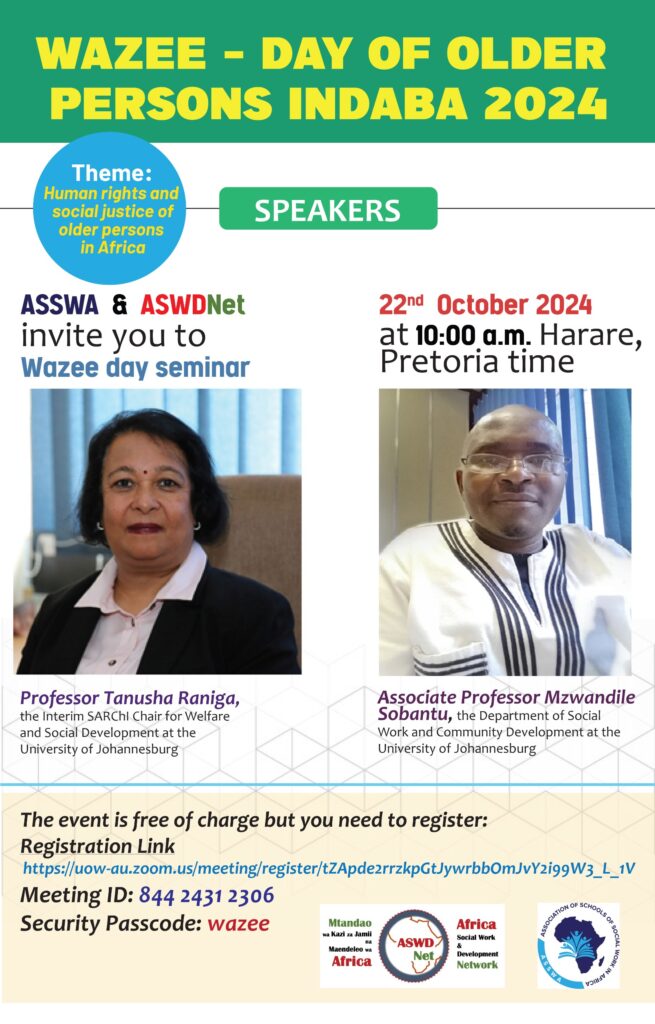
22 October 2024, 10am Central Africa Time

  • Program
  • Poster
  • Special Issue on Social Justice & Human Rights of Older Persons in Africa
  • Okoye Intergenerational Connection Model of Aging (OICMA)
  • Statement on the Celebration of the 2024 Edition of International Day of Older Persons

Program

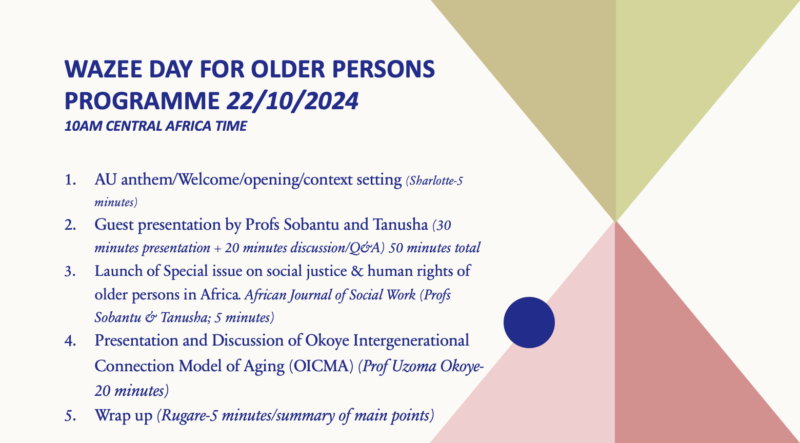
  1. AU anthem/Welcome/opening/context setting (Sharlotte-5 minutes)

2. Guest presentation by Profs Sobantu and Tanusha (30 minutes presentation + 20 minutes discussion/Q&A) 50 minutes total

3. Launch of Special issue on social justice & human rights of older persons in Africa. African Journal of Social Work (Profs Sobantu & Tanusha; 5 minutes)

4. Presentation and Discussion of Okoye Intergenerational Connection Model of Aging (OICMA) (Prof Uzoma Okoye-20 minutes)

5. Wrap up (Rugare-5 minutes/summary of main points)

Poster
Special Issue on Social Justice & Human Rights of Older Persons in Africa

Guest Editors

RANIGA Tanusha, PhD (Social Work), Centre for Social Development in Africa, University of Johannesburg, South Africa. traniga@uj.ac.za

SOBANTU Mziwandile, PhD (Social Work), Department of Social Work and Community Development, University of Johannesburg, South Africa. msobantu@uj.ac.za

GEYER Stephan, PhD (Social Work), Department of Social Work and Criminology, University of Pretoria, South Africa. stephan.geyer@up.ac.za 

Editorial Note

Okoye Intergenerational Connection Model of Aging (OICMA)

The six (6) components of ICMA by Uzoma Odera Okoye’s are:

  1. Sankofa na Mmadu (Intergenerational solidarity): Positive relationships between older adults and youth.
  2. Mzuri wa Mzee (Goodness of the Elder): Older adults provide wisdom, experience, and emotional support.
  3. Igwebuike (Coming Together): Intergenerational relationships facilitate the transfer of cultural values.
  4. Sema (Speak with and educate the youth): Educating youth about aging, ageism, and elder abuse.
  5. Kuleta kwa Jamii (Gathering of the community): Governments and organizations implement initiatives that bring generations together.
  6. Ibuanyidanda (Social Support): Key to successful aging lies in the quality and number of informal social support available to older adults.
Visit theory page
Visit theorist bibliography
Questions to help you reflect on this theory
  1. On a scale of 1-10, how much does this theory relate to the experiences of your African family or community?
  2. What are the best aspects of this theory?
  3. On a scale of 1-10, how likely are you to recommend this theory to a practitioner, educator or researcher on the topic?
  4. Where would the theory be most and less useful?
  5. How can the theory be strengthened?

Statement on the Celebration of the 2024 Edition of International Day of Older Persons

Issued by African Commission on Human and Peoples’ Rights (ACHPR) on 01 October 2024, one of the organs of the AU.
Press release on the human rights promotion mission of the African Commission on Human and Peoples' Rights in the Togolese Republic
Visit statement web page

Disabilities in Africa (the Working Group), in its capacity as a Special Mechanism of the African Commission on Human and Peoples’ Rights, celebrates the 34th Edition of International Day of Older Persons, under the theme of ‘Ageing with Dignity: The Importance of Strengthening Care and Support Systems for Older Persons Worldwide’

This day serves as a powerful reminder of our collective responsibility to ensure that older persons live their later years with respect, security, and the necessary support. On this occasion, the Working Group on the Rights of Older Persons and Persons with Disabilities in Africa reiterates its commitment to States Parties to recognize the rights of older persons in society and to promote a more inclusive society where older persons are valued and respected.

As the global population ages, the need for robust health and care systems has never been more urgent. Millions of older persons on the African continent face challenges ranging from inadequate healthcare to social isolation. Therefore, the Working Group continues its active sensitization activities with States to gather the necessary ratifications for the entry into force of the Protocol to the African Charter on the Rights of Older Persons to guarantee them full and complete protection of their rights.

Consequently, the Working Group takes advantage of this 34th commemoration of the International Day for Older Persons to urge States that have not yet done so to proceed very quickly with the ratification of the said Protocol and its deposit with the Commission. It should be recalled that only one ratification and deposit of the instrument of ratification is required for the Protocol to enter into force, as was recently the case for the Protocol on Persons with Disabilities (which entered into force on 3 May 2024).

On the occasion of this day, the Working Group expresses its solidarity with all older persons on the continent and urges all States to take greater ownership of the challenges related to the health care and social protection of older persons, which ensure them a quality and dignified old age in accordance with articles 7, 10, 11 and 15 of the Protocol on the Rights of Older Persons.

By investing in comprehensive care frameworks, we can guarantee older persons the dignity and support they deserve. To achieve this, we must prioritize several key areas:

  1. Access to quality healthcare: It is essential to ensure that older persons have access to comprehensive and affordable healthcare. This includes preventive services, chronic disease management, and mental health support.
  2. Supportive living environments: We must advocate for communities adapted to older persons that facilitate a safe and independent life. Accessible housing, transportation, and social services are essential components of a supportive environment.
  3. Skilled care workforce: It is crucial to strengthen the training and capacities of caregivers. A well-equipped workforce is essential to provide compassionate and person-centred care that meets the diverse needs of older persons.
  4. Social inclusion: Promoting social relations and inter-generational engagement is essential to combat loneliness and foster a sense of belonging. We must create opportunities for older persons to contribute to society with their knowledge and experiences.

Investments in these areas not only support older persons but also strengthen our communities as a whole through the immense benefit that these communities can draw from the undeniable knowledge and experience of older people.

In Africa, ageing is a grace; at the African Commission on Human and Peoples’ Rights, we add that “ageing well is a collective responsibility”.

The Working Group wishes all older persons a happy celebration of the 2024 Edition of the International Day dedicated to them, and reaffirms its commitment to stand by their side until their full potential and possible contribution to our communities are known and valued accordingly.

Done in Banjul on October 1, 2024

For the Working Group,
The Honourable Commissioner Marie-Louise Abomo, Chairperson

Use the form below to subscibe to Owia Bulletin.

Wazee Tags:Wazee

Post navigation

Previous Post: The dangers of foreign religions in Africa: 3 Christian case studies
Next Post: Our major events – ASWDNet

AFRICA-WIDE INSTITUTIONS

ASWEA logo

ASWEA

1971-1989

Umoja waAfrika (AU) Former OAU Toto/Brief | Agenda63

ADF

Part of ADB

ASSWA logo

ASSWA

Since 2005

PAWO (AU Arm)

Facebook | X

COUNTRY INFORMATION (SOCIAL WORK & DEVELOPMENT)

  • Algeria ๐Ÿ‡ฉ๐Ÿ‡ฟ
  • Angola ๐Ÿ‡ฆ๐Ÿ‡ด
  • Benin ๐Ÿ‡ง๐Ÿ‡ฏ
  • Botswana ๐Ÿ‡ง๐Ÿ‡ผ
  • Burkina Faso ๐Ÿ‡ง๐Ÿ‡ซ
  • Burundi ๐Ÿ‡ง๐Ÿ‡ฎ
  • Cabo Verde ๐Ÿ‡จ๐Ÿ‡ป
  • Cameroon ๐Ÿ‡จ๐Ÿ‡ฒ
  • Central Africa Republic ๐Ÿ‡จ๐Ÿ‡ซ
  • Chad ๐Ÿ‡น๐Ÿ‡ฉ
  • Comoros ๐Ÿ‡ฐ๐Ÿ‡ฒ
    • Mayotte of Comoro
  • Congo, DR ๐Ÿ‡จ๐Ÿ‡ฉ
  • Congo ๐Ÿ‡จ๐Ÿ‡ฌ
  • Cote D’Ivoire ๐Ÿ‡จ๐Ÿ‡ฎ
  • Djibouti ๐Ÿ‡ฉ๐Ÿ‡ฏ
  • Egypt ๐Ÿ‡ช๐Ÿ‡ฌ
  • Equatorial Guinea ๐Ÿ‡ฌ๐Ÿ‡ถ
  • Eritrea ๐Ÿ‡ช๐Ÿ‡ท
  • Eswatini ๐Ÿ‡ธ๐Ÿ‡ฟ
  • Ethiopia ๐Ÿ‡ช๐Ÿ‡น
  • Gabon ๐Ÿ‡ฌ๐Ÿ‡ฆ
  • Gambia, The ๐Ÿ‡ฌ๐Ÿ‡ฒ
  • Ghana ๐Ÿ‡ฌ๐Ÿ‡ญ
  • Guinea ๐Ÿ‡ฌ๐Ÿ‡ณ
  • Guinea-Bissau ๐Ÿ‡ฌ๐Ÿ‡ผ
  • Kenya ๐Ÿ‡ฐ๐Ÿ‡ช
  • Lesotho ๐Ÿ‡ฑ๐Ÿ‡ธ
  • Liberia ๐Ÿ‡ฑ๐Ÿ‡ท
  • Libya ๐Ÿ‡ฑ๐Ÿ‡พ
  • Madagascar ๐Ÿ‡ฒ๐Ÿ‡ฌ
  • Malawi ๐Ÿ‡ฒ๐Ÿ‡ผ
  • Mali ๐Ÿ‡ฒ๐Ÿ‡ฑ
  • Mauritania ๐Ÿ‡ฒ๐Ÿ‡ท
  • Mauritius ๐Ÿ‡ฒ๐Ÿ‡บ
  • Morocco ๐Ÿ‡ฒ๐Ÿ‡ฆ
  • Mozambique ๐Ÿ‡ฒ๐Ÿ‡ฟ
  • Namibia ๐Ÿ‡ณ๐Ÿ‡ฆ
  • Niger ๐Ÿ‡ณ๐Ÿ‡ช
  • Nigeria ๐Ÿ‡ณ๐Ÿ‡ฌ
  • Rwanda ๐Ÿ‡ท๐Ÿ‡ผ
  • Sao Tome and Principe ๐Ÿ‡ธ๐Ÿ‡น
  • Senegal ๐Ÿ‡ธ๐Ÿ‡ณ
  • Seychelles ๐Ÿ‡ธ๐Ÿ‡จ
  • Sierra Leone ๐Ÿ‡ธ๐Ÿ‡ฑ
  • Somalia ๐Ÿ‡ธ๐Ÿ‡ด
  • South Africa ๐Ÿ‡ฟ๐Ÿ‡ฆ
  • South Sudan ๐Ÿ‡ธ๐Ÿ‡ธ
  • Sudan ๐Ÿ‡ธ๐Ÿ‡ฉ
  • Togo ๐Ÿ‡น๐Ÿ‡ฌ
  • Tanzania ๐Ÿ‡น๐Ÿ‡ฟ
  • Tunisia ๐Ÿ‡น๐Ÿ‡ณ
  • Uganda ๐Ÿ‡บ๐Ÿ‡ฌ
  • Western Sahara (SADR)
  • Zambia ๐Ÿ‡ฟ๐Ÿ‡ฒ
  • Zimbabwe ๐Ÿ‡ฟ๐Ÿ‡ผ
  • โ€œDongoโ€
  • ‘Wakanda’
  • Umoja waAfrica (African Union)
  • Afro-Caribbeans
    • Haiti
  • Afro-Latinos
  • Melanesia
    • Aboriginal Countries
    • Papua New Guinea
    • West Papua
  • Afro-Asians โ€˜Sidiโ€™

Decolonisation Calculator (DECA). What is the rate of decolonisation of social work and development training, education and research in your country? Use this simple calculator.

COVID-19 FINAL UPDATE: Africa Infections: 12.3 million people. Deaths 260 000. World infections: 650 million. Deaths 6.7 million. Data aggregated by ASWDNet on 12 December 2022. View this COVID-19 references list for Africa.

Search

Policies | Guidelines | Checklists

  • AI Policy
  • San Code of Ethics
  • Journal Writing Guide
  • Ubuntu Principles in Fundraising & Charity
  • Comments Policy
  • Publisher Checker
  • Decolonisation Calculator
  • African Research Ethics & Malpractice Statement
  • Privacy & Cookie Policy
  • Email, Data and Social Media Policy
  • How Annonciata Niyibizi Muhayimana created the Ingata of Life Narrative Model
  • When Resilience Becomes a Burden: The Hidden Struggles of Women Researchers in Africa
  • Borderless borders: how Dangote’s African Renaissance Group is putting muscle behind Mbeki’s African Renaissance Theory
  • Social Development Award Statement by Vongai P Mangwiro
  • Development Worker of the Year 2026 Statement by Bikila Tesfaye
  • Become a Blogger Blogging
  • Welcome to the AFRICASOCIALWORK.NET All Posts Basket
  • Become a Blogger All Posts Basket
  • The political, legal, radical and policy role of social work in Africa Admin ASWDNet
  • Egypt’s history of social work and social services All Posts Basket
  • Ubuntu and Social Work Resources All Posts Basket
  • Ubuntu Theories All Posts Basket
  • Ethiopian History of Social Work and Social Services All Posts Basket

Email Sign In


Website Log In


Mfundo | Courses | CPD Log In


Members Portal

COPYRIGHT ยฉ 2020 to 2030: Mtandao - Africa Social Work and Development Network (ASWDNet) | UBUNTU ACKNOWLEDGEMENT - We pay our respects to those who came before us, our Elders and forefathers and mothers, who are the sources and protectors (against colonisation) of the knowledge and wisdom that continue to shape lives, teaching, learning, research, and practice across generations. Because they were, we are. Asante. Siyabonga. Tatenda. Waaw. ร€แนฃรฉ.