When Resilience Becomes a Burden: The Hidden Struggles of Women Researchers in Africa
We often celebrate research at its final stage: when a paper is published, findings are presented at a conference, or evidence influences a policy decision.
But rarely do we stop to ask a deeper question: what did it take for that research to happen? What challenges did the person behind the study have to overcome before their findings reached the world?
Behind every publication is a human being navigating deadlines, funding pressures, personal responsibilities, and the expectation to produce knowledge in environments that do not always provide the support needed to succeed.
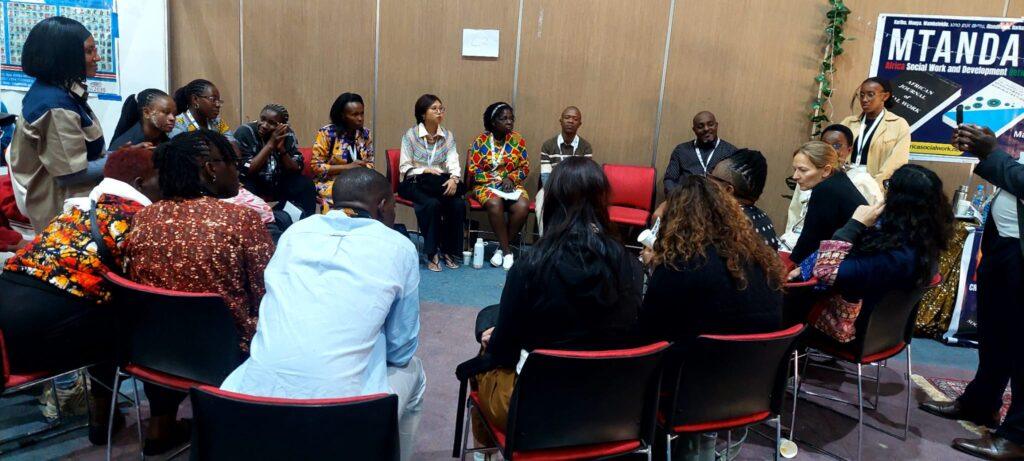
At the 2026 Joint World Conference on Social Work, Education and Social Development (SWSD) in Nairobi, a powerful conversation on women in research revealed a reality often hidden behind academic achievements: many women researchers are expected to produce valuable work while quietly carrying the weight of limited mentorship, inadequate institutional support, and a lack of recognition for the barriers they navigate. This session was organised by Mtandao.
I got to listen to the story of Ropafadzo Ashley Tome, a researcher from Zimbabwe whose work focuses on the experiences of women after incarceration. She spoke about conducting research without the level of institutional support, peer connection, and mentorship that could have helped her navigate the uncertainty that often comes with producing knowledge.
Her story left me reflecting on an uncomfortable question: are we too often celebrating women researchers’ resilience when what they truly need is stronger systems that allow them to thrive?
As I listened to the different perspectives shared during the session, I realized that the barriers women researchers face are not only personal struggles. They also reveal deeper questions about how research systems are designed, who receives support, and whose knowledge is given space to grow.
These are some of the lessons I carried with me from the conversation.
Communities Are Partners in Knowledge, Not Just Sources of Data
One of the strongest messages from the session was that communities should never be treated as places where researchers simply collect information and leave.
Communities hold valuable knowledge. Researchers may arrive with theories, frameworks, and methodologies, but people living through an issue every day understand realities that no textbook can fully capture.
Whether the focus is maternal health, child protection, or gender-based violence, lived experience matters. It helps researchers ask better questions, interpret findings more accurately, and understand realities that numbers alone may not reveal.
Good research begins with listening.
It means asking communities what questions matter to them instead of assuming researchers already have all the answers. It also means returning findings to the people who shared their experiences — not as a symbolic gesture, but as part of producing research that is more ethical, relevant, and accountable.
Research does not only create knowledge. It must also recognize where knowledge already exists.
The Hidden Cost of Doing Research Alone
Research institutions and funders often budget for visible costs: field visits, data collection, software, travel, and publication fees.
But some of the most important costs are invisible.
These include mentorship, peer networks, emotional support, and flexibility when personal responsibilities intersect with academic demands.
Tome’s story reflected this reality. Her experience showed that isolation is not simply an individual challenge — it is also a research challenge.
When researchers have no trusted colleague to discuss ideas with, test assumptions against, or share early findings with, they lose an important opportunity to strengthen their work before it reaches formal review.
This is where institutions often get the timing wrong. Recognition usually comes after the publications, awards, and achievements. But support matters most before those moments — during the uncertain years when researchers are still building confidence, networks, and expertise.
What is needed is not just a mentorship statement on a university website or a policy document sitting on a shelf.
It requires real relationships: a mentor who checks in, peers who create space for honest conversations, and institutions willing to recognize that researchers are also people with responsibilities beyond their academic work.
Every accomplished researcher was once someone writing their first paper. The best time to invest in people is before the world notices their potential.
Complex Problems Need More Than One Discipline
No single discipline can fully explain the challenges communities face today.
Whether we are talking about poverty, gender inequality, migration or child protection, each issue is shaped by social, economic, political, cultural and health-related factors. Looking at only one dimension risks producing incomplete answers to complex questions.
The session reinforced the importance of interdisciplinary research. Social workers, economists, communication specialists, educators and public health researchers all bring different perspectives to the same issue. Working together does not dilute expertise — it strengthens it by revealing connections that might otherwise be overlooked.
People do not experience poverty, health challenges, or inequality in separate boxes. They experience them as interconnected parts of their lives, and research should reflect that reality. The best research teams bring together different ways of understanding the same challenge..
Africa Must Shape Its Own Research Conversations
Many of the issues researchers study across the continent are deeply connected to local histories, cultures, and realities.
Miss Zondile from Zambia highlighted the importance of African researchers shaping conversations about African challenges. This is not a rejection of global collaboration. It is a call for partnerships built on equality and shared decision-making.
Representation is not only about who collects information. It is also about who decides what questions are asked, how problems are framed, and whose knowledge is considered valuable.
For too long, communities in Africa have often been studied by outsiders who define the questions while local researchers provide the answers.
Changing this requires more than increasing African participation. It requires African researchers to lead conversations about the issues that affect their societies.
Research Has Not Finished Its Work Until It Creates Change
A paper can be accepted into a respected journal, carefully reviewed, and celebrated by academics — yet still never reach the policymaker who needed its insights or the program officer who could have used the evidence to improve a project.
Publication matters, but it is not the finish line.
The bigger question is: who needs these findings, and how will they reach the people who can use them?
Sometimes the answer is a two-page policy brief designed for a decision-maker. Sometimes it is a community radio conversation. Sometimes it begins with a simple discussion with the people whose experiences shaped the research in the first place.
Evidence becomes meaningful when it moves beyond journals, databases, and conference rooms.
The purpose of research is not only to add another publication to an academic record. It is to influence decisions, improve programs, shape policies, and support communities.
The Human Side of Research
The biggest lesson I carried from the session was that behind every study, publication, and policy recommendation is a person.
We often see the final product of research , the paper, the findings, the presentation — but rarely see the journey behind it. We do not always see the late nights, the uncertainty, the responsibilities carried outside the research space, or the moments when researchers need guidance but have no one to turn to.
Researcher Tome’s story reminded me that resilience should not become a substitute for support.
Women researchers should not have to prove their strength by surviving broken systems alone — they need the support that lets their work, and their voice, actually thrive
About the Author
Elizabeth Kilulu is a Development Communications Specialist based in Nairobi, Kenya, who uses strategic storytelling and career development initiatives to support youth empowerment and inclusive development. She works with young people and emerging professionals to translate their skills and experiences into meaningful career pathways while sharing practical insights on communications and storytelling. She serves as Kenya Country Ambassador at AfroScholarHub and contributes to communications work with the Africa Social Work and Development Network (Mtandao). Connect with Elizabeth on LinkedIn. https://www.linkedin.com/in/elizabeth-kilulu-2806352a1
Use the form below to subscibe to Owia Bulletin.