
Students as knowledge creators: Reflections on the 16 June Day of the African Child Conference for Students (DACCS2026)
Please note this post is longer than usual posts that we publish on the Mtandao platform.
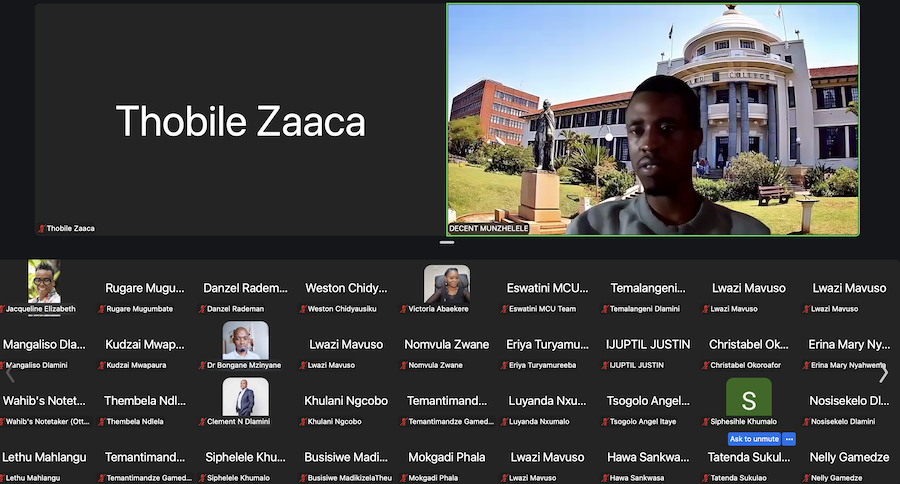
Every year on 16 June, Africa marks the Day of the African Child. For the social work and development community on the continent, this date has taken on an additional meaning. Since 2023, it has been the day students gather at the Day of the African Child Conference for Students (DACCS), hosted by Mtandao, the Africa Social Work and Development Network, to share research and engage with issues affecting children and communities across Africa. The 2026 conference, held on Tuesday 16 June, continued that work.
This post reflects on the 2026 conference, acknowledges the people who made it possible, and extends an invitation to organisations and training institutions ahead of 2027.
Students as knowledge creators
The students who presented at DACCS 2026 were contributing to a body of knowledge. Their honours projects addressed real problems in real communities, and they brought findings, arguments and frameworks that practitioners and policymakers need to engage with.
The themes that ran through the 2026 presentations emerged from students engaging with communities. Water access and sanitation featured strongly, as did child dignity, child protection, gender-based violence, juvenile rehabilitation, disability-inclusive services, decolonial social work practice, and the developmental role of social work. Students from Eswatini, Zimbabwe, South Africa, Nigeria, Malawi and Uganda presented work grounded in their own contexts and connected to broader continental and global debates. Eswatini was particularly well represented, with nine of the nineteen presentations drawing on Eswatini-based research, reflecting strong institutional engagement from the University of Eswatini and Eswatini Medical Christian University.
Honours-level research is a substantive contribution to knowledge. It does not require postgraduate enrolment or externally funded projects to be credible and relevant. The 2026 DACCS demonstrated that undergraduate researchers, when supported and given a platform, produce work that speaks to real conditions in African communities.
Water through an Ubuntu lens
Water was the dominant theme of the 2026 conference, and many presenters approached it through Ubuntu philosophy and other African theoretical frameworks. Ubuntu is a family of interconnected ideas about what it means to be human in relation to others, to the community, to the environment and to the spiritual world. Five concepts from that philosophy shaped how students understood water at this conference.
Ukama refers to relationships and interconnectedness at the family and household level. In the context of water, Ukama addresses how access to, or lack of, water affects family life and children’s dignity in the home. Gender relations are central here. Within households, it is most often women and girls who carry the burden of water collection, often at the cost of their education, safety and participation in other activities. Blessing Simelane drew directly on Ramose’s articulation of Ubuntu to examine how prepaid water systems in peri-urban Eswatini exclude poor families and force children, particularly girls, to rely on unsafe streams. Nongcebo Shabalala introduced Lubumbano, a Swazi concept meaning coming together and acting as one, as a framework for collective social work advocacy around water access in Mbabane’s informal settlements.
Ujamaa refers to community solidarity and shared responsibility. Applied to water, Ujamaa points to community-based responses to water insecurity and the collective duty to ensure children have safe water. Nkosephayo Dlamini linked Ujamaa directly to the facilitation of community water committees and argued for its integration into national WASH policy in Eswatini. Gender relations are relevant here as well. At the community level, women are frequently excluded from decision-making about water infrastructure and resource management, even when they are the primary users.
Uharambe or Ujamii refers to coming together at the societal level for a shared purpose. In relation to water, it calls for coordinated responses across institutions, governments and civil society to address the structural inequalities that determine who has clean water and who does not. At this level, gender inequality in water policy, infrastructure planning and resource allocation becomes visible as a structural issue rather than a household one.
Umvelo refers to the natural environment and the relationship between people and the earth. It situates water as part of a living ecological system rather than a commodity to be managed and calls on social workers to treat environmental issues as central to practice. Veronica Mangwane extended this further by examining how community rituals and sacred water sites, governed through taboos and the authority of community leaders, historically protected water sources and reduced contamination risks for children.
Key lesson was water as part of environmental social work. Key reflection was why environmental social work misses this important topic. A key question WHAT WILL WATER REMEMBER ABOUT US, a question that scales up water to the level of a living being, not just a resource or product to be utilised.
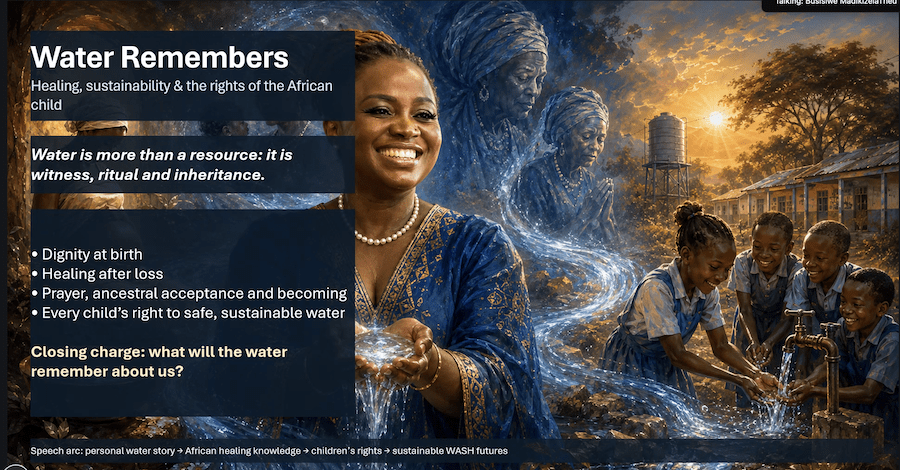
Uroho refers to spirituality and the inner life. Water carries spiritual meaning in many African communities. Sacred waters, community rituals and cultural relationships with rivers and rainfall are part of how communities understand wellbeing, dignity and belonging. Social workers who engage with water access as a purely technical or administrative matter risk missing these dimensions, which matter to the communities they serve.
Together, these five concepts provide a framework for thinking about water that is grounded in African thought and applicable to social work practice. The students who used them were drawing on ways of knowing that belong to the communities they were researching.
Beyond Ubuntu, students drew on a notably wide range of African theoretical frameworks. Tengetile Masuku applied African Humanism, grounding WASH access in principles of solidarity, equality and collective responsibility. Nosisekelo Dlamini used African Intersectionality to examine how gender, class, age and geography overlap to determine which children are most excluded from water services. Vanessa Mandere applied the African Social Development Model to examine WASH access for children with physical disabilities. Nongcebo Shabalala drew on Ubuntu Tenure philosophy, a collective approach to land and environmental stewardship. Thembela Ndlela applied Afrocentric Theory to examine the tensions between cultural practices and child protection in South Africa. Nkosephayo Dlamini proposed the Batho Pele principles as a service delivery standard for public WASH services. This breadth of African theoretical engagement was one of the defining characteristics of the 2025 conference.
Gender and girls at the centre
Several presentations placed the experiences of girls specifically at the centre of their analysis, going beyond general references to gender. Blessing Simelane documented how girls bear the greatest household water-fetching burden and examined the cultural narrative of Kutala Kutelula, which normalises that burden in ways that contradict child-centred Ubuntu values. Tshegofatso Seroka examined how armed conflict disrupts menstrual hygiene management for displaced girls, arguing that menstrual hygiene is a child rights and social justice issue, not only a health concern. Mlondolozi Mamba and Sinenhlanhla Masilela both documented how inadequate school sanitation causes girls to miss school, feel embarrassed and experience psychological distress. Vanessa Mandere showed that girls with disabilities face compounded barriers, with the absence of accessible toilets directly limiting their school attendance. Taken together, these presentations made a clear case that water and sanitation are not gender-neutral issues, and that girls’ experiences must be named and addressed specifically in both policy and social work practice.
A decolonial strand
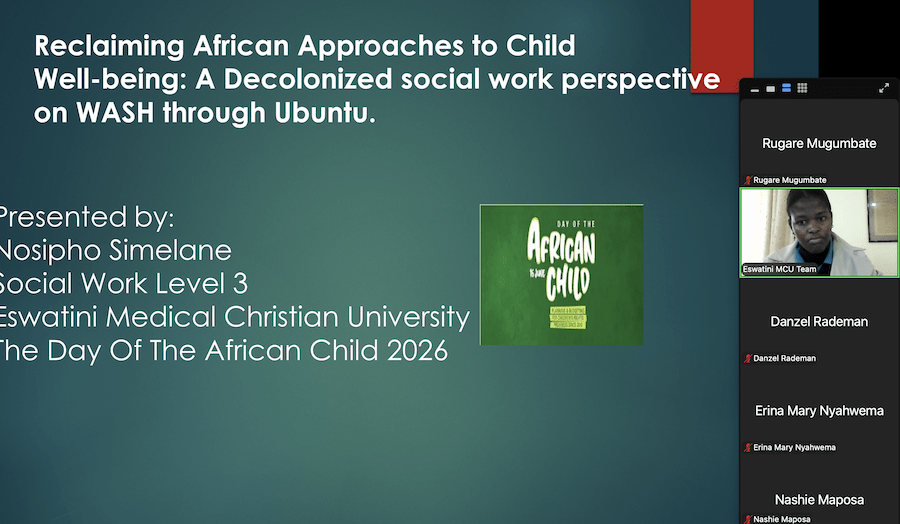
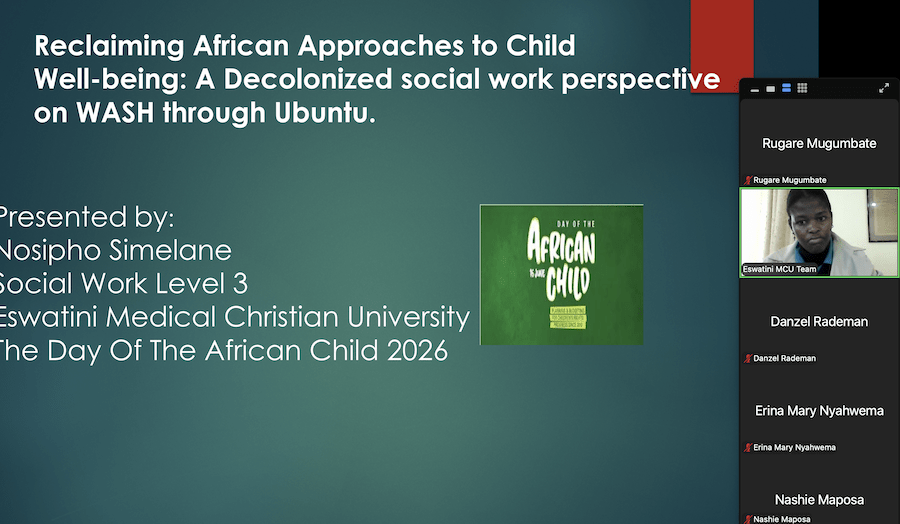
A distinct intellectual strand ran through several presentations: the critique of Western social work frameworks and the argument for African epistemologies as foundations, not supplements, for practice and education. Thobile Zaca examined Ubuntu philosophy and indigenous social protection systems such as Harambee, Stokvel and Mukando as complete alternatives to Western models, arguing that decolonising social work is both an ethical and a professional imperative. Nosipho Simelane argued that Western-led WASH interventions have produced low community ownership and poor sustainability, and that Ubuntu and indigenous knowledge systems offer a more culturally grounded path. Nosisekelo Dlamini applied African Intersectionality to critique top-down, externally driven WASH implementation. These presentations were in conversation with each other and reflected a coherent body of thought developing among African students about the direction of the profession.
Child protection and social work practice
While water dominated the programme, several presentations addressed child protection and social work practice directly. Tafadzwa Mhereyenyoka examined how geographically extensive districts in Zimbabwe create service blind spots, with social workers using personal funds for phone monitoring and isolated children remaining invisible to the child protection system. Ashley Tome and George Chikono studied entrepreneurship training at Kadoma Training Institute in Zimbabwe and found that while skills training shifts child offenders being rehabilitated toward a self-employment mindset, social stigma, family rejection and lack of start-up capital undermine reintegration. Victoria Abaekere examined the awareness of medical social workers’ roles in private healthcare institutions in Lagos, finding an awareness-efficiency gap where recognition of the social work role does not translate into full clinical utilisation.
The scale of the challenge
The abstracts from the 2026 conference carry substantial evidential weight. Globally, 703 million people lack safe drinking water and 297,000 children under five die annually from diarrhoeal disease linked to inadequate sanitation. Girls miss up to 20 per cent of school days due to poor sanitation facilities. Over 1,000 children die daily across Africa from preventable WASH-related disease. In Malawi, 35.5 per cent of children under five are stunted, compounded by recurrent cholera outbreaks during rainy seasons. In Eswatini, approximately 14,500 children with physical disabilities lack access to inclusive WASH services. These are not abstract statistics. They are the conditions that the 2026 DACCS presenters were researching in their own communities.
Reviewers, guest speakers and chairs as mentors
Abstract review is one of the less visible but most important mentoring functions in a student conference. When students submit abstracts, they are often doing so for the first time, and the feedback they receive at that stage shapes how they develop their work before the conference and how they understand the standards of academic communication. Dr Bongane Mzinyane from University of KwaZulu Natal and I reviewed over 40 abstracts submitted for the 2026 DACCS. That process involved reading each submission carefully, assessing the clarity of the research problem, the coherence of the methodology, the strength of the findings, and the alignment between conclusions and evidence, and providing written feedback that students could act on. For many students, this was their first experience of peer review, and the feedback they received was as much a learning resource as the conference itself. I am grateful to Dr Bongane Mzinyane for bringing rigour, generosity and genuine engagement to that process.
The conference was shaped not only by student presenters but by the guest speakers and session chairs who engaged with their work. Prof Mpumelelo E. Ncube from the University of the Free State, Weston Chidyausiku from University of Eswatini, Busisiwe Madikizela-Theu from Nelson Mandela University, and Kudzai Mwapaura from the Women’s University in Africa each brought academic and professional expertise and engaged directly with what students presented. Prof Chinwe Rosabelle Nwanna from Nigeria was scheduled to present but could not do so due to time constraints.
Session chairs and moderators, including Decent Munzhelele from UKZN and Hawa Sankwasa from Botswana, maintained the professional structure of the conference and gave students the experience of presenting in a formal academic environment.
When senior academics and practitioners take student work seriously, ask substantive questions and respond constructively, they are performing a mentoring function that is difficult to replicate in other settings. DACCS provides that environment annually on 16 June.
The organising committee, chaired by Lwazi Mavuso from the University of KwaZulu-Natal, South Africa, and supported by members from across the continent, ran the conference with professionalism. That committee is student-led and gives members experience in conference organisation, cross-institutional coordination and academic communication. The 2026 committee included Tatenda Sukulao from Midlands State University, Zimbabwe (Vice-Chairperson); Christabel Okoroafor from the University of Nigeria, Nigeria (Secretary; Willard Muntanga from Great Zimbabwe University, Zimbabwe (Vice-Secretary); Danzel Rademan from the University of the Free State, South Africa (member and former Chairperson); Eriya Turyamureeba from Makerere University, Uganda (invited member); Devotion Mahamba from Midlands State University, Zimbabwe (member); and Erina Nyahwema, Conference and Meetings Coordinator at ASWDNet, who supported the committee’s operations. Erina facilitated the conference, Lwazi and Christabel opened the conference, Danzel, Erina and Eriya chaired sessions while Devotion gave the closing remarks.
My own involvement in the 2026 conference included mentoring members of the organising committee in the lead-up to the event, serving as a reviewer of submitted papers, chairing one of the sessions on the day, and providing technical support including the management of slides and the Zoom platform during the conference.
Publication of conference outputs
Selected presentations from the 2026 DACCS will be published in the African Journal of Social Work, Africa’s leading social work journal. All abstracts will be published in People Centred – Journal of Development Administration. All presentations will be made available on YouTube, giving students a permanent and accessible record of their contribution and extending the reach of their work to practitioners, educators and researchers across the continent and beyond.
Conference outcomes, challenges and opportunities
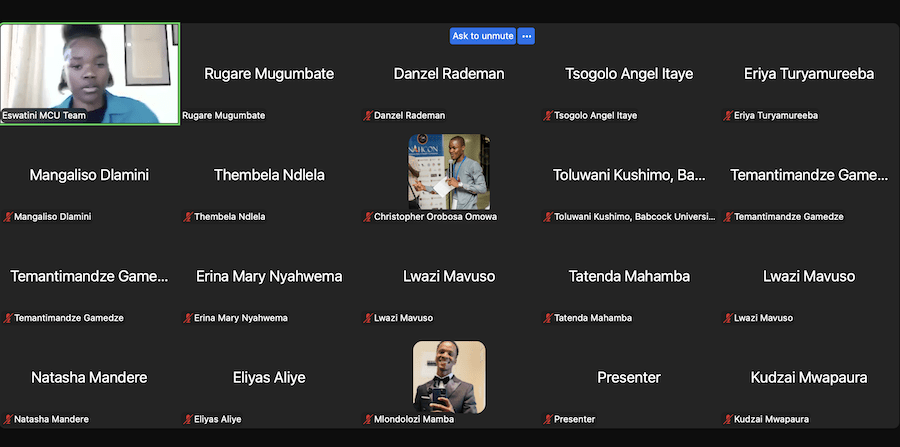
The 2026 DACCS had 186 participants registered to attend online, of whom 105 attended on the day. Twenty-two (22) participants attended in person at ECU, bringing the total to 127. The conference delivered approximately 6.5 hours of learning and engagement across 30 presentations. Attendance doubled compared to the previous year, indicating growing interest in the conference across the region. The quality of chairing was high, guest presentations were substantive, and the opening and closing remarks provided clear direction for the work of the conference. Hongera to the organising committee, presenters, chairs, guests and all participants.
Looking ahead to 2027, several areas present opportunities for strengthening the conference. On the organising side, key roles including facilitation, chairing, technical support and guest liaison should each be held by at least two people to ensure continuity and reduce pressure on individuals. The committee would also benefit from formally retiring inactive members and recruiting new ones.
On conference delivery, moving to a two or three day format, with sessions of two to three hours per day, would allow for deeper engagement with themes. Organising presentations around four defined themes, distributed across the days, would give the programme greater coherence.
Presenter preparation is another area for development. A standardised eight-slide structure covering the research gap, theoretical framework, findings, conclusions and recommendations would help students present their work clearly within the time available. A 30-minute test session before the conference, covering name pronunciation, programme sequence, transitions and time management, would improve the flow of the event.
On presentation formats, pre-recording some presentations for playback during the conference and uploading others directly to YouTube would allow for more flexible scheduling. Guest and keynote presentations delivered live and streamed directly to YouTube would be automatically archived. Inviting two outstanding presenters from the previous conference to present again would build continuity across editions.
Recognising excellence through awards, for example for best methodology, best theory application, best results, best overall paper and best chair, would give additional meaning to participation. Additional recognition for organising committee members beyond certificates is also worth considering.
Finally, expanding partnerships and securing additional sponsors would increase the reach and sustainability of the conference.
An invitation for 2027
The DACCS runs every two years. The next conference will be held on 16 June 2027. This is a direct invitation to organisations, universities, training institutions and professional bodies. Consider nominating a student to join the organising committee. The committee works across institutional and national boundaries and gives students hands-on experience in academic leadership and conference management. If you are a training institution, aim to have at least two students present at the 2027 conference. Honours research projects that address social work and development challenges in African contexts are particularly welcome. The themes of water, child dignity, child protection, environmental social work, gender relations, decolonial practice and Ubuntu-informed frameworks are areas of ongoing interest, but the conference is open to the full range of issues that students are investigating in their research.
Registration details and submission guidelines will be available at africasocialwork.net. Updates will be posted as 2027 approaches.
A note on this post: The ideas in this post are my own, developed from my involvement in and observation of the 2026 DACCS. I used Claude.ai for writing assistance.
Use the form below to subscibe to Owia Bulletin.